
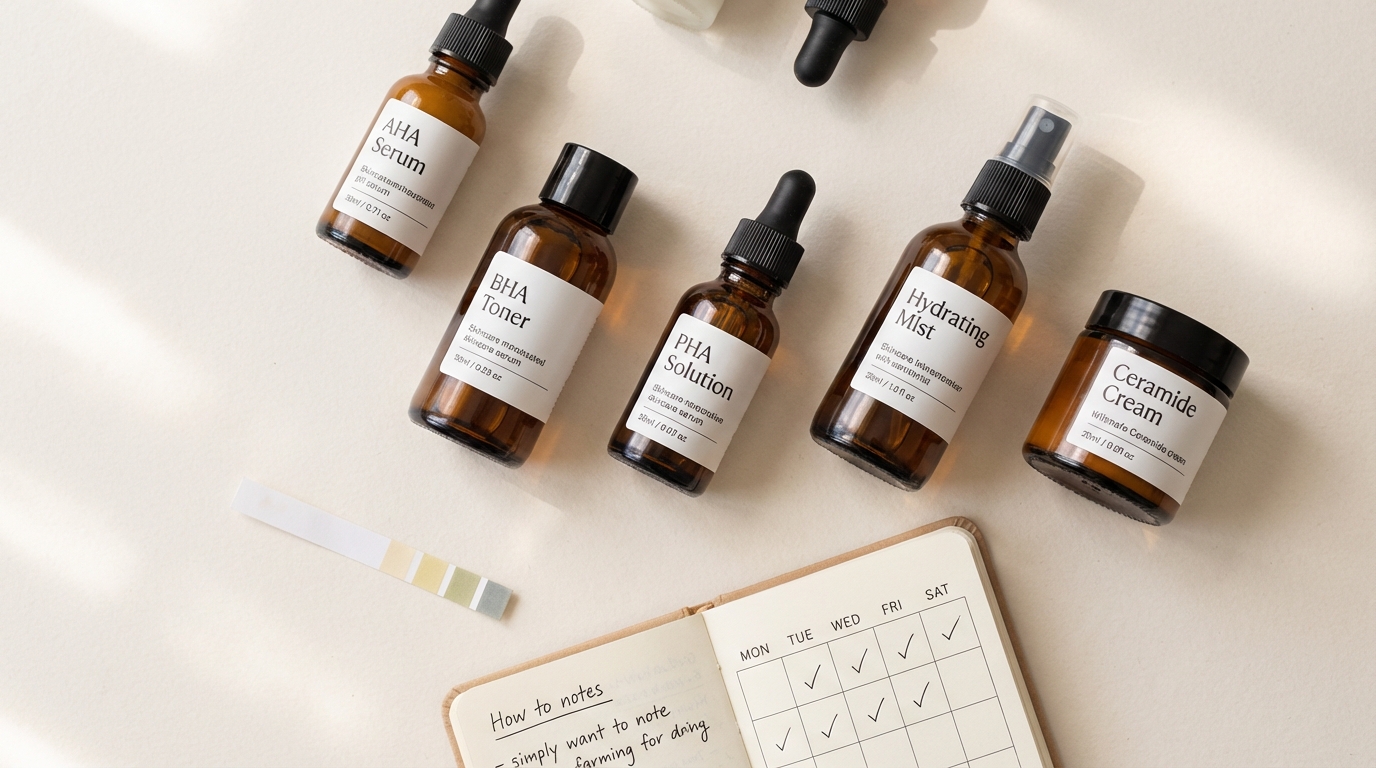
Acids are powerful skincare tools. AHAs, BHAs, PHAs, they all offer real benefits for texture, clarity, and overall skin health. But combine them incorrectly, and you will learn very quickly why the phrase “too much of a good thing” exists.
Understanding how to layer acids safely requires some basic chemistry knowledge and a healthy respect for your skin barrier. Let me walk you through the science so you can exfoliate effectively without destroying your face in the process.
Which Acids Work Together
Not all acids are created equal, and some combinations work better than others. The key is understanding what each acid does and how they interact.
AHAs (alpha hydroxy acids) like glycolic acid and lactic acid are water-soluble and work on the surface of your skin. They excel at addressing dullness, uneven texture, and hyperpigmentation. BHAs (beta hydroxy acids), primarily salicylic acid, are oil-soluble and can penetrate into pores, making them excellent for acne and blackheads.
These two categories can work together because they target different layers. A gentle BHA can clear pores while a gentle AHA addresses surface texture. The key word is gentle. You are not trying to dissolve your face.
PHAs (polyhydroxy acids) like gluconolactone are the gentlest of the group. They can usually be combined with other acids without issue because they work more gradually and are less likely to cause irritation.
What you generally want to avoid: layering multiple strong AHAs together in the same routine. Using glycolic acid and lactic acid at the same time, for example, is redundant and increases irritation risk without additional benefit. Pick one.
pH Considerations
This is where the chemistry gets important. Exfoliating acids work best at specific pH levels, and layering products can disrupt those pH levels and reduce effectiveness or increase irritation.
AHAs typically work best at pH levels between 3 and 4. At higher pH levels, they become less effective as exfoliants. According to research reviewed by the National Center for Biotechnology Information, the free acid concentration (determined partly by pH) is what determines exfoliating activity.
Vitamin C (L-ascorbic acid) also requires a low pH to work effectively, usually around 3.5 or lower. This is why some people experience irritation when layering vitamin C with AHAs, even though both are effective ingredients individually.
A practical approach: if you want to use both vitamin C and an AHA, use them at different times of day. Vitamin C in the morning (where it also provides some antioxidant protection), AHA in the evening. This sidesteps pH conflicts entirely.
Niacinamide and acids is another common question. Older advice warned against this combination, but modern research and formulation science have shown that niacinamide and acids can work together fine in most cases. The concern was about niacin (flushing) formation, but this occurs mainly at very high temperatures not typical of skincare application.
Alternating Days Strategy
The safest approach to using multiple acid products is simply not to use them at the same time. Alternating days gives each acid time to work and gives your skin time to recover.
A sample schedule might look like this:
Monday: Salicylic acid (BHA) in the evening
Tuesday: No acids, just basic routine
Wednesday: Glycolic acid (AHA) in the evening
Thursday: No acids
Friday: Salicylic acid
Saturday: No acids
Sunday: Glycolic acid
This rotation allows you to benefit from both types of exfoliation while giving your skin adequate recovery time. The “off” days are not wasted, they are when your skin rebuilds its barrier and processes the exfoliation you have already done.
If your skin is more resilient and experienced with acids, you might be able to use them on consecutive days. But building up slowly is wise. You can always increase frequency if your skin handles it well. You cannot undo damage from going too fast.
Signs You Are Using Too Much
Your skin will tell you if your acid routine is too aggressive. Learning to read these signals is essential.
Persistent redness that does not fade after an hour or two indicates irritation. Some temporary pinkness immediately after applying an acid can be normal, but if your skin looks angry hours later, that is a problem.
Unusual dryness or flaking, beyond what you experienced when you first started using acids, suggests over-exfoliation. Your skin should adjust to acids over time, not get progressively more irritated.
Increased sensitivity to products that previously did not bother you is a classic sign of a compromised barrier. If your moisturizer suddenly stings, your acids are probably the culprit.
Breakouts in areas where you do not usually break out can indicate that your skin barrier is damaged and struggling to keep bacteria out. This is different from purging, which happens in areas where you typically get breakouts and resolves within a few weeks.
The American Academy of Dermatology recommends watching for these warning signs and reducing acid use immediately if they appear. More exfoliation is not the answer to over-exfoliation. Rest and repair are.
Building an Acid Routine Safely
If you are new to acids or rebuilding after overdoing it, here is how to approach it systematically.
Start with one acid at a low concentration. A 5% glycolic acid or 2% salicylic acid is plenty to begin with. Use it once or twice a week and observe how your skin responds over 2-3 weeks.
If your skin tolerates that well, you can gradually increase frequency. From twice a week to three times. Then every other day if needed. There is no prize for using acids daily. Use them as often as your skin benefits without showing distress.
Once you have established tolerance to one acid, you can consider adding another. But give yourself time, maybe a month or two, before introducing something new. And when you do add a second acid, alternate rather than layer.
Always have a simple, gentle routine to fall back on. If your skin gets irritated, you need to be able to strip back to cleanser, moisturizer, and sunscreen only, giving your barrier time to heal before reintroducing acids.
Practical Combinations That Work
Some combinations are generally well-tolerated by most skin:
Morning: Vitamin C serum, moisturizer, sunscreen. Evening: BHA cleanser, moisturizer. The BHA in cleanser form is gentler because it rinses off, leaving less time to irritate.
Morning: Niacinamide serum, moisturizer, sunscreen. Evening: AHA treatment, moisturizer. Niacinamide actually helps with barrier repair, so it complements acid use.
Morning: Basic routine. Evening (alternating nights): AHA one night, retinol another night. Both exfoliate but through different mechanisms, and alternating prevents over-exfoliation.
According to formulation chemists interviewed by Paula’s Choice, the most important factor is paying attention to your own skin’s response rather than following rigid rules. Everyone’s tolerance is different.
What to Do If You Overdo It
It happens. Even experienced acid users sometimes push too far. Here is how to recover.
Stop all acids immediately. This includes acid cleansers, toners, serums, and anything else exfoliating. You need a complete break.
Simplify to the basics: gentle cleanser, simple moisturizer, sunscreen. Look for products with barrier-repairing ingredients like ceramides, cholesterol, and fatty acids. Avoid fragrance and other potential irritants.
Consider adding a product with centella asiatica (cica) or panthenol, both of which support healing. An occlusive layer like Vaseline or Aquaphor at night can help seal in moisture while your barrier recovers.
Give it time. Depending on how much damage was done, recovery can take anywhere from a few days to several weeks. Do not rush back to acids. Wait until your skin feels genuinely normal again, not just “better than yesterday.”
When you do reintroduce acids, start slower than you did before. Your skin has learned it can be overwhelmed. Earn its trust back gradually.
The Bigger Picture
Acids are tools, not necessities. Many people achieve healthy, clear skin without using acids at all. If you find that your skin does not respond well to chemical exfoliation, that is valid information, not a failure on your part.
The goal is skin health, not maximum exfoliation. A gentle acid used consistently will do more for your skin over time than an aggressive acid that damages your barrier and forces you to stop.
Respect the process. Learn what your skin can handle. And remember that sometimes the most scientific approach is recognizing when less is genuinely more.