
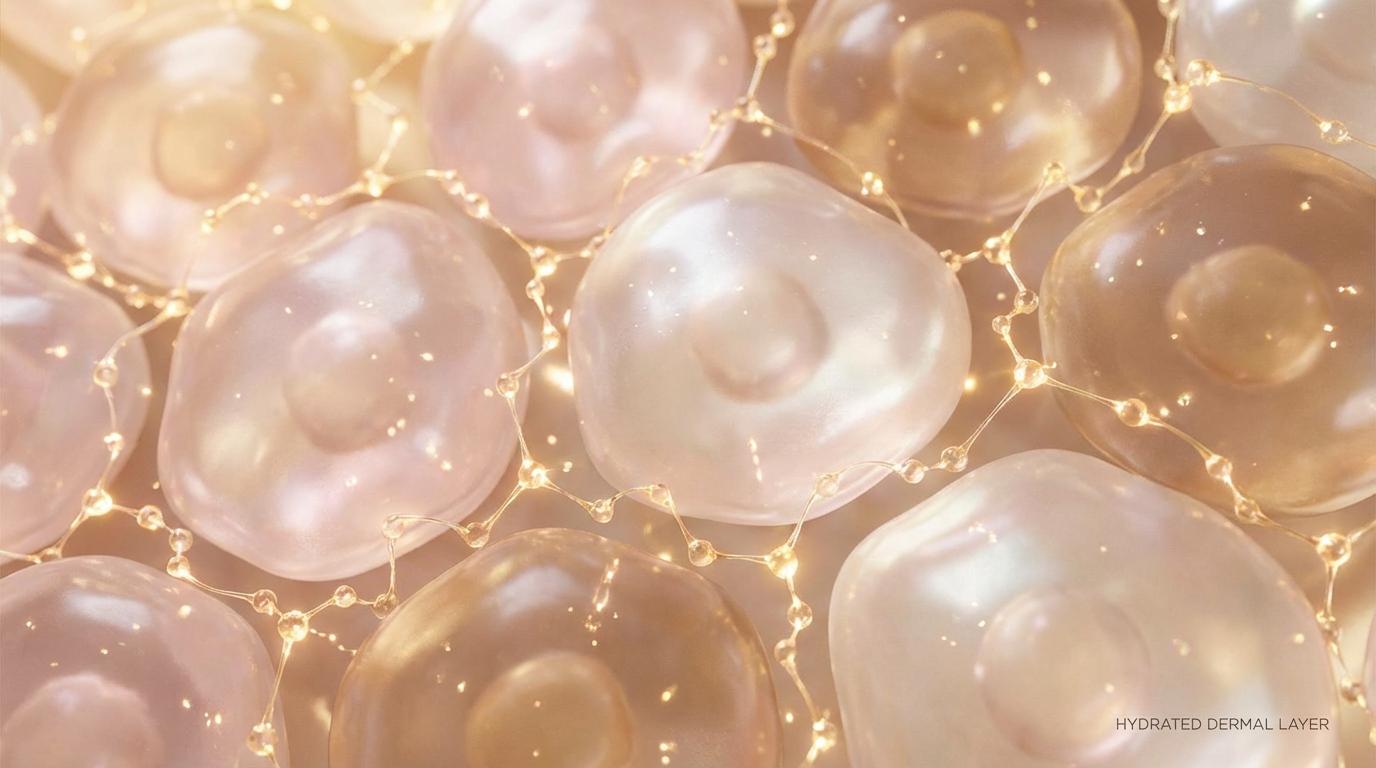
Hyaluronic acid gets marketed like it’s some rare, exotic ingredient your skin desperately needs. It’s not. Your body has been producing it since before you were born, and right now, roughly 50% of all the hyaluronic acid in your entire body is sitting in your skin.
That’s not to say topical HA products are useless. They’re not. But understanding what your skin already has, why it decreases, and what topical products can actually do (versus what marketing wants you to believe) will help you spend your money smarter and set realistic expectations.
What Your Skin Already Produces
Hyaluronic acid is a naturally occurring substance in your body. It’s a type of molecule called a glycosaminoglycan, and its main job is holding onto water. One HA molecule can bind over a thousand times its weight in water. That’s why it’s so effective at keeping tissues hydrated and plump.
Your skin makes HA primarily in the dermis (the deeper layer), produced by cells called fibroblasts. Epidermal cells make some too. This internally-produced HA is what gives young skin that bouncy, hydrated quality everyone’s trying to replicate with skincare.
The Journal of Dermato-Endocrinology published research confirming that HA is one of the key molecules involved in skin moisture. It’s fundamental to how your skin maintains its structure and hydration from the inside out.
Why Your Levels Drop With Age
Here’s the frustrating part. Your body starts producing less HA around age 25. Twenty-five. Not 40, not 50. Twenty-five.
After 30, the decline becomes more noticeable. Production continues to decrease throughout your life, which contributes to the loss of volume, elasticity, and hydration that characterizes aging skin. Less HA means reduced water-binding capacity, which means drier skin that doesn’t bounce back the way it used to.
But aging isn’t the only factor. Environmental stressors accelerate HA depletion. Recent research points to UV exposure, pollution, and lifestyle factors like smoking as significant contributors. Sun damage is particularly brutal: it both speeds up HA breakdown and damages the cells that produce it.
There’s also the matter of turnover. HA in skin has a half-life of less than one day. Your body is constantly breaking down and rebuilding HA reserves. When production slows but breakdown continues at the same rate, the net result is less total HA in your skin over time.
Molecular Weight: Why Size Actually Matters
This is where topical HA gets complicated. Not all hyaluronic acid is created equal, and the differences come down to molecular size.
HA molecules are measured in kilodaltons (kDa). The range is huge: from tiny fragments under 10 kDa to massive molecules over 1,000 kDa. Your skin’s naturally-produced HA tends to be on the larger side. Topical products contain various sizes, and this matters because size determines what the product can actually do.
High molecular weight HA (over 1,000 kDa): These large molecules cannot penetrate your skin. They sit on the surface, forming a hydrating film that helps prevent moisture loss. Good for immediate plumping and a dewy look. Limited for anything deeper.
Medium molecular weight HA (100-1,000 kDa): Some penetration into the outer skin layers. Better than high MW for delivering hydration slightly deeper.
Low molecular weight HA (under 100 kDa): According to research published in Skin Research and Technology, HA below 100 kDa can actually penetrate the skin, with lower weights reaching the dermis. Molecules under 50 kDa show penetration efficiency of 14-19%, compared to 2-10% for larger molecules.
What does this mean practically? A serum with only high molecular weight HA will hydrate your skin’s surface but won’t replenish the HA your dermis has lost. For that, you need lower molecular weight forms.
What Topical HA Actually Does
Time to be realistic about expectations.
It hydrates. This is HA’s primary function, and topical products do this well. By drawing water to the skin’s surface (or slightly below, depending on molecular weight), HA helps skin look and feel more hydrated. If your skin is dehydrated, this makes a visible difference.
It provides temporary plumping. That instant “dewey” effect you get from HA products? Real. But it’s temporary. The product is holding water at or near your skin’s surface. When you wash it off or it degrades, the effect goes with it.
It supports barrier function. Hydrated skin is healthier skin. By maintaining moisture levels, HA products help support your skin barrier’s ability to do its job. If you’re working on repairing a compromised barrier, consistent hydration helps. For more on keeping your skin barrier healthy, check out our guide on preventing skin aging.
What it won’t do: Topical HA won’t permanently restore your skin’s HA levels to what they were at 20. It won’t reverse structural aging or replace collagen. It’s a hydration tool, not an anti-aging treatment. Products that claim otherwise are overselling.
Getting the Most From Topical HA
If you’re going to use HA products, here’s how to actually make them work:
Look for multi-weight formulas. Products that combine different molecular weights give you surface hydration (high MW) plus deeper penetration (low MW). Many modern serums do this. The label might say “multi-molecular” or list multiple forms of HA.
Apply to damp skin. HA is a humectant. It pulls in moisture. If you apply it to dry skin in a dry environment, it will pull moisture from wherever it can find it, potentially including your own skin. Apply after cleansing while skin is still slightly damp, or mist with water first.
Seal it in. HA isn’t an occlusive. It won’t prevent moisture from evaporating. Follow with a moisturizer or oil that creates a barrier to lock in the hydration. Otherwise, the water HA pulled in will just evaporate out.
Be consistent. The hydration benefits of HA are cumulative with regular use but temporary without it. Using it once won’t do much. Using it daily builds noticeable results. Your skin’s moisture reserves need constant support, especially if you live somewhere dry.
Manage expectations. HA is one ingredient. It does hydration well. It won’t solve texture issues, hyperpigmentation, or deep wrinkles. Those require other actives (retinoids, vitamin C, exfoliating acids) or procedures that topical products can’t replicate.
When Topical Isn’t Enough
For significant HA restoration (the kind that actually rebuilds volume), injectable HA fillers are the only proven option. That’s a dermatologist conversation, not a skincare product purchase. Fillers work because they deposit HA directly into the dermis where your natural production has declined. Topical products, even low molecular weight ones, can’t match that.
There’s nothing wrong with wanting to try topical HA first, and for many people, it provides enough hydration improvement to be worth it. Just know the ceiling of what’s possible.
The Bottom Line On Your Skin’s HA
Your skin has been making hyaluronic acid your entire life. It’s not a foreign substance you need to import. What’s happening as you age is a production decline, and topical products can help compensate for some of that loss by providing external hydration support.
Choose products with multiple molecular weights. Apply correctly (damp skin, seal it in). Use consistently. And stop expecting a serum to do what your declining fibroblast production can’t. Good skincare is about working with your skin’s biology, not pretending to replace it.