
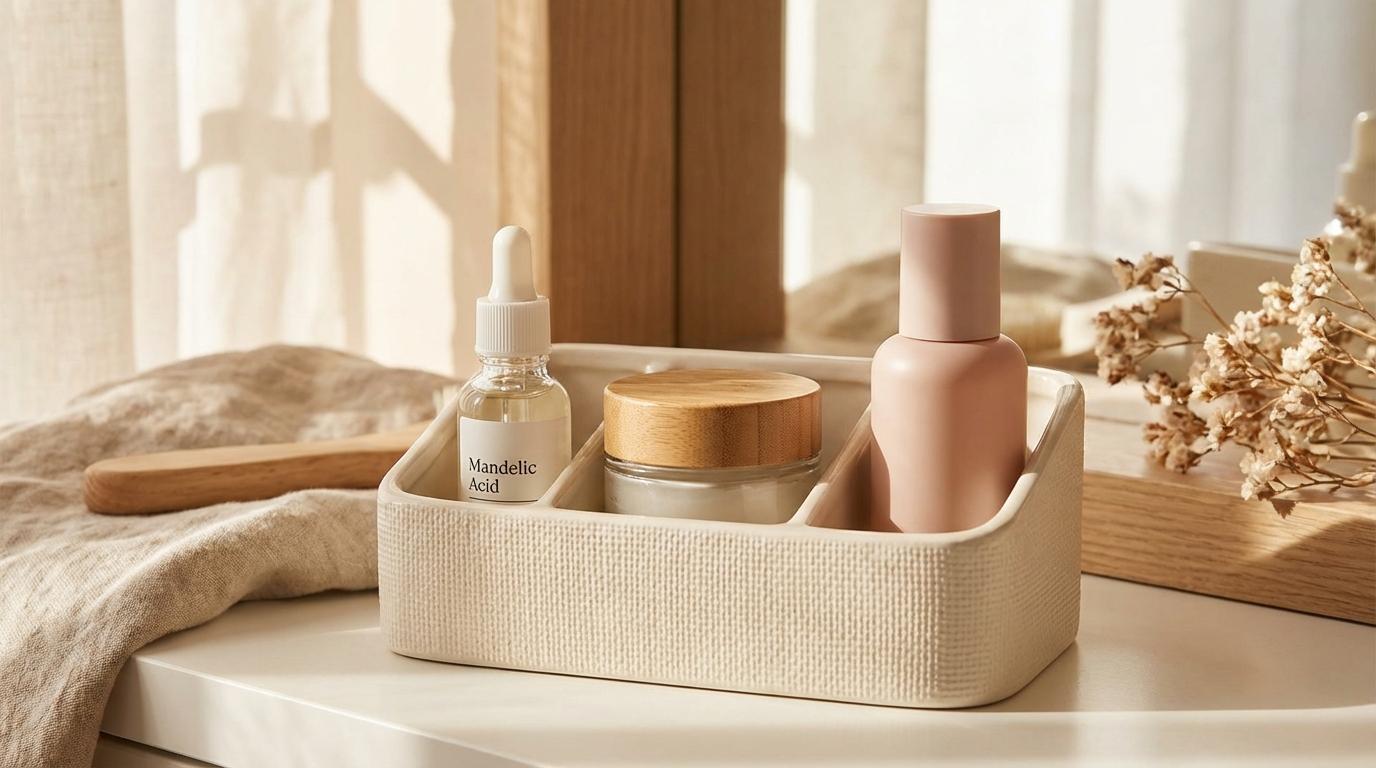
Mandelic acid has been quietly revolutionizing the way people with melanin-rich skin approach chemical exfoliation. If you’ve ever tried a glycolic acid product only to end up with patchy, darkened spots where your skin decided to rebel, you already understand why this particular alpha hydroxy acid deserves special attention.
As someone who spent way too much time in organic chemistry labs, I find mandelic acid fascinating because its molecular structure tells you everything about why it behaves so differently from other AHAs. So let’s break down the science of why this ingredient works especially well for darker skin tones, and how you can start incorporating it into your routine without the drama.
Understanding Mandelic Acid at the Molecular Level
Mandelic acid is derived from bitter almonds (the name comes from “mandel,” German for almond). What makes it structurally unique among AHAs is its molecular size. With a molecular weight of 152.15 g/mol, mandelic acid is significantly larger than glycolic acid (76.05 g/mol) and even lactic acid (90.08 g/mol).
Why does size matter? In chemistry, we often say that larger molecules are “lazier” when it comes to penetration. They move more slowly through the stratum corneum (your skin’s outermost layer) because they simply take longer to work their way between cells. This slower penetration rate is actually a huge advantage for certain skin types.
Research published in the Journal of Cosmetic Dermatology demonstrated that mandelic acid produces more even, predictable results precisely because of this controlled penetration. The acid has more time to work uniformly across the skin surface rather than diving deep into some areas while barely touching others.
Why Darker Skin Tones React Differently to Acids
Here’s where we need to talk about melanocytes, the cells responsible for producing melanin. In darker skin, melanocytes are more reactive. Think of them as being on high alert. When they detect any kind of injury or inflammation, they can respond by producing excess melanin, a phenomenon called post-inflammatory hyperpigmentation (PIH).
Faster-penetrating acids like glycolic acid can trigger this response even when they’re technically “working.” The rapid penetration creates micro-inflammation that your melanocytes interpret as damage, prompting them to darken the affected area. It’s frustrating because you’re using an acid to brighten your skin and ending up with the opposite result.
Mandelic acid’s slow, steady approach minimizes this inflammatory response. A comparative study on AHAs and skin of color found that subjects using mandelic acid experienced significantly less irritation and fewer instances of hyperpigmentation compared to those using glycolic acid at equivalent concentrations.
The Antibacterial Bonus
Mandelic acid has another trick that other AHAs lack: it’s antibacterial. The same structural features that slow its penetration also give it properties similar to certain antibiotics. Studies have shown it’s effective against Propionibacterium acnes, the bacteria involved in inflammatory acne.
This dual action makes mandelic acid particularly valuable if you’re dealing with both hyperpigmentation and breakouts. Instead of layering multiple active ingredients (which increases irritation risk), you get exfoliation and antibacterial benefits from a single, gentler acid.
If you’re struggling with acne-related dark spots, you might also benefit from understanding how lactic acid works as a gentler AHA alternative for when your skin needs a break from more intensive treatments.
Comparing Mandelic Acid to Other AHAs
Let’s put this in perspective with a quick comparison:
Glycolic Acid (smallest AHA)
- Fastest penetration
- Most dramatic results in fair skin
- Highest risk of PIH in darker skin
- Can cause immediate stinging and redness
Lactic Acid (medium-sized AHA)
- Moderate penetration speed
- Added hydrating properties
- Lower PIH risk than glycolic
- Good middle-ground option
Mandelic Acid (largest common AHA)
- Slowest, most controlled penetration
- Lowest inflammation and PIH risk
- Antibacterial properties
- Best suited for reactive, darker skin tones
What the Research Actually Shows
A clinical study published in the Journal of the American Academy of Dermatology examined the efficacy of mandelic acid in treating melasma (a form of hyperpigmentation common in darker skin tones). After 4 weeks of treatment with a 10% mandelic acid formulation, subjects showed a 50% improvement in melasma severity with minimal side effects.
Another study focusing specifically on Fitzpatrick skin types IV-VI (darker skin tones) found that mandelic acid peels produced comparable brightening results to glycolic acid peels but with 75% fewer reports of irritation or adverse reactions.
These aren’t small differences. When you’re working with skin that’s prone to hyperpigmentation, avoiding irritation isn’t just about comfort. It’s about actually achieving the results you want.
How to Start Using Mandelic Acid
Ready to try it? Here’s a practical approach based on how mandelic acid actually behaves:
Week 1-2: Introduction Phase
Start with a low concentration (5-10%) and use it only twice a week. Apply to clean, dry skin in the evening. You’re looking for zero irritation during this phase. If your skin handles it well with no redness, stinging, or increased sensitivity, you can proceed.
Week 3-4: Building Tolerance
Increase to every other night. Your skin is adapting to the acid and building tolerance. You might notice improved texture during this phase as dead skin cells turn over more efficiently.
Week 5 onward: Regular Use
If your skin continues to tolerate it well, you can move to nightly use. Some people find that every-other-night works better long term, and that’s perfectly fine. More isn’t always better with chemical exfoliants.
During this adjustment period, remember that rest days for your skin aren’t just acceptable, they’re often necessary for optimal results.
What to Look for in Mandelic Acid Products
Concentration matters, but so does formulation pH. For an AHA to exfoliate effectively, the product’s pH should be between 3 and 4. Some products contain mandelic acid but are formulated at a pH where the acid is essentially inactive.
Look for:
- Concentration between 5-15% for leave-on products
- pH listed on packaging or available from the brand
- Simple formulations without too many other active ingredients
- Serum or toner formats (easier to control application)
Avoid products that combine mandelic acid with retinol or vitamin C in the same formula. While you can use these ingredients in the same routine (on alternating nights), combining them in one product often compromises the effectiveness of all ingredients while maximizing irritation potential.
When Results Actually Appear
Patience is essential here. Because mandelic acid works more slowly than other AHAs, it also takes longer to show dramatic results. Most clinical studies assess outcomes at the 8-12 week mark.
Here’s what to expect:
- Weeks 1-3: Improved skin texture, possibly some purging if you’re acne-prone
- Weeks 4-6: More even skin tone, reduced dullness
- Weeks 8-12: Visible fading of hyperpigmentation, improved clarity
The gradual nature of these results is actually a good sign. It means your skin is adjusting without the inflammatory response that causes rebound hyperpigmentation.
Combining with Other Skincare
Mandelic acid plays well with most ingredients, but timing matters:
Safe to use in the same routine:
- Hyaluronic acid (hydration)
- Niacinamide (brightening, oil control)
- Peptides (anti-aging support)
Use on alternating nights:
- Retinoids (too much exfoliation together)
- Other AHAs/BHAs (redundant and irritating)
- Vitamin C (can work but may reduce efficacy of both)
Non-negotiable:
SPF during the day. Any AHA increases photosensitivity. Using mandelic acid without sun protection is counterproductive since UV exposure triggers the exact melanin production you’re trying to control. A broad-spectrum SPF 30 or higher is essential.
Signs It’s Working vs. Signs to Stop
Normal adjustment signs:
- Mild tingling for the first few minutes after application
- Slight dryness or flaking (especially in the first few weeks)
- Minor purging if you’re acne-prone (small bumps that resolve quickly)
Stop and reassess if you experience:
- Burning that doesn’t subside within 5 minutes
- Persistent redness that lasts into the next day
- Any darkening of existing spots (sign of inflammation)
- Itching or rash (possible sensitivity reaction)
If you need to stop, don’t panic. Give your skin a week or two to recover, then consider reintroducing at a lower concentration or frequency. Sometimes skin just needs a gentler approach.
The Bottom Line
Mandelic acid isn’t the most glamorous or talked-about ingredient in skincare, but its molecular properties make it uniquely suited for darker skin tones. The larger molecule size, slower penetration rate, and antibacterial benefits create an acid that exfoliates effectively without triggering the inflammatory response that leads to hyperpigmentation.
Science doesn’t care about marketing hype. What matters is how ingredients interact with your specific skin biology. If you’ve struggled with acids before, mandelic acid offers a genuinely different experience backed by clinical research. Give it the 8-12 weeks it needs to work, stay consistent with sun protection, and let the chemistry do its thing.
Your melanocytes will thank you for choosing the gentler path.