
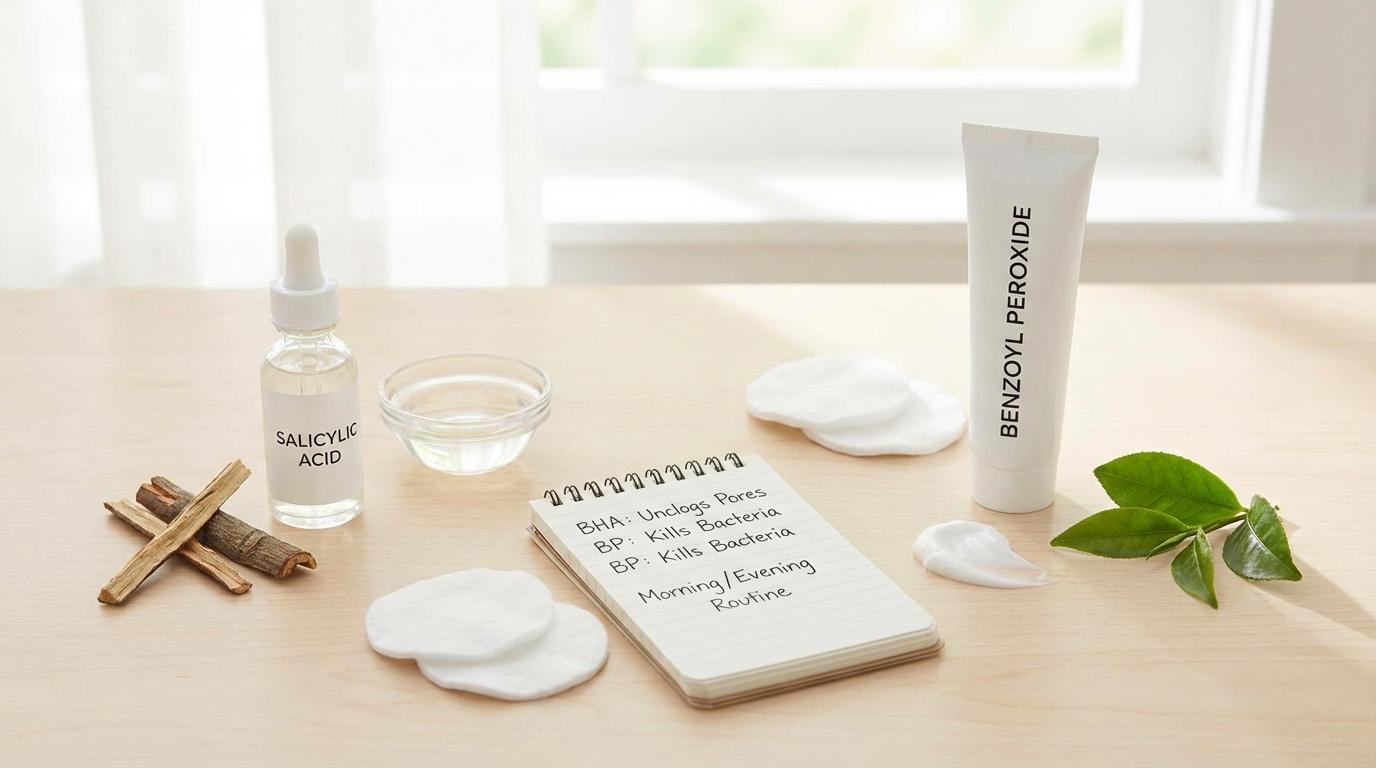
When you start looking into acne treatments, two ingredients pop up over and over again: salicylic acid and benzoyl peroxide. Both have been around for decades, both work, and both have loyal followers who swear by them. So how do you know which one belongs in your routine? The answer isn’t about which one is “better” because that’s not really the right question. It’s about understanding what each one does and matching that to what your skin actually needs right now.
I want to help you understand these two ingredients in a way that feels simple and clear, because skincare shouldn’t feel like a chemistry exam. Once you know how each one works, choosing becomes almost intuitive.
How Salicylic Acid and Benzoyl Peroxide Work Differently
Salicylic acid is a beta hydroxy acid (BHA) that works by getting inside your pores and gently dissolving the mix of dead skin cells, sebum, and debris that clogs them up. Think of it as a deep clean from the inside out. Because it’s oil-soluble, it can actually penetrate through the oily layer on your skin and work within the pore itself. This makes it particularly effective at preventing the conditions that lead to breakouts in the first place. The American Academy of Dermatology notes that salicylic acid helps shed dead skin cells and is especially useful for blackheads and whiteheads.
Benzoyl peroxide takes a completely different approach. Instead of focusing on what’s clogging your pores, it goes after the bacteria that cause inflammatory acne. The main culprit behind those red, angry pimples is a bacteria called Cutibacterium acnes (formerly known as Propionibacterium acnes), and benzoyl peroxide kills it by releasing oxygen into your pores. Bacteria can’t survive in that oxygen-rich environment, so the infection clears up. According to research published in StatPearls, benzoyl peroxide remains one of the most effective topical treatments for inflammatory acne precisely because bacteria haven’t developed significant resistance to it.
So in the simplest terms: salicylic acid clears the blockage, benzoyl peroxide kills the bacteria. They’re solving different problems, which is why the answer to “which is better” really depends on what problem you’re trying to solve.
Matching the Ingredient to Your Skin Type
Your skin type plays a real role in how well you’ll tolerate each ingredient and how effective it will be for you. Salicylic acid tends to be the gentler option for most people, especially if your skin leans sensitive or dry. It has natural anti-inflammatory properties, so even as it exfoliates, it’s not usually irritating when used at appropriate concentrations (typically 0.5% to 2% for over-the-counter products). If you have oily or combination skin with a tendency toward clogged pores, blackheads, and the occasional whitehead, salicylic acid can feel like it was made for you.
Benzoyl peroxide is more powerful but also more drying. It can bleach fabrics (including your pillowcases and towels), and it’s not uncommon for people to experience redness, peeling, or tightness when they first start using it. If you have dry or sensitive skin, you’ll want to approach benzoyl peroxide carefully, perhaps starting with a lower concentration like 2.5% and seeing how your skin responds. The Mayo Clinic recommends starting with the lowest concentration to minimize irritation while still getting effective results. People with oilier, more resilient skin often tolerate higher concentrations (up to 10%) without much trouble, but more isn’t always better here.
If your skin is somewhere in the middle, neither extremely oily nor particularly sensitive, you have more flexibility. You might do well with either ingredient, and your choice will come down more to your specific acne type than your skin type.
Choosing Based on Your Acne Type
This is where understanding the difference really pays off. Acne isn’t just acne. There are different types, and they respond differently to treatment. Blackheads and whiteheads are what dermatologists call comedonal acne, and they form when pores get clogged but there’s no significant bacterial infection involved yet. For this type, salicylic acid is usually the better choice because it directly addresses the clogging issue. It keeps pores clear so those comedones can’t form in the first place.
Inflammatory acne is different. This includes papules (small red bumps), pustules (pimples with white or yellow centers), and more severe forms like nodules and cysts. When bacteria get involved and your immune system responds, you get inflammation, redness, and pain. For this type, benzoyl peroxide’s antibacterial action makes it particularly effective. It doesn’t just sit on the surface; it actively fights the bacterial infection causing the problem.
Many people have a mix of both types, which brings us to an important question that comes up constantly.
Can You Use Both Together?
Yes, you can use both salicylic acid and benzoyl peroxide, but with some thoughtfulness about how you do it. Using them at the same time, layered one right after the other, can be too much for most skin types. The combination of exfoliation and antibacterial action plus the inherent drying nature of benzoyl peroxide can lead to irritation, excessive dryness, and a compromised skin barrier.
A gentler approach is to use them at different times of day, perhaps salicylic acid in the morning and benzoyl peroxide at night, or to alternate days. Some people find that using salicylic acid as a cleanser (which rinses off) and benzoyl peroxide as a leave-on spot treatment works well. The key is giving your skin time to adjust and not overwhelming it with too many active ingredients at once. Paula’s Choice recommends introducing one ingredient at a time and watching how your skin responds before adding the other.
If you do want to use both, start slowly. Perhaps use salicylic acid daily for a couple of weeks, then introduce benzoyl peroxide two or three times a week. Pay attention to how your skin feels. Some tightness or slight dryness is normal as your skin adjusts, but if you’re experiencing persistent redness, flaking, or discomfort, scale back.
Remember that more products and more actives don’t always mean better results. Sometimes the simplest routine, one that your skin can actually tolerate and that you’ll consistently follow, does more good than an elaborate regimen that irritates your skin or that you abandon after a week.
Finding What Works for You
Start by honestly assessing your acne. Is it mostly clogged pores and blackheads? Salicylic acid is probably your friend. Is it inflamed, red, and angry looking? Benzoyl peroxide might be the answer. Is it a bit of everything? You might benefit from both, used strategically.
Consider your skin type and your patience level. Benzoyl peroxide works faster for many people but requires more care to avoid irritation. Salicylic acid is gentler and more forgiving but may take longer to show results. Neither is wrong, they’re just different tools for different situations.
And please, whatever you choose, give it time. Skin cells turn over roughly every four to six weeks, so expecting dramatic changes in a few days isn’t realistic. Consistency over time is what actually transforms skin. Pick one approach, stick with it for at least six to eight weeks, and then evaluate. You can always adjust from there.
Your skin is unique, and finding what works is a process of paying attention and responding to what you observe. Trust that process, be patient with yourself, and know that clearer skin is absolutely achievable with the right approach for your specific needs.