
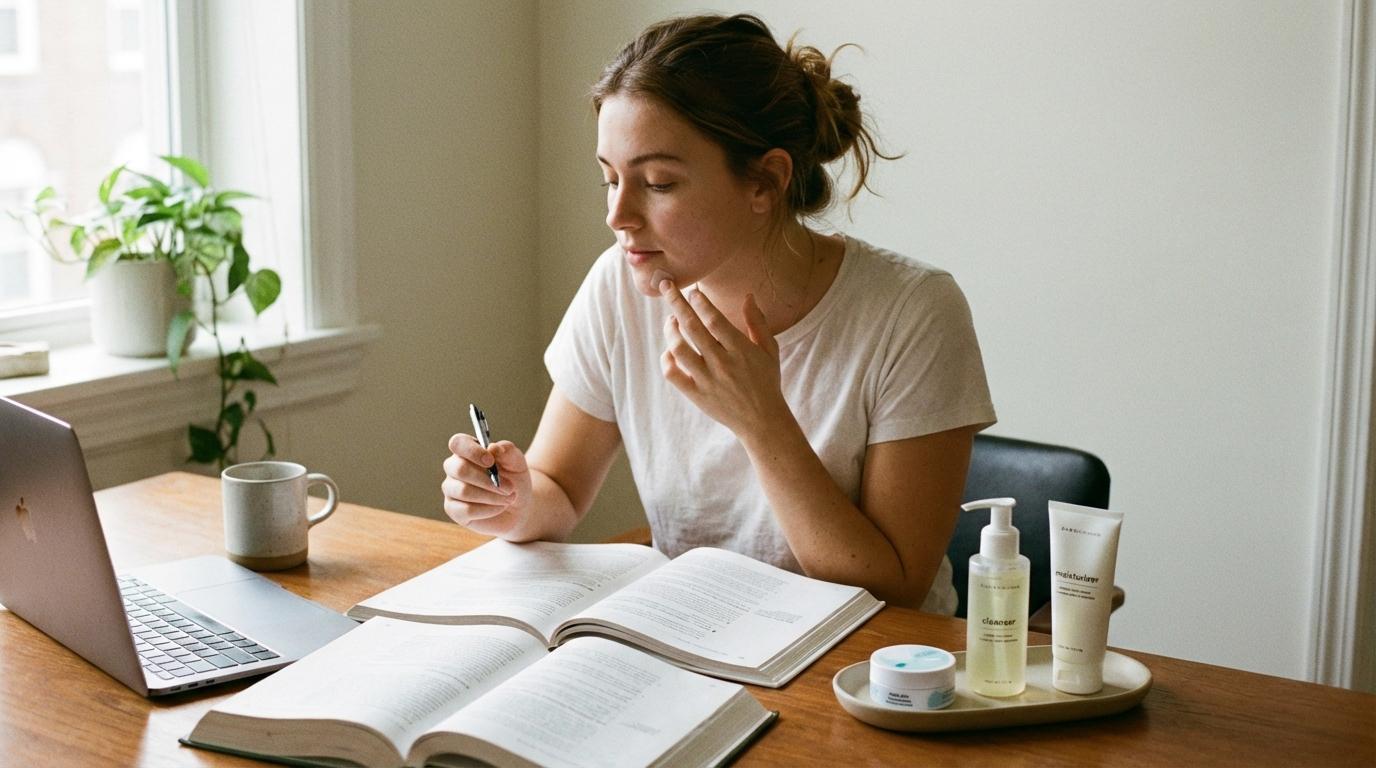
Okay, let’s talk about what happens to your skin the second finals week hits. You’re running on four hours of sleep, you’ve been surviving on coffee and vending machine snacks, and suddenly your forehead has decided to host a whole constellation of stress pimples. I’ve been there. Multiple times. And I’ve finally figured out how to keep my skin from completely falling apart during the most chaotic weeks of the semester.
The thing is, your skin freaks out during exams because stress literally changes your body chemistry. When you’re anxious about that organic chemistry final, your body pumps out cortisol, and cortisol tells your skin to produce more oil. More oil means clogged pores. Clogged pores mean breakouts. It’s not your imagination, and it’s not your fault. It’s biology working against you at the worst possible time.
Why Your Skin Betrays You During Finals
Here’s what’s actually happening: stress triggers your hormonal system to release cortisol, which ramps up sebum production in your skin. Sebum is that oily substance your skin naturally makes, and usually it’s fine. But when you’re stressed, your skin starts overproducing it like crazy. That excess oil mixes with dead skin cells, clogs your pores, and boom, you’ve got stress acne showing up right before your presentation.
But it’s not just acne. Stress can trigger eczema flare-ups, make rosacea worse, and cause your skin to look dull and tired (because it literally is). Your skin barrier also weakens when you’re stressed, which means products that normally work fine might suddenly irritate you. Fun times.
The good news? You can work with your skin instead of against it during these high-pressure weeks. It just requires being a little strategic about your routine.
The Three-Minute Morning Routine
I know what you’re thinking. You don’t have time for skincare when you need to review 400 flashcards before 8 AM. I get it. That’s why your exam week morning routine needs to be fast, effective, and impossible to skip.
Step one: gentle cleanser. Not the harsh acne wash you might be tempted to reach for when you see breakouts forming. Dr. Amy Wechsler, a dermatologist and psychiatrist who specializes in stress-related skin issues, points out that students tend to either skip their routines entirely when stressed or overcorrect with harsh products. Neither helps. Use a gentle, hydrating cleanser that won’t strip your already-stressed skin. CeraVe Hydrating Cleanser or Vanicream Gentle Facial Cleanser are both under ten dollars and do the job perfectly.
Step two: moisturizer with SPF. Yes, even if you’re just going to the library. Even if it’s cloudy. Your skin needs that hydration, especially if you’ve been stuck in air-conditioned buildings. Look for something lightweight that won’t feel heavy or make you break out. La Roche-Posay Toleriane Double Repair UV is solid, or if you’re really on a budget, Cetaphil Daily Hydrating Lotion with SPF 30 works fine.
That’s it. Two products. Three minutes, tops. You can do this between hitting snooze and grabbing your notes.
The Five-Minute Night Routine
Nighttime is when your skin actually repairs itself, so this routine matters even when you’re exhausted. The key is keeping it simple enough that you’ll actually do it, even at midnight after a study session.
Start with the same gentle cleanser from morning. If you wore makeup or sunscreen (which you should have), you might want to double cleanse by using micellar water first. Bioderma Sensibio works great, or grab any drugstore micellar water that doesn’t sting your eyes.
Next, if you’re dealing with active breakouts, this is when you apply your spot treatment. Salicylic acid at 2% (like the Neutrogena On-the-Spot or Paula’s Choice BHA liquid) helps unclog pores. Dab it only on the spots, not all over your face. More product does not mean faster results; it just means more irritation.
Finish with a good moisturizer. If your skin feels dry and stressed, you can use something richer at night than during the day. The ordinary Natural Moisturizing Factors is affordable and doesn’t clog pores, or you can stick with whatever moisturizer you normally use that works for your skin.
What to Skip During Exam Week
This is important. Your stressed skin cannot handle extra aggression right now. Here’s what to put aside until finals are over:
- Exfoliating acids (glycolic, lactic, or scrubs). Your skin barrier is already compromised from stress. Adding exfoliation on top of that is asking for redness, irritation, and possibly more breakouts.
- Retinol or retinoids. Same deal. These are effective but potentially irritating, and your skin can’t handle irritation right now.
- New products. This is not the time to experiment. Stick with what you know works for your skin.
- Sheet masks and complicated treatments. They’re not going to save you, and you probably don’t have the time anyway.
I know it’s tempting to throw everything at your skin when it’s breaking out, but dermatologists consistently warn against over-exfoliation, which can cause micro-tears in the skin and lead to more irritation and redness. Less is genuinely more when your skin is under stress.
The Cardinal Rule: Do Not Pick
I need to say this directly because I know the urge is real: do not pick at your skin during exam week. When you’re stressed and anxious, picking at pimples or bumps becomes almost compulsive for a lot of people. It feels productive in the moment, like you’re doing something about the problem.
You’re not. You’re making it worse.
Picking spreads bacteria, causes inflammation, and can lead to scarring that lasts way longer than any pimple would have on its own. When you notice yourself reaching for your face during a study session, try to redirect. Keep a stress ball nearby. Sit on your hands if you have to. Put pimple patches on any spots so you physically can’t pick at them.
Hydrocolloid pimple patches (like Mighty Patch or the Cosrx ones) are actually great for exam week because they protect spots from your fingers, absorb some of the gunk, and make it physically impossible to pick without being obvious about it. Stick them on at night, or even during the day if you’re just going to be studying alone.
Quick Fixes for Specific Problems
Let’s be practical about what you might be dealing with:
Puffy, tired eyes from late nights: Cold spoons from the freezer, held against your under-eyes for a few minutes, actually help with puffiness. It’s not fancy, but it works. Or splash cold water on your face in the morning before applying anything else.
Dry, flaky patches: Slug your skin at night. This just means applying a thin layer of plain Vaseline or Aquaphor over your moisturizer on dry areas. It locks in moisture while you sleep. Your pillowcase might suffer, but your skin won’t.
New pimples appearing: Benzoyl peroxide or salicylic acid spot treatment, applied at night only. Don’t try to dry out pimples with toothpaste or other weird hacks. They don’t work and usually make things worse.
Generally dull, tired-looking skin: Hydrate from the inside out. Seriously, drink water. I know you’re living on coffee right now, but try to match each cup of coffee with a glass of water. Your skin will look better within a day or two.
The Post-Exam Recovery Plan
Once your last final is done and you can actually breathe again, your skin is probably going to need some TLC. Here’s how to help it recover:
First, catch up on sleep. This isn’t just general wellness advice. Sleep deprivation directly impacts skin health, affecting everything from collagen production to how quickly your skin heals. When you finally get those eight hours, your skin will bounce back faster than you’d expect.
Second, reintroduce your regular products slowly. If you were using retinol or exfoliating acids before exam week, wait a few days before adding them back. Start with every other night and work back up to your normal frequency.
Third, consider a hydrating mask or treatment. This is when it’s appropriate to pamper your skin a bit. A simple hydrating sheet mask or a layer of pure hyaluronic acid serum followed by moisturizer can help replenish moisture your skin lost during the stress period.
Finally, be patient. Stress breakouts can take a couple of weeks to fully clear up, even after the stress is gone. Your skin is recovering along with the rest of you. Don’t panic and start throwing harsh products at it; just keep up with your gentle routine and give it time.
Building Habits That Last
Here’s the thing about exam week skincare: if you can maintain a simple routine during your most chaotic, stressful times, you can maintain it always. The habits you build when things are hard are the habits that stick.
Keep your essential products (cleanser, moisturizer, spot treatment) somewhere visible and easy to access. On your desk, next to your toothbrush, wherever you’ll actually see them and use them. The simpler you make it to take care of your skin, the more likely you are to actually do it.
And remember, your skin is going through something stressful right along with you. It’s responding to the same cortisol, the same sleep deprivation, the same anxiety. Treating it gently, keeping things simple, and avoiding the urge to pick or overtreat is genuinely the best thing you can do for it.
You’ve got this. Your skin’s got this too. Now go crush those finals.