
I remember the first time someone mentioned skin pH to me. I was at a yoga retreat, chatting with a dermatologist who happened to be there, and she casually mentioned that most of the irritation people experience comes down to one simple thing: pH imbalance. I nodded along like I understood, but honestly, the concept felt abstract. What does a chemistry measurement have to do with my face? Turns out, quite a lot.
The thing about pH is that it sounds complicated, but it is actually beautifully simple once you understand the basics. And more importantly, understanding pH can help you simplify your routine rather than add to it. Because that is really what we are all looking for, is it not? Fewer products, less confusion, skin that just… works.
What pH Actually Means for Your Skin
pH stands for “potential hydrogen” and it measures how acidic or alkaline something is on a scale from 0 to 14. Pure water sits at 7, which is neutral. Anything below 7 is acidic, and anything above is alkaline. Your skin, in its healthiest state, maintains a slightly acidic pH somewhere between 4.5 and 5.5. This is often called the “acid mantle,” and it is not just a number on a chart. It is a living, breathing protective barrier that keeps your skin healthy.
This acid mantle does some important work. It helps keep beneficial bacteria thriving while making the environment inhospitable for harmful bacteria. It supports the enzymes that help your skin shed dead cells naturally. It maintains moisture by keeping your skin barrier intact. When researchers at the American Academy of Dermatology study skin conditions, pH imbalance comes up repeatedly as a contributing factor to everything from acne to eczema to premature aging.
Think of your acid mantle like a gentle bouncer at the door of your skin. When it is functioning well, good things get in and bad things stay out. But when the pH gets disrupted, that bouncer gets confused, and chaos can follow.
The Ideal pH Range for Your Products
Here is where things get practical. Not every product needs to match your skin’s exact pH, but understanding the general ranges helps you make better choices. Most well-formulated skincare products fall somewhere in the 4.5 to 7 range, and there is a reason for that.
Different products work best at different pH levels:
- Cleansers work best between pH 4.5 and 6.5. Traditional bar soaps often sit around pH 9 or 10, which is why many dermatologists, including those at published research in the International Journal of Cosmetic Science, recommend switching to pH-balanced cleansers if you experience dryness or irritation.
- Vitamin C serums need a low pH, usually around 2.5 to 3.5, to remain stable and penetrate effectively. This is one case where acidity is intentional and beneficial.
- AHA and BHA exfoliants also require lower pH levels, typically between 3 and 4, to work properly. If the pH is too high, these acids convert to their salt form and lose their exfoliating ability.
- Moisturizers and sunscreens generally hover around pH 5 to 7, which is gentle and compatible with most skin.
The key is not obsessing over exact numbers but understanding that very high pH products, especially cleansers, can strip away your protective barrier over time. Research published in the International Journal of Cosmetic Science consistently shows that maintaining proper skin pH supports better barrier function and reduces sensitivity.
When pH Goes Wrong
You might be disrupting your skin’s pH without realizing it. The signs can be subtle at first: a little extra dryness here, some unexpected breakouts there, maybe some redness that was not there before. Over time, these small disruptions can compound into bigger issues.
Common pH disruptors include:
- High-pH cleansers, especially traditional bar soaps and some foaming cleansers
- Over-exfoliating with too many acid products layered together
- Using tap water with a high mineral content (hard water)
- Mixing products that were not formulated to work together
When your pH is consistently off, your skin might feel tight after cleansing, look dull despite your best efforts, break out in ways that seem random, or react sensitively to products that never bothered you before. If any of this sounds familiar, pH could be part of the puzzle.
Dr. Whitney Bowe, a board-certified dermatologist, has discussed extensively how skin barrier repair often starts with addressing pH imbalance. The fix is usually not adding more products but choosing the right ones and giving your skin space to restore its natural balance.
Testing Product pH at Home
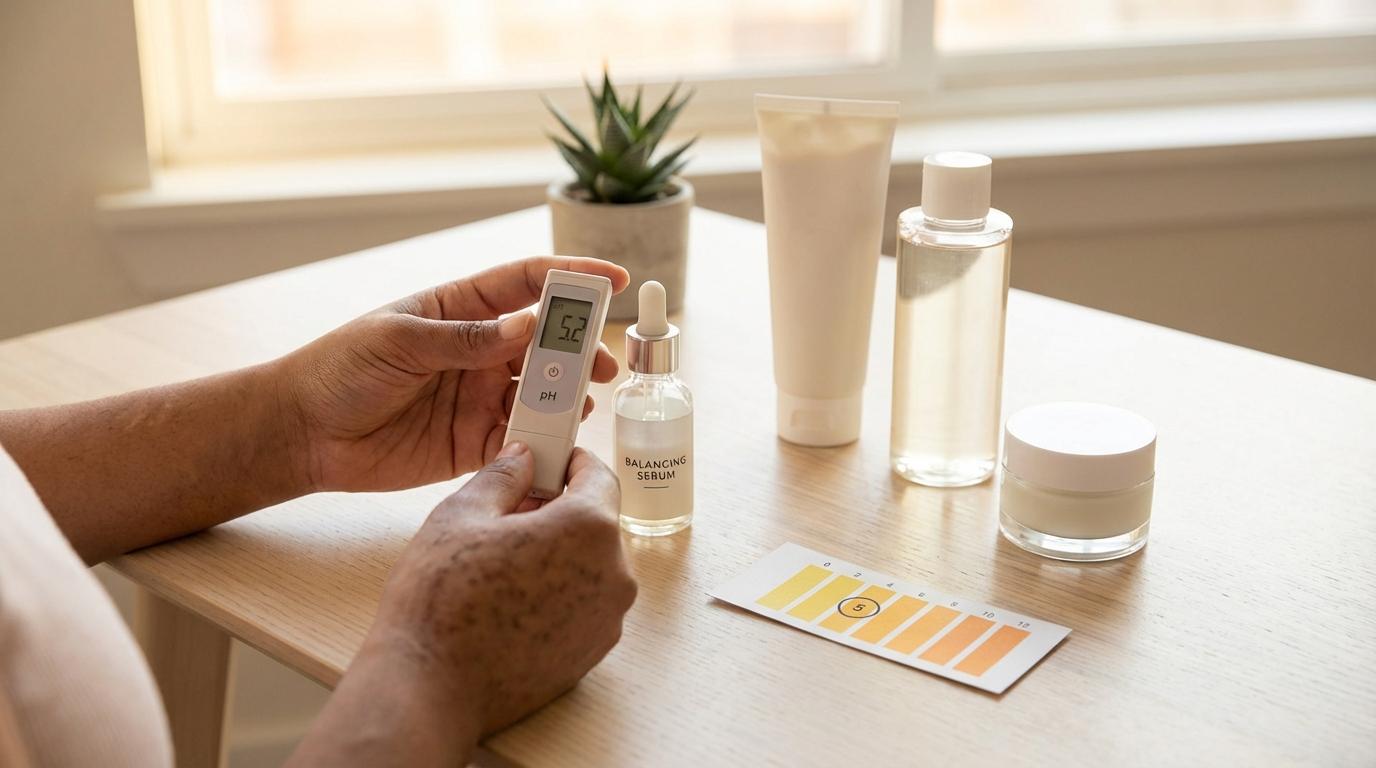
If you are curious about the pH of your products, testing at home is surprisingly simple. You do not need a chemistry degree or expensive equipment. pH test strips, available at most pharmacies or online for a few dollars, work perfectly well for this purpose.
Here is how to test:
- Get pH test strips with a range of at least 0 to 14 (though 4 to 10 works for most skincare testing)
- Apply a small amount of product directly to the strip
- Wait the time specified on your strip package, usually 15 to 30 seconds
- Compare the color to the chart provided
For water-based products like toners and cleansers, this method works well. Thicker products like creams may need to be diluted slightly with distilled water for accurate reading, though the result will be approximate.
Honestly, you do not need to test everything. Start with your cleanser since that is where most pH problems originate. If it registers above 7, consider swapping it out. Many brands now list pH on their websites or will share it if you email their customer service.
The goal here is awareness, not obsession. Once you understand the basics, you can make informed choices without turning your bathroom into a laboratory. Your skin is resilient and adaptable. Give it products that work with its natural chemistry rather than against it, and you might find that simplicity is the most effective routine of all.
Sometimes the kindest thing we can do for our skin is to stop fighting its nature. Your acid mantle has been doing its job since before you knew it existed. Trust it, support it, and let it do what it does best.