
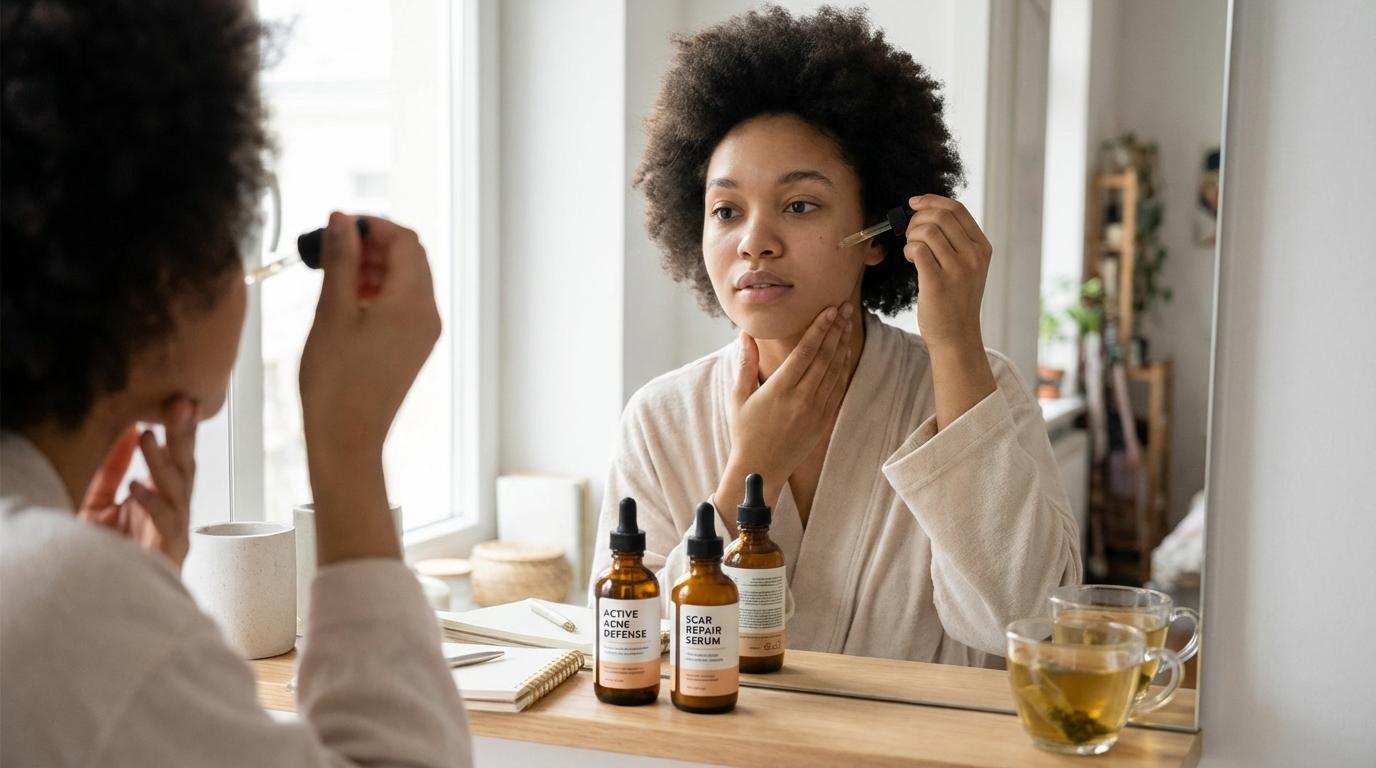
Okay, real talk: I spent way too long throwing random products at my face thinking I could treat my acne and fade my scars at the same time. Spoiler alert, that was a mess. Turns out, active breakouts and the marks they leave behind are completely different beasts that need completely different strategies. And trying to tackle both at once? That’s basically skincare chaos. Let me break down what I wish someone had told me years ago.
Why You Need to Deal With Active Acne First
I know, I know. You want those scars gone yesterday. But here’s the thing: treating scars while you still have active acne is like mopping the floor while someone’s still tracking in mud. You’re just going to create more scars while trying to fix the old ones.
Active acne is inflammation happening right now in your skin. Those red, angry bumps, the whiteheads, the deep cystic ones that hurt when you accidentally touch them. Your skin is actively fighting bacteria, dealing with clogged pores, and trying to heal. When you pile aggressive scar treatments on top of that, you risk irritating already inflamed skin and potentially making everything worse.
According to research published in the Journal of Clinical and Aesthetic Dermatology, treating acne scars while breakouts are still occurring can lead to poor outcomes and even more scarring. The goal is to get your skin to a stable place first, where breakouts are minimal or under control, before you start addressing texture issues.
What does “under control” actually mean? Most dermatologists say you should have at least a few months of clear or mostly clear skin before starting intensive scar treatments. For mild scarring and OTC products, you can usually start sooner, but for anything professional, you want stability.
The Different Types of Scarring (Yes, It Matters)
Not all acne scars are created equal, and knowing what type you have determines what will actually work. Here’s the breakdown:
Post-Inflammatory Hyperpigmentation (PIH)
These are the flat, dark or red marks left behind after a pimple heals. Good news: these aren’t technically scars. They’re just pigment changes, and they will fade on their own over time (we’re talking months to a year or more depending on your skin tone). You can speed this up with the right products, though.
Post-Inflammatory Erythema (PIE)
Those pink or red marks that stick around after acne? That’s PIE. It’s caused by damaged blood vessels under the skin, and it’s most visible on lighter skin tones. This one’s tricky because not much topically treats it effectively, but it does fade with time and sun protection.
Atrophic Scars (The Indented Ones)
This is where things get more complicated. Atrophic scars are actual depressions in your skin where collagen was lost during healing. According to Healthline, about 80-90% of people with acne scars have this type. They come in three varieties:
- Ice pick scars: Deep, narrow, V-shaped holes that look like someone poked your skin with a sharp object. These are the most common (60-70% of atrophic scars) and unfortunately the hardest to treat because they go so deep.
- Boxcar scars: Wider depressions with defined edges, kind of like chickenpox scars. They can be shallow or deep.
- Rolling scars: Wavy, uneven texture without sharp edges. The good news? These are usually the easiest to improve because they’re more shallow.
Hypertrophic and Keloid Scars
These are raised scars where your skin produced too much collagen while healing. Keloids actually grow beyond the original wound area. They’re less common with acne but can happen, especially along the jawline and chest.
OTC Options That Actually Help (For Mild Scarring)
Let me be honest with you: no drugstore product is going to completely erase deep ice pick scars. That’s just not how skin works. But for PIH, PIE, and mild texture issues? You’ve got options.
Retinoids
This is your MVP for both preventing new breakouts AND improving mild scarring. Adapalene (sold as Differin) is available over the counter and promotes cell turnover, which helps fade dark marks faster and can slightly improve texture over time. If you’re new to retinoids, start slow because they will make your skin peel and get angry if you go too hard too fast. Two to three times a week is plenty at first.
Niacinamide
This vitamin B3 derivative is great for fading hyperpigmentation and strengthening your skin barrier. It plays nice with most other ingredients and is usually well-tolerated even by sensitive skin. Look for products with 5-10% niacinamide.
Azelaic Acid
Underrated ingredient alert. Azelaic acid helps with both active acne AND post-acne marks. It’s anti-inflammatory, antibacterial, and helps even out skin tone. The Ordinary has an affordable 10% suspension. Some people find higher percentages (15-20%) more effective, but those usually require a prescription.
Vitamin C
Specifically L-ascorbic acid, which is the most studied form. It’s an antioxidant that can help brighten dark marks and boost collagen production. Fair warning: vitamin C serums can be unstable and oxidize quickly (if it turns orange or brown, toss it).
Alpha Hydroxy Acids (AHAs)
Glycolic acid and lactic acid can help with surface-level texture and hyperpigmentation by exfoliating dead skin cells. Don’t go overboard, though. Once or twice a week is enough for most people. And always, always wear sunscreen when using acids because they increase sun sensitivity.
The key with all of these? Consistency and patience. We’re talking months, not weeks, to see improvement. And you shouldn’t use all of them at once. Pick one or two to start.
When You Need to Call in the Professionals
Here’s the part where I have to be straight with you: if you have moderate to severe scarring, especially deep ice pick or boxcar scars, OTC products alone won’t cut it. They can help, but they won’t dramatically change the texture of your skin. For that, you need professional treatments.
Microneedling
This creates controlled micro-injuries that trigger your skin’s healing response and collagen production. It’s effective for rolling and shallow boxcar scars. Professional microneedling goes deeper than those at-home dermarollers (which honestly aren’t worth it and can cause damage if used incorrectly).
Chemical Peels
Professional-strength peels go deeper than anything you can buy at Sephora. They’re good for mild to moderate scarring and hyperpigmentation. Multiple sessions are usually needed.
Laser Treatments
Fractional lasers (like Fraxel) create tiny columns of thermal damage that stimulate collagen remodeling. They’re effective but pricey, and you’ll need multiple sessions with significant downtime. Board-certified dermatologists often recommend these for moderate to severe scarring.
Subcision
For rolling and tethered boxcar scars, a dermatologist can use a needle to break up the scar tissue pulling your skin down. Often combined with fillers or other treatments.
Fillers
Injectable fillers can literally fill in depressed scars, giving immediate results. The downside? Most fillers are temporary and need to be repeated.
Radiofrequency Microneedling
This combines microneedling with radiofrequency energy for enhanced collagen stimulation. Studies show 25-75% improvement after 3-4 sessions for ice pick and boxcar scars.
Building Your Strategy
So what does this actually look like in practice? Here’s how I’d approach it:
Step 1: Get your acne under control
Work with a dermatologist if your acne is moderate to severe. For mild acne, a basic routine with a gentle cleanser, adapalene or benzoyl peroxide, and a simple moisturizer can work. Be patient. This can take 2-3 months minimum.
Step 2: Assess your scarring
Look at your skin in natural lighting. Are you mostly dealing with flat discoloration (PIH/PIE)? Or do you have actual texture changes (indentations or raised areas)? Be honest about what you’re working with.
Step 3: Start with OTC for mild issues
If you have PIH and minor texture concerns, give OTC products a solid 3-6 months. A basic approach would be: retinoid at night (adapalene or retinol), niacinamide in the morning, and sunscreen every single day. Sun exposure is the enemy of fading dark marks.
Step 4: Consult a dermatologist for deeper scars
If you have ice pick scars, deep boxcar scars, or significant texture issues, save yourself time and frustration. A dermatologist can assess your specific scarring and recommend a treatment plan. Most people need multiple professional sessions combined with good at-home care.
Step 5: Protect your investment
Whatever you do, wear sunscreen. SPF 30 or higher, every day, even when it’s cloudy. UV exposure darkens hyperpigmentation and can undo your progress. This is non-negotiable.
Managing Expectations
I’m not going to lie to you and say you can get perfectly smooth, poreless skin. That’s not realistic for most people, and honestly, that level of perfection mostly exists in filtered photos anyway. What you can realistically expect is improvement. Hyperpigmentation can fade significantly. Mild texture can smooth out. Even deeper scars can be noticeably reduced with professional treatments.
But it takes time. Like, a lot of time. We’re talking months to years depending on your scarring. And it often takes money too, especially if you need professional treatments. Be wary of any product promising dramatic results in two weeks. That’s not how skin healing works.
The most important thing is addressing active acne first. I cannot stress this enough. Every new breakout is a potential new scar. Get control of that, protect your skin from the sun, be consistent with your routine, and the improvement will come. It’s slow, but it’s real.