
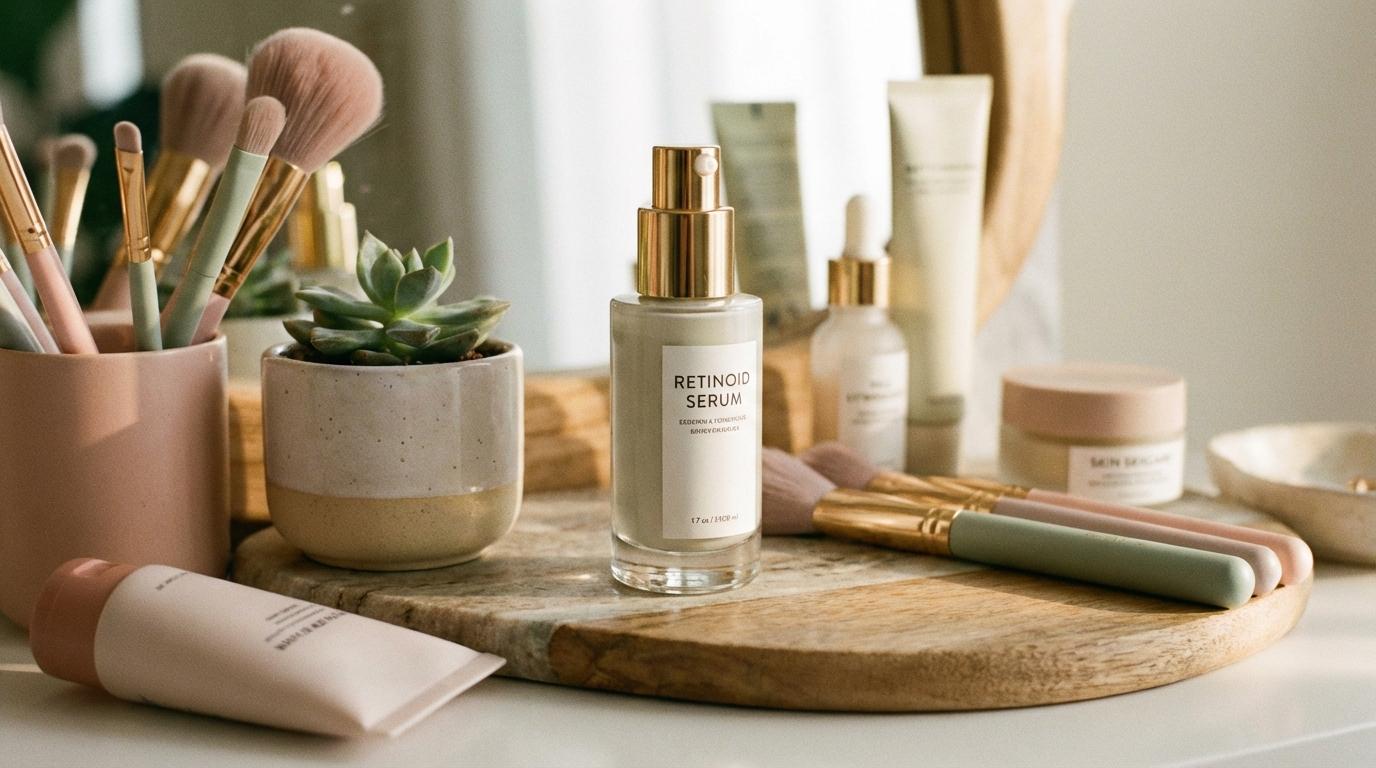
Retinoids are confusing.
Like, there’s retinol, retinaldehyde, tretinoin, adapalene, and now something called “granactive retinoid” that The Ordinary made famous. And I know you’ve heard all the claims: it works like retinol but without the peeling! It’s gentler! It’s better! But is any of that actually true, or is it just marketing vibes?
I’ve been down this rabbit hole at 2am more times than I’d like to admit (my screen time report is judging me), so let me break it down for you.
What Is Granactive Retinoid, Anyway?
Okay so “Granactive Retinoid” is actually a brand name (trademarked by Grant Industries, hence the “Grant-active”). The actual ingredient is called hydroxypinacolone retinoate, or HPR if you want to sound fancy at skincare meetups (which I know you don’t attend because you’re a normal person, but still).
HPR is an ester of retinoic acid. That’s important because retinoic acid is the form of vitamin A that actually works on your skin cells. Regular retinol has to go through a whole conversion process in your skin: retinol becomes retinaldehyde, which becomes retinoic acid. Only then does it start doing the anti-aging magic.
Related reading: how peptides signal skin repair.
HPR supposedly skips this whole conversion thing and binds directly to the retinoid receptors in your skin. Which sounds great in theory. No conversion = no waiting around = faster results? Maybe?
The “Just as Effective But Gentler” Claims
This is what everyone wants to know. Does it actually work as well as retinol without making your face peel off like a snake?
Here’s what the research actually shows: An Estee Lauder-sponsored study found that HPR increased collagen-related gene transcription more than retinol at the same concentration. That’s genuinely impressive. BUT (and this is a big but) it still didn’t reach the same levels as pure tretinoin (prescription-strength retinoic acid).
The interesting part? When they cranked up the HPR concentration, the highest dose actually out-performed tretinoin. And here’s the kicker: HPR didn’t cause more inflammation than the vehicle control (basically the cream without active ingredients). Tretinoin definitely does cause more inflammation.
You might also want to know why your face ages faster than your body.
So the “effective without irritation” claim has some legitimacy. It’s not just marketing speak (shocking, I know).
The Stability Situation
Here’s something cool that doesn’t get talked about enough: HPR is really stable. Like, impressively stable.
A 2020 study tested how different retinoids held up over time. Regular retinol can lose up to 80% of its potency after 6 months at room temperature (which is why your retinol serum probably should live in the fridge, but does anyone actually do that?). HPR kept 95% of its potency after 6 months at 25 degrees Celsius. Even at 40 degrees (like if you left it in a hot bathroom), it retained 97% after 3 months.
This matters because a retinoid that’s degraded by the time you use it is basically expensive face water. HPR actually stays active.
How It Compares to Other Retinoids
Let me give you the hierarchy as I understand it (from strongest/most irritating to gentlest):
- Tretinoin (Retin-A): The prescription gold standard. Works fast, definitely works, but can make your face hate you for 4-6 weeks during the adjustment period
- Adapalene (Differin): Prescription-strength but more tolerable than tretinoin, especially good for acne
- Retinaldehyde: One step away from retinoic acid, quite effective but less studied than retinol
- Retinol: The OG over-the-counter option. Works but takes longer and needs conversion
- HPR/Granactive Retinoid: Binds directly to receptors, gentle, stable, but less proven than retinol in long-term studies
- Retinyl palmitate: The “starter” retinoid that honestly might not do much at typical concentrations
Where HPR gets interesting is that it might not fit neatly into this hierarchy. Because it doesn’t need conversion, it could theoretically be more effective than where its gentleness would suggest. But we need more head-to-head human studies to really know.
The Concentration Thing (Important!)
Okay this trips people up constantly. When a product says “2% Granactive Retinoid,” that’s NOT 2% HPR.
Granactive Retinoid as sold to cosmetic companies is a pre-diluted solution that’s 90% solvent and only 10% actual HPR. So your “2% Granactive Retinoid” serum actually contains 0.2% HPR. Your “5% Granactive Retinoid” product has 0.5% HPR.
This isn’t a scam, it’s just how the ingredient is standardized and sold. But it does mean you shouldn’t compare percentages across different retinoid types. 1% retinol is not the same as 1% Granactive Retinoid.
Who Should Actually Try This?
Based on the research and, honestly, personal observation of my own face (very scientific, I know), Granactive Retinoid makes sense if you:
- Have sensitive or reactive skin that freaks out at regular retinol (redness, peeling, burning)
- Want to start using a retinoid but are scared of the adjustment period (valid)
- Are pregnant or breastfeeding… wait no, check with your doctor on that, I’m not qualified to advise on that
- Want to use a retinoid more frequently without the irritation
- Keep your products in a warm bathroom (that stability is clutch)
It might NOT be the best choice if you:
- Already tolerate retinol well and are seeing results (why fix what isn’t broken?)
- Have severe acne or significant sun damage and need maximum strength
- Want the most researched option with the longest track record (that’s still retinol and tretinoin)
Combining It With Other Actives
Because HPR is gentler, you might be able to use it alongside other actives that would be a no-go with tretinoin. But still be careful because retinoid + AHA + vitamin C in one routine is how you end up with a compromised moisture barrier (been there, texted friends panicked selfies at midnight about it).
General rules still apply:
- Introduce one active at a time
- Buffer with moisturizer if needed
- Sunscreen is non-negotiable with any retinoid
- If something stings, stop and reassess
I’d personally feel comfortable using HPR the same night as niacinamide or hyaluronic acid. I’d be more cautious mixing it with acids or benzoyl peroxide even though it’s supposed to be gentler.
The Honest Assessment
Here’s what I actually think: Granactive Retinoid is a legit ingredient, not just hype. The direct receptor binding mechanism is real. The stability is real. The reduced irritation is real.
What’s less certain is whether it delivers results as impressive as regular retinol for things like wrinkles, texture, and tone when used consistently over years. We just don’t have the same depth of long-term research that we do for retinol (which has decades of studies behind it).
INCIDecoder describes it as a “super promising rising star, but not fully proven yet.” I think that’s fair. The early data looks good. Real good, actually. But it’s still early data.
My Take (Take It or Leave It)
I think of Granactive Retinoid as the retinoid you graduate to when you’re tired of dealing with retinol’s drama. It’s like the emotionally stable ex of the retinoid world. Less intense, less highs and lows, still gets the job done (probably).
If you’re retinoid-curious but terrified of the purge, start here. If you’ve tried retinol and your skin said “absolutely not,” try here. If you’re already getting great results from retinol or tret, you probably don’t need to switch.
And if you’re on prescription tretinoin and it’s working for you, I definitely wouldn’t downgrade to HPR just because it’s trendier. Prescription strength exists for a reason.
Basically: it’s good, it’s real, it’s worth trying for the right person. It’s just not definitively better than everything else (nothing ever is, despite what skincare TikTok wants you to believe).
Now I’m going to go put mine on because it’s 1:47am and that’s apparently when I do skincare and write about skincare and think about skincare. We’re all normal here.