
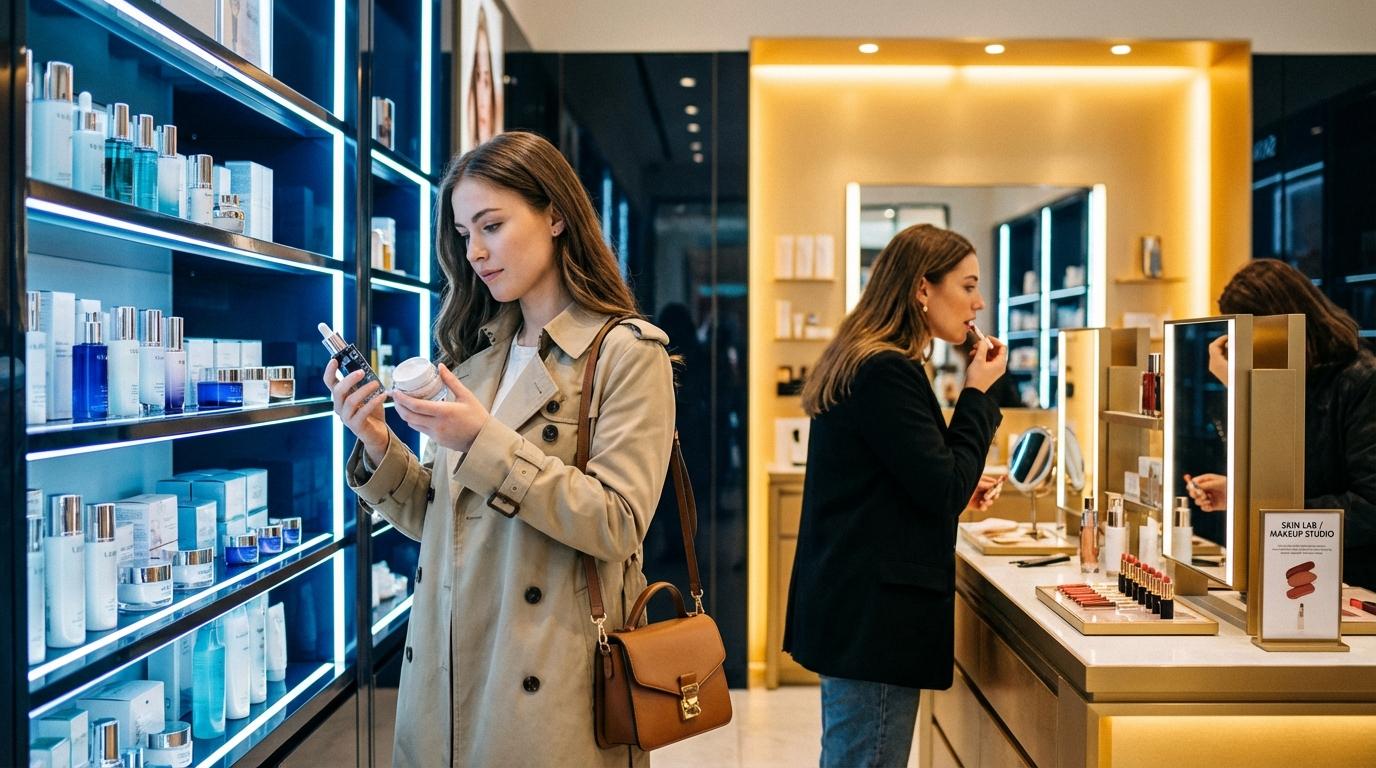
That foundation didn’t match at home, and it’s not your fault. Retail lighting is engineered to make you buy, not to show you what products actually look like in real life. And once you understand the tricks at play, you’ll stop wasting money on returns.
What Store Lighting Actually Does
Walk into any Sephora, Ulta, or department store beauty counter and you’re immediately bathed in bright, flattering light. This isn’t accidental. Retailers invest heavily in lighting design because studies show it can boost sales by up to 40%.
The key metric here is Color Rendering Index (CRI). Premium retail spaces use lighting with CRI values of 90-100, which makes colors appear vibrant and skin look smooth. Your bathroom mirror? Probably lit by bulbs with a CRI around 80. Your office? Even lower.
That “perfect” shade match you found in-store exists in conditions you’ll never recreate at home.
The Specific Tricks to Watch For
Downlighting at beauty counters: Light coming from above creates soft shadows that minimize pores, fine lines, and texture. Your skin looks airbrushed before you’ve applied anything. Then you buy a foundation expecting that same effect.
Warm vs. cool temperature: Department stores often use warmer lighting (around 3000K) because it makes skin tones look healthier. But if you work in an office with cool fluorescent lighting (5000K+), that warm-toned foundation will look orange under your actual daily conditions.
This post covers pollution damage.
Strategic mirror placement: Mirrors in beauty stores are positioned at angles that catch the most flattering light. Many are also slightly tilted to elongate your reflection. These subtle tricks make you look better than any product could achieve.
Spotlight on product, shadow on you: Testers and displays get their own dedicated lighting, making products look more luminous and appealing. Meanwhile, the lighting in the testing area may be different from the display, creating inconsistency in how you evaluate them.
Testing Products Properly (Despite the Tricks)
You can’t change store lighting, but you can work around it.
More on routine mistakes.
Step outside. Natural daylight is the most honest light source. If a store has windows near the entrance, walk over there to check your shade match. If not, ask for a sample and leave the store. Check in your car using natural light through the windshield.
Test on your jaw, not your hand. Your hand is a different color than your face. Always swatch on your jawline where the color needs to blend seamlessly into your neck. If a salesperson pressures you to decide quickly, that’s a red flag.
Photograph in multiple lighting conditions. Use your phone camera to capture the swatch in-store, then again outside. The camera often reveals undertone mismatches your eye adjusts to automatically.
This applies beyond foundation. Understanding how to properly evaluate products before purchase extends to reading labels, checking concentrations, and knowing what ingredients actually do versus what marketing claims.
Online Shopping: Different Problems
You’d think buying online avoids the store lighting issue. Not exactly. You’re now dealing with professional product photography that’s been color-corrected, retouched, and optimized for screen displays.
The model wearing that lipstick? Shot in a studio with controlled lighting, potentially with the image adjusted to make the shade appear more saturated. Your phone screen might display colors differently than your laptop. And neither shows what that lipstick looks like in your bathroom at 7am.
What helps:
- Search for customer photos: Real people taking photos in real lighting give you better information than brand images.
- Watch video reviews: Movement and changing angles in video reveal product behavior that static photos hide. You’ll see how that highlighter looks in motion, not just at the perfect angle.
- Read reviews mentioning lighting: Pay attention when reviewers mention how products look in different environments.
- Use virtual try-on with skepticism: AR tools can give a general impression but they flatten texture and struggle with undertones.
The Psychology Behind Retail Environments
Lighting is just one element of a carefully designed buying experience. Stores know that 80% of sensory impressions come through our eyes. What you see becomes the primary driver of purchase decisions.
Mirrors, music tempo, scent, and even floor texture all contribute to creating a state where you’re more likely to buy. Beauty retail specifically uses what researchers call “retail theater” to elevate ordinary shopping into an experience.
None of this is inherently wrong. But being aware means you’re making informed decisions rather than reacting to designed stimuli. That awareness becomes especially valuable when budgeting for skincare and makeup.
Making Informed Decisions
The most expensive lighting trick is the one that makes you buy products you won’t use. Every wrong-shade foundation, every highlighter that looked stunning in-store but reads as glitter bomb in daylight represents money and resources wasted.
Request samples ruthlessly. Any brand worth buying from offers samples. If they refuse, consider whether they’re confident in their products.
Know your environment. Think about where you actually spend your time. If you work from home near windows, natural light compatibility matters. If you’re in a fluorescent office eight hours a day, test under similar conditions. Your “daily” makeup look should work for your actual daily life.
Build relationships with honest salespeople. Good beauty advisors exist. They’ll tell you when a shade isn’t right rather than push whatever meets their sales quota. Find these people and return to them.
Accept that some trial and error is inevitable. Even with perfect testing, chemistry between products and your skin varies. But minimizing obvious environmental mismatches through smart testing reduces expensive mistakes significantly.
The same skepticism applies to skincare claims. Products marketed under flattering conditions may not perform as expected in your routine. Research how retailers use lighting strategically and you’ll never see a beauty counter the same way.
Your Lighting Checklist
Before any beauty purchase, run through this:
- What lighting am I testing this under?
- Can I check this in natural light before committing?
- Where will I actually wear/use this product?
- Am I being rushed or pressured to decide now?
- Can I get a sample to test at home?
Five questions. They take seconds to consider and can save you hundreds of dollars annually on products that would have gathered dust in your drawer.
Stores aren’t trying to deceive you maliciously. They’re optimizing for sales in a competitive market. But your job as a consumer is to optimize for products that actually work for your face, in your life, under your lights. Those priorities don’t always align with what looks best under a CRI 95 spotlight in a temperature-controlled retail environment.
Next time you’re reaching for your wallet at a beauty counter, pause. Step back. Find different light. The extra minute of evaluation beats the frustration of another product that only looked good in the store.