I learned this lesson the hard way during my freshman year. I walked into a drugstore, saw “50% OFF” slapped on a cleanser, and grabbed three without thinking. Turns out, that “sale” price was still more expensive than the regular price at Target. Twenty bucks down the drain because I got excited by a red tag.
Here’s the thing: brands know we love a deal. They count on it. And they’ve gotten really, really good at making mediocre discounts look like steals. So let me share what I’ve figured out after three years of stretching my skincare budget to its absolute limits.
What Actually Makes a Sale Worth It
A good sale isn’t just about the percentage off. I know, I know, seeing “40% OFF” makes your brain light up. Mine too. But here’s what actually matters:
The original price has to be real. Some brands inflate their “regular” prices right before sales so the discount looks bigger. If a serum was $15 yesterday and is now “marked down” from $30 to $18, you’re not saving anything. You’re paying more. The FTC has rules about this, but enforcement is spotty at best.
You need to actually need the product. This sounds obvious, but be honest with yourself. A $5 toner you won’t use is still $5 wasted. I keep a running list on my phone of products I’m genuinely running low on. If something goes on sale and it’s not on my list, I walk away. Period.
Check if it’s close to expiring. Clearance items are often discounted because they’re nearing their expiration date. That’s fine if you’ll use the product within a few months. Not fine if you’re stocking up on five bottles of SPF that will go off before next summer.
The Unit Price Trick That Changed Everything
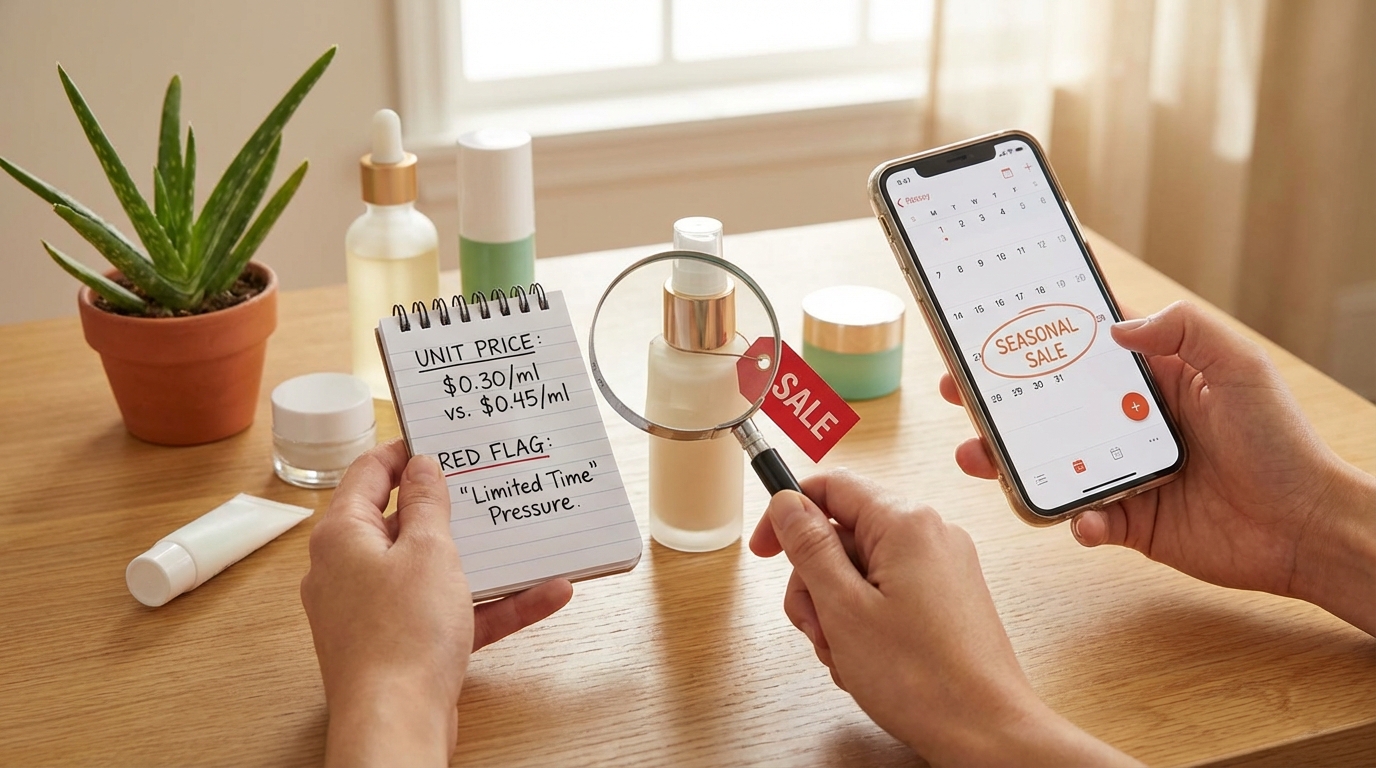
Okay, this is the boring but genuinely useful part. Unit price comparison is how grocery stores let you compare different sized packages fairly. And you can use the same math for skincare.
Here’s the formula: divide the total price by the number of ounces (or milliliters). That gives you the price per unit.
Example: A 3.4 oz moisturizer for $12 costs $3.53 per ounce. A 1.7 oz version of the same moisturizer on “sale” for $8 costs $4.70 per ounce. The “sale” item is actually worse value.
I do this math every single time now. It takes ten seconds and has saved me so much money. NerdWallet has a great breakdown of unit pricing if you want to get into the details.
Pro tip: pull up the same product on Amazon, Ulta, and Target while you’re standing in the store. Use their websites to compare unit prices across retailers. What looks like a deal at one place might be regular price somewhere else.
Timing Your Purchases Around Sales Cycles
Skincare sales follow predictable patterns. Once you know them, you can plan your purchases and actually save real money instead of impulse buying during random flash sales.
January: Post-holiday clearance. Great for gift sets that didn’t sell. These often have legitimate savings since stores need to clear inventory.
March/April: Spring sales. Brands push new formulations and discount the old ones. If you like the current formula of something, stock up before they “improve” it.
July: Amazon Prime Day and competitors’ response sales. RetailMeNot tracks these annually and you can see patterns from previous years.
November: Black Friday through Cyber Monday. The biggest discounts of the year, but also the most marketing manipulation. More on that below.
End of each month: Many stores have quotas to hit. You’ll often find unadvertised markdowns during the last week of the month.
Drugstores like CVS and Walgreens cycle their “buy one get one 50% off” sales every few weeks for different brands. If you miss one, just wait. It’ll come back.
Red Flags That Scream “Don’t Buy This”
After years of making mistakes, I’ve learned to recognize when a sale is designed to manipulate rather than offer genuine value. Here’s what makes me put a product back on the shelf:
“Limited time only!” with no end date. Real sales have real deadlines. Vague urgency language is just pressure tactics. Psychology Today explains why these tactics work on our brains, and it’s honestly a little uncomfortable to read.
Prices ending in .99 or .97. This is retail psychology 101. A product priced at $19.99 feels significantly cheaper than $20, even though it’s basically the same. When evaluating sales, round up to get a realistic picture of what you’re spending.
“Up to X% off.” That “up to” is doing a lot of work. It means one random item might be 50% off while everything else is 10% off. Always check the actual discount on the specific product you want.
Bundles you don’t need. “Buy this cleanser, toner, and moisturizer set and save 30%!” Cool, but I don’t need a new cleanser. Buying the set means spending more total, even if the per-item price is lower. Only buy bundles when you actually need every item in them.
Free gift with purchase over $X. This is designed to make you spend more than you planned. If you were going to spend $35 anyway and the threshold is $35, great. If you were planning to spend $20 and now you’re adding random stuff to hit $50 for a free sample? You just paid $30 for a sample.
The phrase “compare at” or “valued at.” These phrases mean absolutely nothing. A brand can say their serum is “valued at $100” when nobody has ever paid that price for it. The FTC guidelines on advertising technically address this, but “valued at” is a loophole.
My Personal Sale Shopping Checklist
Before I buy anything on sale, I run through these questions:
- Is this product on my “need to replace soon” list?
- What’s the unit price compared to other sizes and retailers?
- When does this product expire?
- Have I price-checked this at other stores?
- Would I buy this at full price if I had to?
- Am I feeling rushed or pressured right now?
If I can’t answer those questions confidently, I don’t buy. The product will go on sale again. Another deal will come along. Your wallet will still be there next week.
Being smart about sales isn’t about never buying anything on discount. It’s about making sure that when you do buy, you’re actually getting value instead of just feeling like you are. The red tags and countdown timers are designed by professionals who study consumer psychology. Don’t feel bad for falling for it before. Just arm yourself with better tools going forward.
Your budget matters. Make the sales work for you, not the other way around.