
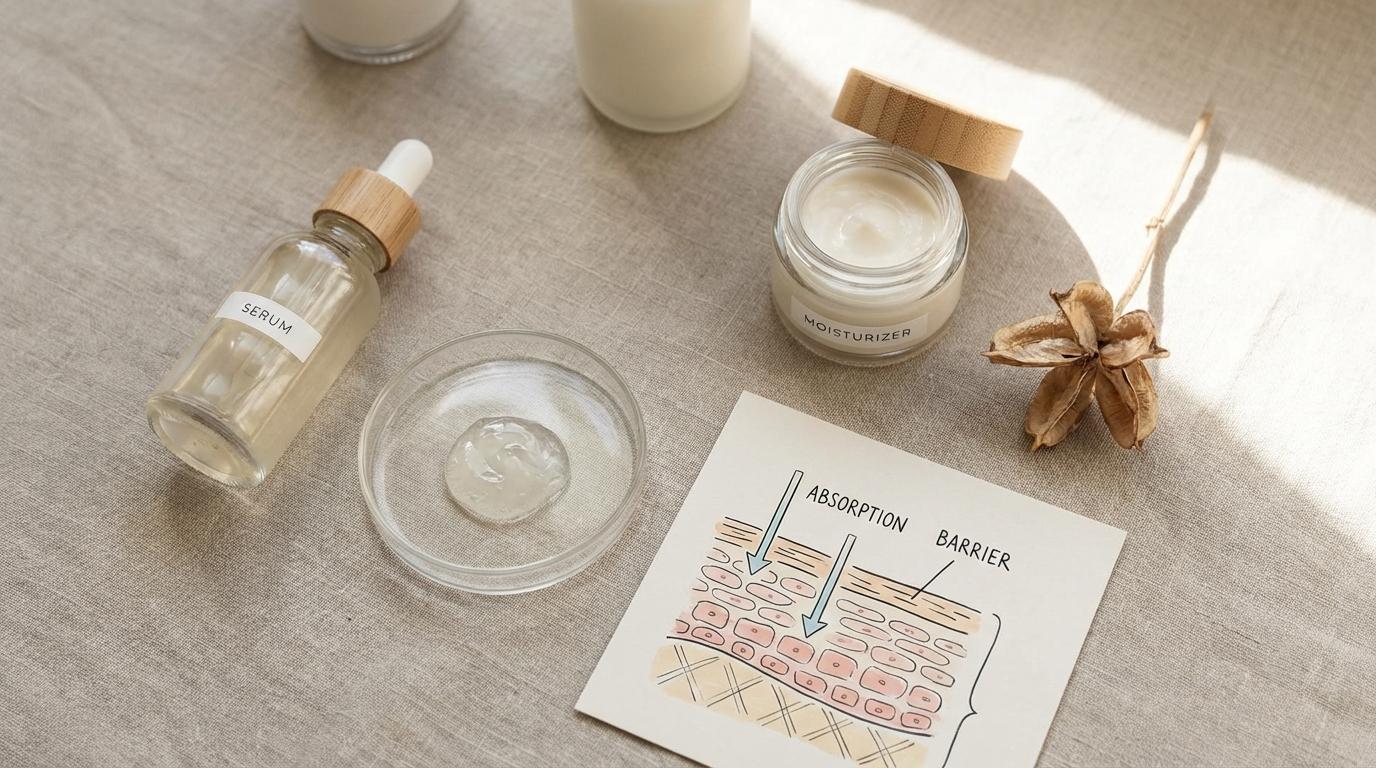
There is something beautifully grounding about understanding how things actually work. When we talk about skincare, we often focus on what products to use or which ingredients are trending, but rarely do we pause to consider the journey those products take once they meet our skin. Knowing how your skin absorbs what you apply can help you build a more intentional, simplified routine that truly serves you.
The Layers of Your Skin: A Brief Tour
Your skin is not a single sheet but rather a multi-layered system designed to protect you from the outside world. The outermost layer, called the stratum corneum, is made up of dead skin cells held together by lipids. Think of it as a brick wall where the cells are bricks and the lipids are mortar. This barrier is remarkably effective at keeping things out, which is exactly what it evolved to do. Below this sits the epidermis, where living cells gradually make their way upward, and beneath that lies the dermis, rich with collagen, blood vessels, and nerve endings.
When you apply a serum, cream, or oil, your product first encounters that brick wall. Most ingredients will stay right there on the surface or within the very top layers. For an ingredient to reach the living cells of the epidermis or penetrate all the way to the dermis, it needs to navigate through those tightly packed cells and lipids. This is not something every ingredient can do, and honestly, not every ingredient needs to. Many beneficial compounds work beautifully right at the surface, hydrating and protecting without needing to go any deeper. Understanding this can free you from the pressure of seeking out products that promise impossible levels of penetration.
Why Size Matters More Than You Think
One of the most important factors determining whether an ingredient can penetrate your skin is its molecular size, measured in units called Daltons. As a general guideline supported by research published in the Journal of Controlled Release, molecules larger than about 500 Daltons have a very difficult time passing through the stratum corneum. This 500 Dalton rule is not absolute, but it provides a helpful framework for understanding why some ingredients work and others remain on the surface.
Hyaluronic acid is a perfect example. Traditional hyaluronic acid molecules are massive, often exceeding 1 million Daltons. They simply cannot penetrate your skin in any meaningful way. What they do instead is sit on the surface and draw moisture from the environment and lower skin layers, creating a temporary plumping effect. This is not a failure; it is exactly what those molecules are good at. Smaller, fragmented versions of hyaluronic acid, sometimes labeled as low molecular weight or hydrolyzed hyaluronic acid, can reach slightly deeper but still primarily work within the upper layers. Knowing this helps you set realistic expectations and appreciate what your products genuinely accomplish.
On the other end of the spectrum, ingredients like niacinamide (122 Daltons) and caffeine (194 Daltons) have no trouble passing through the skin barrier. Retinol, vitamin C derivatives, and certain peptides also fall into the range where penetration is possible, which is why these ingredients can produce visible changes over time with consistent use.
Some Ingredients Simply Cannot Get Through
There is a certain peace in accepting that not everything needs to penetrate deeply to be useful. Collagen in skincare, for instance, has molecules far too large to enter your skin. When you apply a collagen cream, those molecules form a film on the surface that can help with hydration and create a smoother appearance, but they will not become part of your skin’s collagen structure. Your body builds collagen from within using amino acids, vitamin C, and other nutrients, not from topical application of collagen itself.
Similarly, many botanical extracts, antioxidants, and protective compounds work primarily at the surface, shielding your skin from environmental stressors without needing to travel deeper. This surface activity is valuable. Your stratum corneum is constantly exposed to pollution, UV radiation, and oxidative stress, so having ingredients that work right there, at the front line, makes perfect sense. The American Academy of Dermatology emphasizes that a good skincare routine does not require deep penetration of every ingredient; surface hydration and protection are foundational to healthy skin.
Understanding this can simplify your routine significantly. Instead of layering product after product hoping more will somehow get through, you can choose a few well-formulated options that address what your skin actually needs, knowing that less can truly be more.
The Role of Occlusion in Absorption
One factor that genuinely influences how much your skin absorbs is occlusion, which means covering the skin in a way that prevents water loss. When you apply an occlusive product like petroleum jelly, mineral oil, or a heavy balm, you create a barrier that traps moisture and increases the hydration of your stratum corneum. This hydration softens the barrier and can slightly enhance the penetration of other ingredients applied underneath.
This is why many people find that applying a hydrating serum followed by a thicker moisturizer produces better results than the serum alone. The occlusive layer holds everything in place and creates an environment where active ingredients have more time and opportunity to work. Healthline explains that occlusives do not add moisture directly but instead prevent its loss, making them particularly valuable for dry or compromised skin.
There is also something called the “slug” technique, where people apply a layer of petroleum jelly over their entire routine. While this can boost hydration dramatically, it is not necessary for everyone. If your skin feels comfortable and healthy with a lighter approach, trust that. Occlusion is a tool, not a requirement, and using it thoughtfully based on your skin’s needs is more important than following any trend.
Bringing It All Together
When you understand how your skin absorbs products, you gain the freedom to be more intentional and less anxious about your routine. You do not need twenty steps or the latest penetration-enhancing technology. What you need is a few good products suited to your skin type, applied consistently with realistic expectations. Some ingredients will work at the surface, and that is perfectly fine. Others will travel a bit deeper and create gradual change over time. Both are valid, and both contribute to healthy skin in their own way.
Let this knowledge simplify things for you. Choose products with ingredients in the right molecular range for their intended purpose. Layer thoughtfully, with lighter products first and occlusives last if needed. And most importantly, release the pressure to make everything penetrate as deeply as possible. Your skin is designed to protect you, and working with that design, rather than against it, is the most sustainable path to skin that feels good and looks healthy. Trust the process, keep it simple, and let your skin do what it knows how to do.