
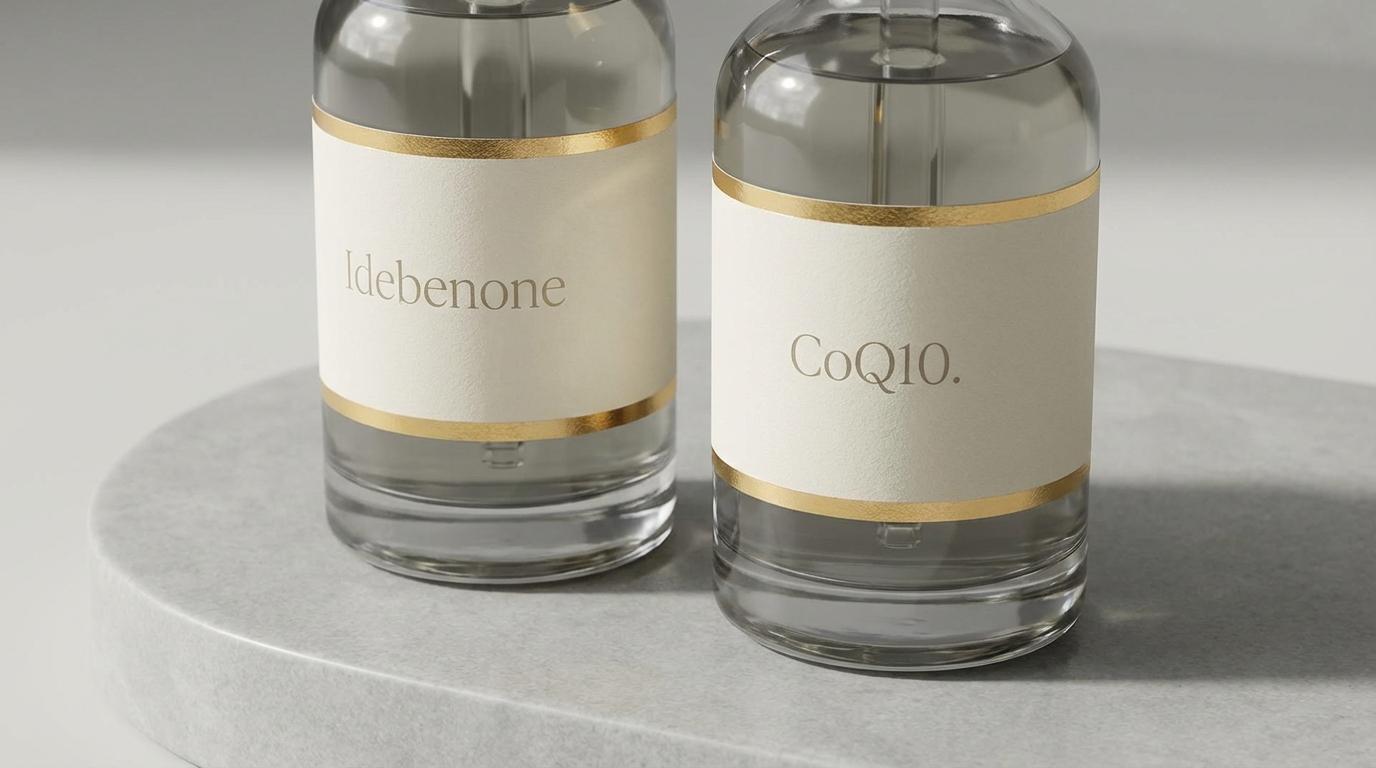
Like a souped-up version of an ingredient your skin already knows, idebenone takes everything useful about Coenzyme Q10 and dials it up. If you have seen CoQ10 on ingredient lists and wondered whether it actually does much, idebenone is the answer to “what if it did more?” It is a synthetic analog of CoQ10 with stronger antioxidant activity, and it has quietly been gaining ground in skincare formulations over the last few years.
I first heard about idebenone in my organic chemistry class, of all places. It was originally developed as a treatment for mitochondrial disorders, not as a skincare ingredient. But researchers noticed its potent ability to neutralize free radicals, and the beauty industry picked up on that potential.
What Idebenone Actually Is
Idebenone (pronounced eye-DEB-eh-known) is a benzoquinone compound. Structurally, it is very similar to CoQ10 (ubiquinone), but with a shorter side chain. That shorter chain is the whole reason it works differently in the skin.
CoQ10 is a larger molecule. It has a long lipophilic tail that makes it excellent at working inside mitochondria, which is its natural job in the body. But that size makes it harder to penetrate the skin when applied topically. Idebenone’s smaller structure allows it to penetrate more effectively and distribute across skin layers more evenly.
Both molecules serve as electron carriers. They shuttle electrons in biochemical reactions, and when free radicals steal electrons from your skin cells, antioxidants like these donate replacements to stop the chain reaction. Idebenone just does this more efficiently when applied to the skin’s surface.
The EPF Score and Why It Matters
Scientists use something called the Environmental Protection Factor (EPF) to measure how well an antioxidant protects skin from environmental stress, including UV, pollution, and cigarette smoke. A study published in the early 2000s tested several common antioxidants head-to-head, and idebenone scored the highest EPF of any antioxidant tested.
For reference, the rankings were: idebenone scored 95, vitamin E scored 80, CoQ10 scored 68, kinetin scored 68, and vitamin C scored 52. Now, this is a single study and real-world performance depends on formulation, concentration, and pH. But it does give idebenone a strong starting point in the antioxidant conversation.
If you have been reading about CoQ10 in skincare, you already understand the general concept of mitochondrial antioxidants. Idebenone operates on the same principle but with what the research suggests is greater potency per molecule.
How Idebenone Compares to CoQ10 in Practice
On paper, idebenone sounds like a clear upgrade. In practice, the comparison is more nuanced.
CoQ10 is naturally present in the body. Your skin cells make it, though production declines with age. Applying it topically is essentially a top-up of something your body already recognizes. This means the chance of irritation is extremely low, and it integrates seamlessly into the skin’s existing antioxidant network.
Idebenone is synthetic, which is not inherently bad (lots of effective skincare ingredients are synthetic), but it does mean the skin has no existing pathway for processing it. Some people experience mild irritation with idebenone, particularly at higher concentrations. If you have sensitive or reactive skin, this is worth noting.
The other practical difference is availability. CoQ10 is in hundreds of products across every price point. Idebenone is in far fewer, and they tend to be pricier. For college-budget skincare, CoQ10 products are much more accessible. Elizabeth Arden’s Prevage line is the most well-known idebenone-containing range, and it is not cheap.
Finding Products with Idebenone
If you want to try idebenone without spending a fortune, you have a few options.
- Elizabeth Arden Prevage Anti-Aging Daily Serum is the original and most researched idebenone product. It contains 1% idebenone and has clinical data behind it. The price is high, but it occasionally goes on sale at Dermstore and department store sites.
- Some Korean and Japanese beauty brands have started including idebenone at lower concentrations (0.1 to 0.5%) in serums and ampoules. These are usually more affordable, though the lower concentration means less dramatic results.
- A few independent brands on platforms like Amazon sell idebenone serums in the $20 to $35 range. Check the concentration and read reviews carefully. Not all of these are well-formulated.
When reading ingredient lists, idebenone may also be listed as hydroxydecyl ubiquinone. Same compound, different naming convention.
Who Should Consider Idebenone
Idebenone makes the most sense for people who are already using a solid barrier-supporting routine and want to add a high-performance antioxidant. It is particularly useful for:
- People who live in high-pollution environments, since the EPF data specifically measures environmental stress protection.
- Anyone already using CoQ10 who wants to upgrade to something with more published antioxidant data.
- People in their mid-twenties and up who are starting to think about prevention rather than correction.
It is less ideal for people with highly sensitive skin, those on a tight budget, or anyone already using multiple strong actives (retinoids, vitamin C, AHAs) who does not need yet another active in the rotation.
How to Work It Into a Routine
Idebenone serums go on after cleansing and toning, before moisturizer. Because it is oil-soluble, it layers well under heavier creams and sunscreens.
You can use it morning or evening. Morning application pairs well with sunscreen, since idebenone helps neutralize the free radicals that UV generates even when sunscreen is doing its job (no sunscreen blocks 100% of UV). Evening use is fine too, especially if your morning routine is already packed with actives.
It plays well with niacinamide, hyaluronic acid, and peptides. Be cautious combining it with high-concentration vitamin C serums (above 15% L-ascorbic acid), as some users report increased sensitivity with that pairing. There is no formal contraindication, but the combination of two potent antioxidants at high concentrations can sometimes irritate rather than help.
The Honest Budget Take
I will be real: as a college student, idebenone is not where I would spend my limited skincare dollars. A good vitamin C serum, consistent sunscreen use, and a CoQ10-containing moisturizer will cover most of the same antioxidant bases for significantly less money.
Where idebenone becomes worth it is if you have the budget to spare and want an ingredient with standout antioxidant data. Think of it as the premium option, not the essential one. Your skin will not suffer without it, but if you can swing one of the more affordable options, it adds a measurable layer of protection that simpler antioxidants do not quite match.
If you are still building your basic routine and watching every dollar, focus on the fundamentals first: cleanser, moisturizer, SPF, and one proven active like retinol or vitamin C. Idebenone is a “nice to have,” not a “need to have.” And there is nothing wrong with circling back to it once the essentials are locked in.