
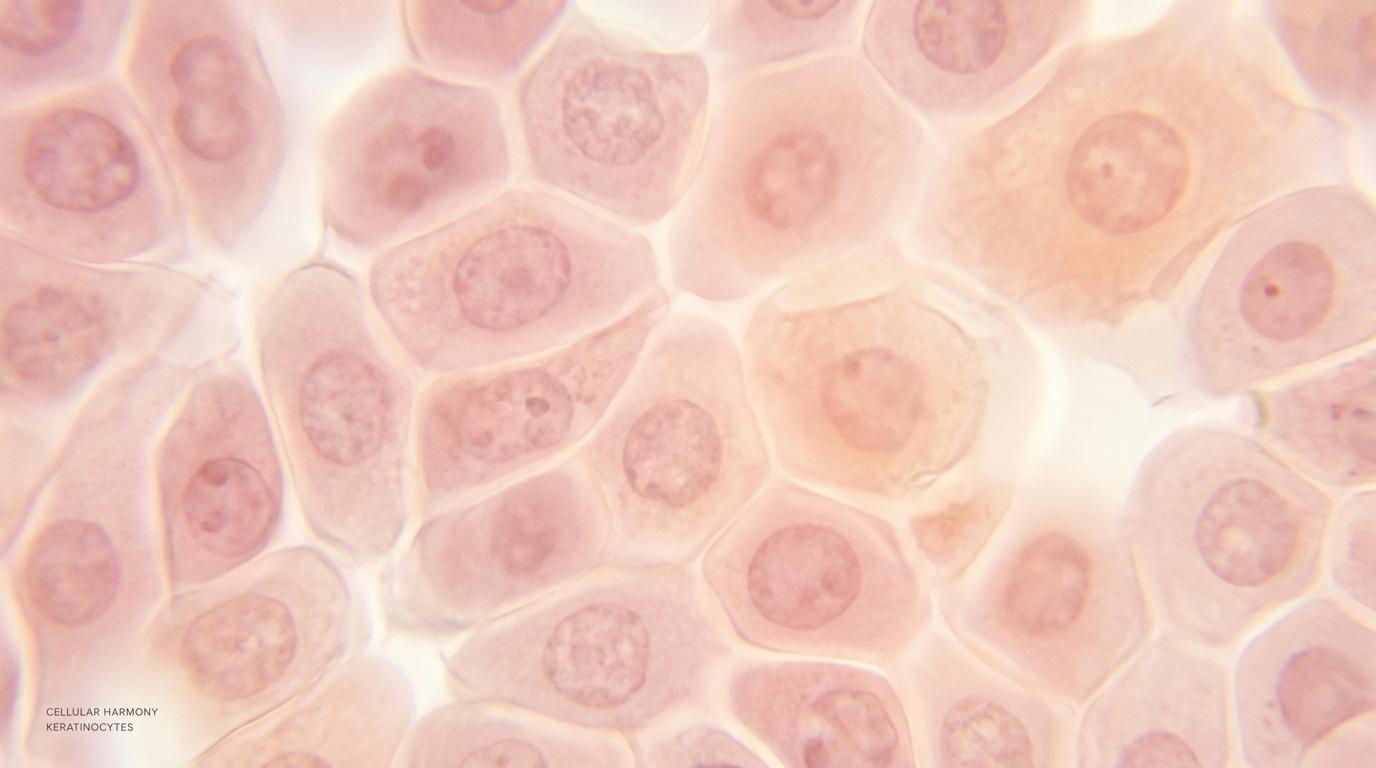
Right now, as you read this, millions of cells in your epidermis are undergoing a transformation that takes about a month to complete, a continuous cycle of birth, maturation, and sacrifice that keeps your skin barrier functioning. These cells are keratinocytes, and they make up roughly 90% of your epidermis. Understanding them is basically understanding your skin.
What Are Keratinocytes, Exactly?
Keratinocytes are specialized epithelial cells whose primary job is producing keratin, a fibrous structural protein that gives your skin its protective qualities. The name literally breaks down to “keratin-producing cells” (from Greek: keras meaning horn, and kytos meaning cell). They’re not glamorous, but they’re absolutely essential.
A 2019 study published in the Nature Reviews Molecular Cell Biology highlighted that keratinocytes don’t just produce keratin. They’re immunologically active, releasing cytokines and antimicrobial peptides that help defend against pathogens. Your skin isn’t just a passive barrier; it’s an active immune organ, and keratinocytes are central to that function.
The Life Cycle of a Keratinocyte
This is where it gets genuinely fascinating. Keratinocytes have a programmed life cycle that takes them from the deepest layer of the epidermis to the surface, where they eventually shed. The process is called keratinization or cornification, and it’s remarkably organized.
The epidermis has four main layers (five in thick skin like your palms and soles), and keratinocytes move through each one:
- Stratum basale (basal layer): This is where keratinocyte stem cells live and divide. New cells are constantly being produced here through mitosis.
- Stratum spinosum (spiny layer): Cells begin synthesizing large amounts of keratin. They’re connected by desmosomes, protein complexes that give this layer its spiny appearance under a microscope.
- Stratum granulosum (granular layer): Cells start accumulating keratohyalin granules and release lipids that will form the waterproof barrier. This is where they begin dying.
- Stratum corneum (horny layer): Fully keratinized, flattened dead cells called corneocytes. This is your actual skin surface, about 15-20 cell layers thick.
The entire journey from basal cell to shedding corneocyte takes approximately 28 days in healthy adult skin. This is why dermatologists often tell you to wait a month before judging whether a new skincare product is working. You’re literally waiting for a full cellular turnover.
From Base to Surface: What Actually Happens
The transformation keratinocytes undergo isn’t passive. It’s a form of programmed cell death, but different from apoptosis (the typical cell death pathway). Researchers call it cornification, and it involves specific molecular events.
In the basal layer, keratinocytes are metabolically active, with all the normal cellular machinery. They’re attached to the basement membrane by hemidesmosomes and receive nutrients from the dermis below. As they divide, daughter cells push upward.
Moving into the spinosum, cells start producing more keratin intermediate filaments, particularly keratins 1 and 10 (replacing the basal keratins 5 and 14). They also form tight connections with neighboring cells. This layer is metabolically active and several cells thick.
The granulosum is where things get dramatic. Cells release lamellar bodies containing lipids that create the hydrophobic barrier between living and dead skin layers. They also accumulate profilaggrin, which will later be processed into filaggrin, a protein critical for skin hydration. People with filaggrin mutations often have dry skin conditions like ichthyosis or eczema, which shows how important this protein is for maintaining moisture.
By the time cells reach the stratum corneum, they’ve lost their nuclei and organelles. They’re essentially protein-filled sacs surrounded by a specialized lipid matrix. The papillary dermis below provides the structural foundation that supports this entire process.
Why Keratinocyte Health Matters for Your Skin
When keratinocyte turnover is disrupted, you see it in your skin. Too slow, and you get dullness and buildup. Too fast (as in psoriasis, where the cycle compresses to about 4 days), and you get thick, scaly patches because cells don’t mature properly before reaching the surface.
Several factors influence keratinocyte function:
- UV radiation: Damages DNA in keratinocytes, which can lead to mutations and, in severe cases, skin cancer. Keratinocytes actually produce melanin-stimulating signals when UV-exposed, prompting melanocytes to produce more pigment.
- Chronic stress: Research has shown that stress hormones like cortisol can impair barrier function and slow wound healing. If you’ve noticed that stress shows on your face, disrupted keratinocyte function is part of why.
- Nutritional deficiencies: Keratinocytes need adequate protein, essential fatty acids, zinc, and vitamins A and C to function properly.
- Age: Keratinocyte turnover slows with age, from about 28 days in young adults to potentially 40-50 days in older individuals.
Supporting Your Keratinocytes Through Skincare
Given what we know about keratinocyte biology, certain skincare approaches make more sense than others.
Retinoids work in part by normalizing keratinocyte turnover. They bind to nuclear receptors that regulate gene expression, influencing how keratinocytes differentiate. This is why retinol is so effective for both anti-aging and acne.
Chemical exfoliants (AHAs and BHAs) help by loosening the bonds between corneocytes in the stratum corneum, promoting more regular shedding. This doesn’t speed up the entire keratinocyte life cycle, but it does prevent dead cell buildup.
Ceramides and fatty acids in moisturizers support the lipid matrix that keratinocytes deposit during cornification. If your barrier is compromised, replenishing these lipids externally can help while your keratinocytes catch up on production.
Niacinamide has been shown in multiple studies to increase ceramide synthesis in keratinocytes, improving barrier function. A 2000 study in the British Journal of Dermatology found that topical niacinamide improved skin barrier function in as little as four weeks.
The Bigger Picture
Your keratinocytes are constantly working, dividing, transforming, and eventually sacrificing themselves to form the protective barrier you see as your skin. When you look in the mirror, you’re seeing the end stage of a cellular process that started about a month ago in the deepest layer of your epidermis.
This understanding can inform your skincare choices. Products that support keratinocyte health, like retinoids for turnover regulation, barrier-supporting lipids, and gentle exfoliants, work with this natural process rather than against it. And patience becomes less frustrating when you understand that real changes in skin require waiting for at least one complete cellular cycle.
The humble keratinocyte might not get the attention that collagen or hyaluronic acid receives in skincare marketing, but it’s fundamentally what your skin is made of. Every improvement in texture, barrier function, or clarity involves these cells working as they should.