
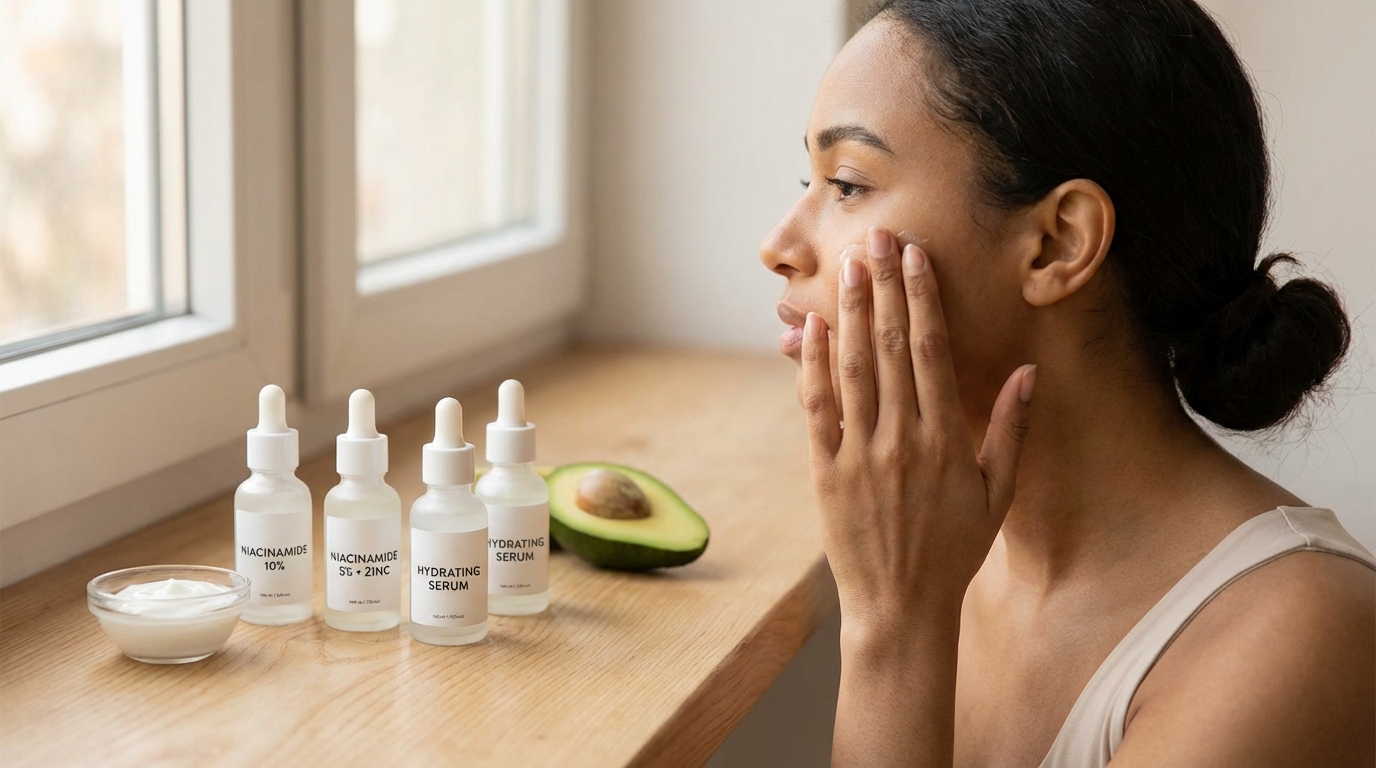
If you have scrolled through any skincare aisle recently, you have probably noticed niacinamide appearing on every other product. Serums, moisturizers, toners, even cleansers. Unlike most hyped ingredients that only work for specific skin types, niacinamide genuinely has something to offer nearly everyone. And as someone who spent years studying biochemistry before becoming obsessed with skincare, I find the science behind this ingredient genuinely fascinating.
Let me break down exactly what happens when niacinamide meets your skin cells, why it can help both oily and dry skin (yes, really), and how to use it effectively with your other products.
What Niacinamide Actually Does at the Cellular Level
Niacinamide is the active form of vitamin B3, also called nicotinamide. When you apply it topically, it gets absorbed into your skin and converted into NAD+ (nicotinamide adenine dinucleotide), a coenzyme that is essential for cellular energy production. Think of NAD+ as the cellular equivalent of charging your phone battery.
Here is where it gets interesting. According to research published in the Journal of Clinical and Aesthetic Dermatology, niacinamide influences multiple pathways simultaneously:
- Ceramide synthesis: It stimulates your skin’s production of ceramides, the lipids that form your skin’s protective barrier. More ceramides means better moisture retention and protection against environmental stressors.
- Keratinocyte differentiation: It helps your skin cells mature properly, which improves overall skin texture and function.
- Melanin transfer inhibition: It does not stop melanin production, but it does reduce how much melanin gets transferred to your skin’s surface. This can help with hyperpigmentation and uneven skin tone over time.
- Sebum regulation: It modulates sebaceous gland activity without completely shutting down oil production.
The multi-tasking nature of niacinamide is what makes it so universally useful. It is not targeting one specific issue. It is supporting fundamental cellular processes that benefit basically everyone.
Why It Works for Both Oily and Dry Skin
This seems counterintuitive at first. How can one ingredient help someone with an oil slick by noon AND someone with chronically parched skin? The answer lies in how niacinamide works differently depending on what your skin needs.
For oily skin, niacinamide has been shown to reduce sebum production. A 12-week study found that 2% topical niacinamide significantly decreased sebum excretion rate in participants with oily skin. It does not dry you out or cause the rebound oil production that harsh treatments can trigger. Instead, it helps regulate your sebaceous glands to produce a more appropriate amount of oil.
For dry skin, the benefit comes from that ceramide-boosting effect I mentioned earlier. Research in the Journal of the American Academy of Dermatology demonstrated that niacinamide increases ceramide and free fatty acid levels in the stratum corneum. Translation: it helps rebuild and strengthen your skin barrier, which means your skin holds onto moisture better.
Think of niacinamide as an adaptogen for your skin. It does not force your skin in one direction. It helps normalize function. If you are producing too much oil, it calms things down. If your barrier is compromised, it helps repair it.
The Concentration Debate: Do You Need 10% or Will 2% Work?
Walk into any beauty store and you will see niacinamide products ranging from 2% to 20% concentration. More must be better, right? Not necessarily.
Most clinical studies showing significant benefits used concentrations between 2% and 5%. The International Journal of Cosmetic Science published research showing that 2% niacinamide produced measurable improvements in skin barrier function and reduced transepidermal water loss.
Higher concentrations like 10% are not dangerous, but they do not necessarily work proportionally better. Some people do well with higher percentages, while others experience flushing, irritation, or even breakouts. This is likely because niacinamide at very high concentrations can sometimes convert to niacin (nicotinic acid) on the skin, which causes that familiar flush feeling.
My honest recommendation: start with something in the 4-5% range. This is the sweet spot where most people see real results without irritation. If your skin tolerates it well and you want to try higher concentrations, go ahead. But do not assume that jumping straight to 10% will give you faster or better results. Skincare is not always linear like that.
Also worth noting: the formulation matters as much as the percentage. A well-formulated 5% product will likely outperform a poorly made 10% product. Look for stable formulations that combine niacinamide with other supportive ingredients like zinc (great for oily skin), hyaluronic acid (for hydration), or peptides.
Layering Niacinamide with Other Actives
One of the best things about niacinamide is how well it plays with other ingredients. Unlike some actives that are notoriously picky about their partners (I am looking at you, vitamin C and retinol), niacinamide is genuinely compatible with most skincare ingredients.
With retinoids: This is actually a fantastic combination. Niacinamide can help offset some of the irritation and dryness that retinoids cause, while the retinoid handles cell turnover and collagen stimulation. Use niacinamide in the morning and retinol at night, or layer them in the same routine if your skin can handle it.
With vitamin C: There is an old rumor that these two should not be combined because they cancel each other out or cause irritation. Modern formulation chemistry has largely debunked this. The concern was based on studies using unstable forms of vitamin C at high temperatures. In real-world use with properly formulated products, these ingredients can be used together without issues.
With AHAs and BHAs: Niacinamide can actually help calm skin after acid exfoliation. Apply your acid product first, wait a few minutes, then follow with niacinamide. The pH difference is not significant enough to cause problems in most formulations.
With hyaluronic acid: These two are best friends. Apply hyaluronic acid to damp skin, then follow with niacinamide. The HA pulls moisture in while the niacinamide helps your skin hold onto it by strengthening the barrier.
The main thing to watch for when layering is irritation. If you are using multiple active ingredients and your skin starts getting red, tight, or sensitive, it is probably too much, not a specific ingredient incompatibility. Scale back and introduce products one at a time.
Getting Started with Niacinamide
If you are new to niacinamide, here is my practical advice: pick one product with niacinamide in the 4-5% range and use it consistently for 8-12 weeks before evaluating results. Skincare changes at the cellular level take time to become visible.
You can use niacinamide morning and night. It is not photosensitizing, so daytime use is perfectly fine. In fact, some research suggests it may help protect against some UV-induced damage (though it is absolutely not a substitute for sunscreen).
Watch your ingredient lists. Niacinamide is showing up everywhere now, so you might already be using it without realizing it. Check your moisturizer, your serum, even your eye cream. Using multiple products with niacinamide is not necessarily bad, but be aware of your total exposure, especially if you start experiencing any irritation.
The reason niacinamide has become so popular is not marketing hype. It is because the ingredient genuinely works across skin types and concerns, backed by decades of research. It is not flashy, it will not transform your skin overnight, but it will quietly support your skin’s natural function in ways that add up over time. Sometimes the best ingredients are the ones that just do their job without drama.