
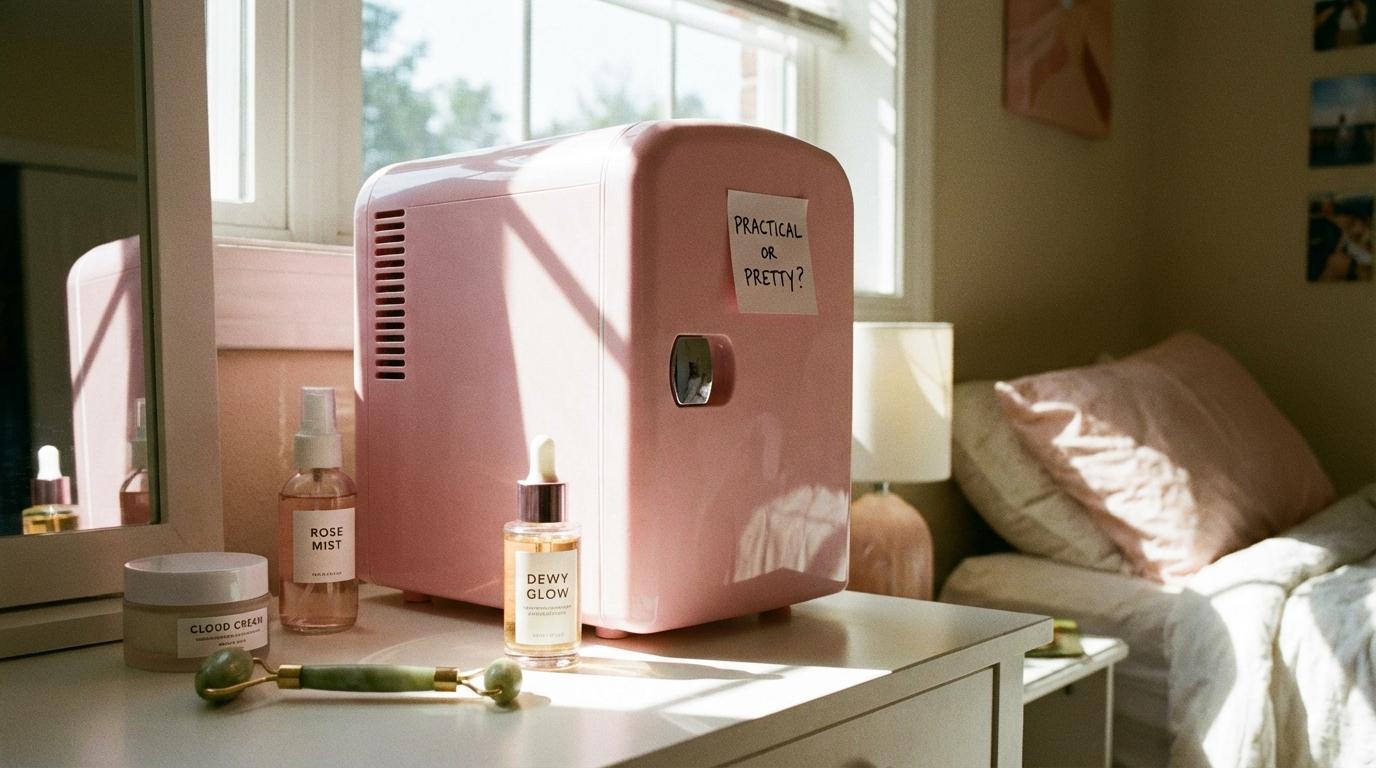
The skincare fridge has become one of those aspirational objects that seems to live permanently in your Instagram feed, nestled between someone’s shelfie and their morning smoothie bowl. These adorable little appliances, often in pastel pink or mint green, promise to take your routine to the next level while looking impossibly cute on your bathroom counter. But before you add one to your cart, it’s worth asking whether cold storage actually benefits your products or if this is simply another case of aesthetic over substance.
Understanding What Cold Actually Does to Skincare
Temperature affects skincare formulations in a few meaningful ways, though perhaps not as dramatically as marketing would have you believe. When certain products are kept cool, they can provide a pleasant sensory experience upon application. There’s something genuinely nice about putting a cold eye cream on puffy morning eyes or applying a chilled sheet mask after a long day. The cooling sensation can temporarily help reduce the appearance of puffiness by constricting blood vessels, and it simply feels soothing on irritated or warm skin.
Beyond the sensory aspect, some ingredients are genuinely more stable at lower temperatures. Vitamin C serums, particularly those formulated with L-ascorbic acid, are notoriously unstable and can oxidize when exposed to heat and light. Refrigeration can slow down this oxidation process, potentially extending the life of your serum by a few weeks. Similarly, certain natural or preservative-free formulations may genuinely benefit from cold storage because cooler temperatures inhibit bacterial growth.
That said, most commercially formulated skincare products are designed to be shelf-stable at room temperature. Cosmetic chemists spend considerable time ensuring that their formulations remain effective and safe when stored under normal conditions. The preservative systems, packaging choices, and stabilizers in your products are specifically chosen to keep them working properly in your bathroom cabinet.
Products That Actually Benefit from Refrigeration
While the list of products that truly need refrigeration is shorter than social media might suggest, there are genuine cases where cold storage makes sense.
Eye creams and gels often benefit from refrigeration, though not because of stability concerns. The cooling sensation can help with morning puffiness, and the cold temperature may enhance the soothing effects of ingredients like caffeine or cucumber extract. If you struggle with under-eye bags, keeping your eye product in the fridge creates a mini treatment moment each morning. This is similar to the old trick of keeping spoons in the freezer to press against puffy eyes, just slightly more elegant.
Vitamin C serums, as mentioned, can benefit from cold storage if you want to maximize their lifespan. Pure L-ascorbic acid formulations are particularly prone to oxidation, turning from clear to yellow to brown as they degrade. While refrigeration won’t stop this process entirely, it can slow it down meaningfully. If you tend to use vitamin C serums slowly or have noticed yours changing color before you finish the bottle, the fridge might be worth considering. For more on how different ingredients behave over time, understanding ingredient stability can help you make better choices about storage.
Natural, organic, or preservative-free products often have shorter shelf lives and may genuinely need refrigeration. If you’ve purchased something from a small-batch brand or made your own skincare, cold storage becomes more important because these products lack the robust preservative systems of mainstream formulations. The same applies to certain facial oils, particularly those high in omega fatty acids that can go rancid when exposed to heat.
Sheet masks are perhaps the most satisfying products to refrigerate. There’s no stability benefit here, just pure enjoyment. A cold sheet mask on a hot day or after a workout is genuinely refreshing, and the cooling effect can help calm inflammation and redness temporarily. If you enjoy the ritual aspect of skincare, this is one of those small pleasures that costs nothing and harms nothing.
Certain tools also benefit from cold storage. Jade rollers, gua sha stones, and metal eye massagers all feel more effective when chilled, as the cold temperature enhances their ability to temporarily reduce puffiness. If you use these tools as part of your morning routine, keeping them in a skincare fridge or regular refrigerator makes them more functional.
Products That Get Damaged by Cold
This is where things get important, because refrigerating certain products can actually ruin them.
Oil-based products can become cloudy or thicken when stored in cold temperatures. While this typically doesn’t affect their efficacy, it can change their texture and make them less pleasant to apply. Some oils may even separate or crystallize in the cold, though they usually return to normal once warmed. If you love your facial oil and don’t want to wait for it to warm up each morning, keep it out of the fridge.
Clay masks and thick cream masks often don’t fare well in cold storage. The temperature can cause them to harden, separate, or change texture in ways that affect their application. These products are formulated to be stored at room temperature, and chilling them offers no real benefit while potentially causing problems.
Emulsions and creamy products can sometimes separate or become grainy when refrigerated. The cold can affect the delicate balance of oil and water in these formulations, potentially breaking the emulsion and leaving you with a product that no longer applies smoothly. This is particularly true for lighter moisturizers and lotions.
Sunscreens should generally stay out of the fridge. Both chemical and mineral sunscreens are formulated to be stable at room temperature, and cold storage can potentially affect their texture and, more importantly, their even distribution of UV filters. You want your sunscreen working optimally, so there’s no reason to experiment with cold storage here.
Retinol products, while light-sensitive, don’t necessarily need refrigeration. Most retinol formulations are packaged in opaque, airless containers specifically to protect them from light and oxidation. These products are designed to remain stable at room temperature, and unless the manufacturer specifically recommends refrigeration, your retinol is fine on your shelf. Understanding when to give your skin a break from actives matters more than where you store them.
The Honest Case For and Against a Skincare Fridge
A dedicated skincare fridge makes sense if you genuinely enjoy the sensory experience of cold products and have the space and budget for one. The ritual aspect of skincare matters, and if opening your little pink fridge each morning brings you joy, that’s a valid reason to own one. Skincare should feel like self-care, not a chore, and small pleasures add up.
It also makes sense if you regularly use products that benefit from cold storage, such as vitamin C serums, natural formulations, or sheet masks. If you’ve found that your products oxidize or go off before you finish them, refrigeration might save you money in the long run by extending their usable life.
However, a skincare fridge is unnecessary if you’re mainly using shelf-stable commercial products, your bathroom stays reasonably cool, and you finish your products within normal timeframes. Most products simply don’t need refrigeration, and the cute factor alone might not justify the cost and counter space for everyone.
There’s also the question of whether the marketing around skincare fridges has created a solution in search of a problem. The skincare industry excels at making us feel like we need more, more products, more steps, more accessories. Sometimes the most powerful thing we can do is recognize that our simple routine is actually enough. Taking a minimalist approach to skincare often yields better results than adding complexity.
DIY Cold Storage Solutions That Work Just as Well
If you want to try refrigerating some of your products without investing in a dedicated fridge, there are simpler options that work just as effectively.
Your regular refrigerator works perfectly for skincare storage. The main concern people have is keeping skincare away from food, but a small designated container or basket can solve this easily. A clear plastic organizer on a refrigerator shelf keeps your products contained and visible, and it costs a fraction of what a skincare fridge would. Some people worry about contamination, but as long as your products are properly sealed (which they should be anyway), there’s no real risk.
A small cooler with a reusable ice pack is another option if you don’t want your skincare mingling with your groceries. You can keep this in your bathroom and refresh the ice pack as needed. It’s not as convenient as a powered fridge, but it works for sheet masks and tools that you want cold rather than cold-stored.
For tools like jade rollers and gua sha stones, simply keeping them in your regular freezer for a few minutes before use gives you the same cooling effect without needing any special equipment. The metal eye massagers that have become popular work the same way, and some people even use the back of a cold spoon for the same effect.
If vitamin C oxidation is your main concern, buying smaller sizes of serum and storing them in a cool, dark place (like a medicine cabinet or drawer) often works just as well as refrigeration. You can also look for more stable vitamin C derivatives like sodium ascorbyl phosphate or ascorbyl tetraisopalmitate, which don’t oxidize as quickly and don’t require special storage.
What the Research Actually Says
Scientific literature on skincare refrigeration is limited because most cosmetic stability testing focuses on shelf life at room temperature. Products undergo accelerated stability testing at various temperatures before hitting the market, and manufacturers are required to ensure their products remain safe and effective under expected storage conditions.
According to the FDA’s guidance on cosmetic shelf life, most products are formulated to remain stable for one to three years when stored at room temperature away from direct heat and sunlight. Refrigeration isn’t typically necessary for products that follow these standard formulation guidelines.
Research from cosmetic science journals indicates that while some active ingredients like vitamin C do degrade faster at higher temperatures, the difference between room temperature storage and refrigeration is often less dramatic than marketing suggests. A well-formulated product in appropriate packaging can remain stable for its expected shelf life without special storage requirements.
The Personal Care Products Council notes that cosmetic products undergo rigorous testing to ensure they remain safe and effective throughout their intended use period. This testing assumes normal storage conditions, not refrigerated ones.
Making the Right Choice for Your Routine
The decision about whether to refrigerate your skincare ultimately comes down to your personal preferences, product choices, and what brings you joy in your routine.
If you find yourself regularly throwing away oxidized vitamin C serums, using natural products with short shelf lives, or simply loving the feeling of cold products on your skin, some form of cold storage might add genuine value to your routine. You don’t necessarily need a dedicated skincare fridge for this, but if having one makes your routine feel more special and you have the space, there’s nothing wrong with that choice.
If your routine consists mainly of stable commercial products, you finish your products within normal timeframes, and the sensory experience of cold products doesn’t appeal to you, refrigeration probably isn’t necessary. Your products are designed to work just fine at room temperature, and adding complexity to your storage situation offers no real benefit.
The most important thing, as always, is to actually use your products consistently rather than worrying too much about optimizing their storage. A vitamin C serum that lives in your refrigerator but gets forgotten about is less effective than one that sits on your counter and gets used every morning. A sheet mask that’s perfectly chilled but stays in the fridge indefinitely isn’t doing anything for your skin.
Products like vitamin C serums and natural formulations may benefit from cooler temperatures, while most other products in your routine are perfectly happy at room temperature. Focus on what works for your actual habits and preferences rather than what looks aesthetically pleasing for social media.
Ultimately, a skincare fridge is a nice-to-have rather than a need-to-have. It can enhance certain aspects of your routine and bring a bit of joy to your mornings, but it won’t transform your skin on its own. The products inside the fridge matter far more than the fridge itself, and the consistency with which you use them matters most of all. Sometimes the simplest approach is still the best one.