
Your skin at 40 is not the same organ it was at 25. This is not a value judgment, just biology. The changes happening at the cellular level mean that what worked for your skin a decade ago may not work as well now, and some adjustments can make a genuine difference in how your skin looks and feels.
As someone who studied biochemistry before getting into skincare writing, I find these changes fascinating. Understanding why your skin is changing helps you make smarter decisions about what to put on it. So let me break down what is actually happening and how to respond intelligently.
What Changes After 40 (The Science)
Several key processes slow down as we move through our 40s. Collagen production, which keeps skin firm and plump, decreases by about 1% per year starting in your mid-20s. By 40, you have already lost roughly 15-20% of your collagen, and that rate can accelerate, especially after menopause. The National Library of Medicine has documented this extensively.
Your skin also produces less sebum (natural oil) and hyaluronic acid (which holds water in your skin). This is why skin that was once oily might feel drier or more balanced, and why hydration becomes non-negotiable rather than optional.
Cell turnover slows too. In your 20s, your skin cells renew approximately every 28 days. By 40, that cycle extends to 40-50 days. Dead cells linger on the surface longer, which can make skin look dull and interfere with product absorption.
Estrogen levels also begin declining, particularly during perimenopause and menopause. Estrogen supports skin thickness, elasticity, and moisture retention. As it decreases, skin becomes thinner and more vulnerable to damage.
Hydration Becomes Your Foundation
If there is one thing to prioritize after 40, it is hydration. Not just moisturizing (applying something that prevents water loss) but actually pulling water into your skin and keeping it there.
Hyaluronic acid serums have become popular for good reason. This molecule can hold up to 1000 times its weight in water. Applied to damp skin and sealed with a moisturizer, it helps compensate for the hyaluronic acid your body produces less of naturally. La Roche-Posay’s Hyalu B5 serum is one option, but many drugstore versions work just as well.
Look for moisturizers with ceramides. Ceramides are lipids that naturally occur in your skin barrier, and they decrease with age. Products that replace them help your skin hold onto moisture more effectively. CeraVe built their entire line around this ingredient, and it shows.
Adding a facial oil in the evening can also help. Your skin produces less sebum now, and a few drops of a gentle oil (rosehip, squalane, or jojoba) can supplement what your skin no longer makes on its own. Apply it after your moisturizer to lock everything in.
Gentle Actives: Less Irritation, More Results
Here is where many people go wrong. They assume that mature skin needs aggressive treatments to see results. The opposite is true. As skin thins and becomes more sensitive, gentler formulations often work better and cause fewer problems.
Retinoids remain the gold standard for anti-aging, but the approach should shift. If you have been using tretinoin (prescription retinoid) without issues, you can likely continue. But if you are new to retinoids or finding that your current strength is causing irritation, consider scaling back.
Start with a low-strength retinol (0.25% or 0.5%) or look for retinaldehyde, which sits between retinol and tretinoin in terms of effectiveness and tends to be better tolerated. Apply it two or three times a week rather than nightly, and always buffer with moisturizer if needed.
For exfoliation, swap harsh scrubs for gentle chemical exfoliants. Lactic acid is especially good for mature skin because it hydrates while it exfoliates. The Paula’s Choice website has helpful information about which acids work for different skin concerns.
Vitamin C remains valuable for brightening and supporting collagen, but consider gentler forms like sodium ascorbyl phosphate or ascorbyl glucoside if L-ascorbic acid irritates your skin. These derivatives are less potent but also less likely to cause sensitivity.
Do Not Forget Your Neck and Chest
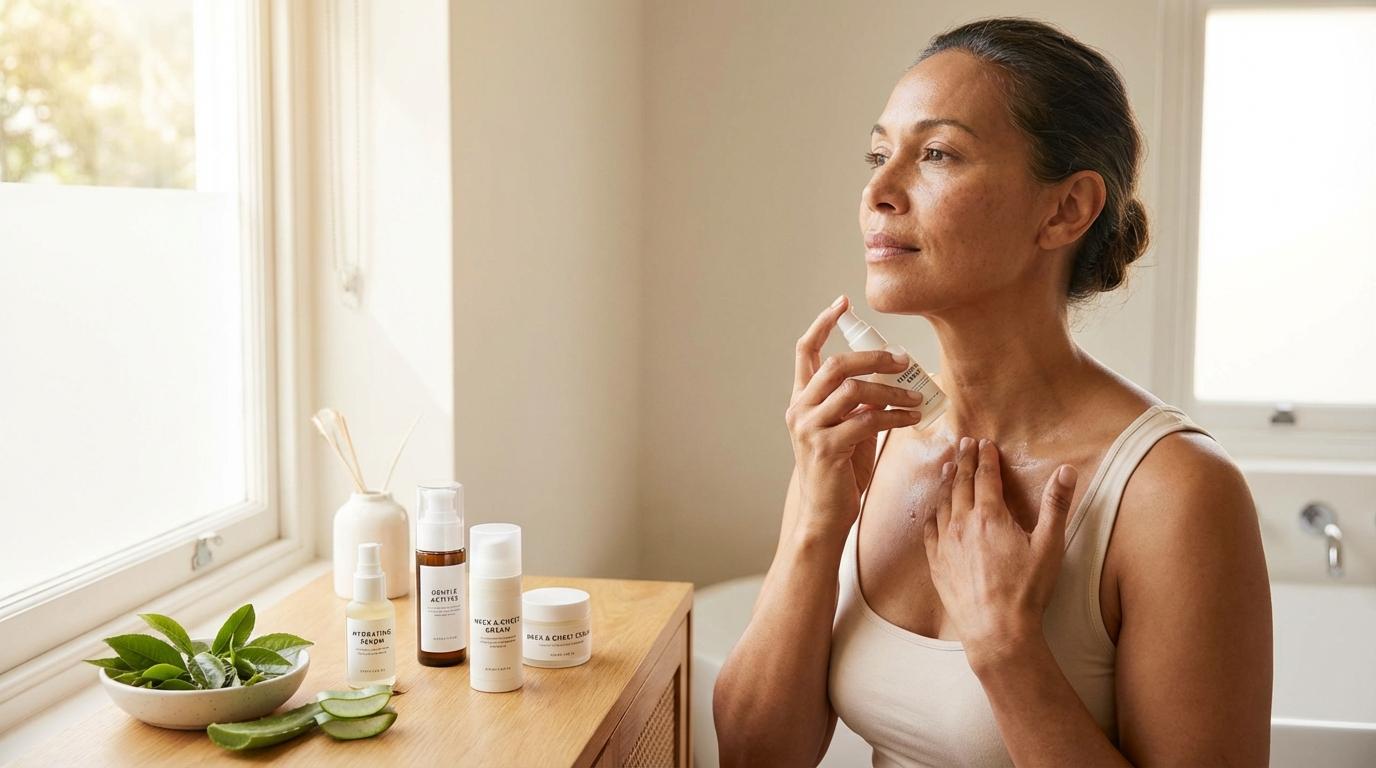
The skin on your neck and chest (often called the “decolletage”) is thinner than your face and shows age just as readily, sometimes more so. Yet most of us stop our skincare at the jawline.
Everything you apply to your face should extend down your neck to your collarbone. Cleanser, serum, moisturizer, sunscreen, all of it. The skin in these areas has fewer oil glands and is often exposed to sun without protection, which means it may actually need more attention than your face.
If your neck and chest already show sun damage or crepey texture, they can benefit from retinoids too. Start gently (even more gently than your face) since this skin is especially delicate. Two or three times a week with a low-strength formula is enough to start.
The backs of your hands are another often-neglected area. Apply sunscreen there daily. Age spots on the hands are purely sun damage, and they are preventable.
Ingredients That Actually Help
Let me cut through the marketing noise and tell you which ingredients have solid research behind them for mature skin:
Niacinamide (vitamin B3) strengthens the skin barrier, improves uneven tone, and minimizes the appearance of pores. It is gentle enough to use twice daily and plays well with most other ingredients. Studies in the International Journal of Cosmetic Science support its effectiveness for aging skin.
Peptides are short chains of amino acids that can signal your skin to produce more collagen. They are not as powerful as retinoids, but they are gentler and can be a good option if you cannot tolerate retinoids. Look for copper peptides, matrixyl, or argireline in ingredient lists.
Squalane is a lipid that naturally occurs in your skin’s sebum. As we produce less sebum with age, supplementing with squalane helps maintain hydration and suppleness without feeling greasy.
Ceramides (mentioned earlier) repair and reinforce the skin barrier. They are particularly important for mature skin that may struggle to retain moisture.
Antioxidants like vitamin C, vitamin E, and ferulic acid protect against environmental damage that accelerates aging. A good antioxidant serum in the morning, under your sunscreen, gives your skin an extra layer of defense.
Sunscreen Is Still Non-Negotiable
I mention this because it cannot be overstated. UV exposure accounts for the majority of visible skin aging. If you were lax about sunscreen in your 20s and 30s, now is the time to get serious.
Choose SPF 30 or higher, broad-spectrum, and apply it every morning regardless of weather or whether you plan to go outside. Windows do not block UVA rays. If you are concerned about white cast or heaviness, newer formulations (especially those from Asian brands like Biore) offer lightweight, elegant options.
Reapply every two hours if you are spending significant time outdoors. Yes, even if you are wearing makeup. Powder sunscreens make reapplication easier.
Simplicity Still Works
Despite everything I have outlined, your routine does not need to become complicated. A well-chosen cleanser, hydrating serum, moisturizer with ceramides, sunscreen in the morning, and retinoid a few nights a week covers the essentials.
The best routine is one you will actually follow consistently. Adding more products does not automatically mean better results, especially if you cannot keep up with it or if layering too much causes irritation.
Listen to your skin. It will tell you what it needs through dryness, sensitivity, or how it looks in the morning. Adjust accordingly. And remember that taking care of your skin at 40, 50, and beyond is not about chasing youth. It is about supporting the skin you have now so it stays healthy and comfortable for decades to come.