
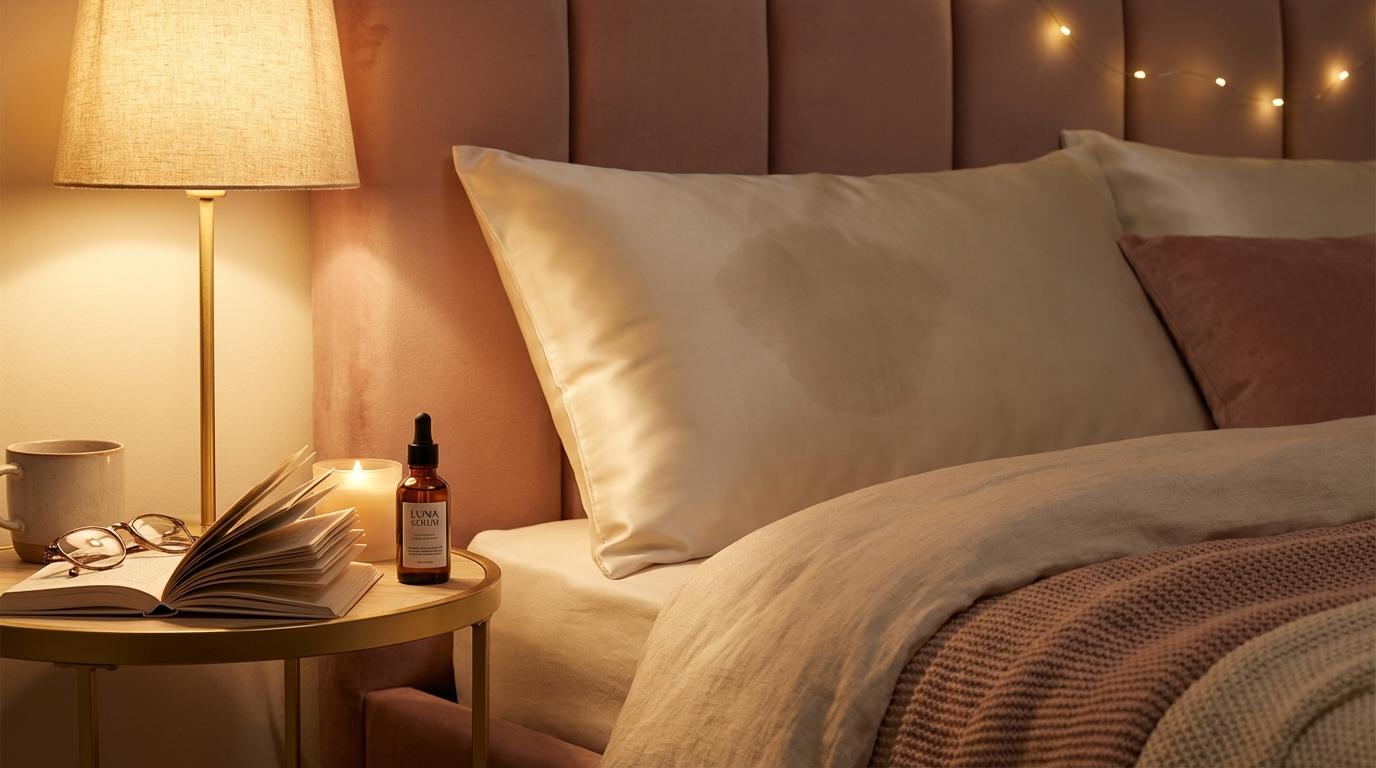
Staphylococcus aureus, the bacterium most commonly associated with skin infections, thrives in warm and moist environments. When you go to bed with wet hair, you are essentially creating the ideal breeding ground right next to your face. The moisture from your hair transfers to your pillowcase, and over the course of a night, that damp fabric becomes a reservoir for bacterial growth that presses directly against your cheeks, jawline, and forehead.
This might sound dramatic, but the connection between sleeping on a damp pillow and waking up with new breakouts is grounded in straightforward microbiology. If you have been struggling with persistent acne along the sides of your face or your jawline, your nighttime hair habits could be a contributing factor worth examining.
What Happens on a Damp Pillowcase
Your pillowcase already collects sebum, dead skin cells, and traces of skincare products throughout the night. Adding moisture from wet hair accelerates the rate at which bacteria and fungi can multiply in that environment. Cotton pillowcases, which most people use, are especially absorbent and retain moisture for hours.
A study published in the journal Applied and Environmental Microbiology demonstrated that textile surfaces maintain bacterial viability significantly longer when moisture is present. In practical terms, this means that a pillowcase dampened by wet hair at 10 PM may still be hosting active bacterial colonies at 3 AM when you roll over onto it.
The species that tend to proliferate in these conditions include Staphylococcus, Propionibacterium (now reclassified as Cutibacterium acnes), and various fungal organisms like Malassezia. Each of these can contribute to inflammatory acne or fungal acne in their own way.
Product Transfer: A Less Obvious Problem
Beyond bacteria, there is a second mechanism at play. When your hair is wet, any product residue, whether from conditioner, leave-in treatments, or styling products, becomes mobile. Water acts as a solvent and a vehicle, carrying these product ingredients from your hair onto the pillowcase and then onto your skin.
Many hair conditioners contain ingredients like silicones, fatty alcohols, and oils that are comedogenic when they come into prolonged contact with facial skin. Dermstore has catalogued several common comedogenic ingredients found in hair products, and many of them are staples in conditioner formulations.
During the day, brief contact between your hair and face is unlikely to cause problems because the exposure time is short and your skin’s natural defenses are active. At night, however, your face is pressed against a surface coated with these transferred products for six to eight hours. That prolonged exposure gives comedogenic ingredients ample time to settle into pores and trigger the inflammatory cascade that produces a breakout.
The Jawline and Cheek Connection
If your acne is concentrated along the jawline, lower cheeks, or temples, it is worth considering whether external factors like pillowcase hygiene are involved. Dermatologists sometimes refer to this pattern as “acne mechanica” when it results from friction and pressure, though in the case of wet-hair-related breakouts, the mechanism is more accurately described as a combination of microbial transfer and comedogenic product exposure.
The distribution pattern makes sense anatomically. When you sleep on your side, your cheek and jaw bear the most contact with the pillow surface. These are exactly the areas where wet-hair-related acne tends to appear. If you notice that breakouts are worse on the side you typically sleep on, this asymmetry is a strong indicator that your pillow environment is playing a role.
What the Research Tells Us About Pillow Hygiene
A frequently cited recommendation from dermatologists is to change your pillowcase every two to three days. This advice becomes even more important if you are sleeping with damp hair. The moisture essentially compresses what might be a week’s worth of bacterial growth into a single night.
Some dermatologists, including Dr. Shereene Idriss, have discussed on their YouTube channels how overlooked pillow hygiene can be as a contributor to persistent breakouts. The advice is consistent across practitioners: manage what touches your face at night.
Practical Solutions
The simplest solution is, of course, to let your hair dry completely before going to bed. But if you are someone who washes your hair in the evening and does not have time (or energy) to blow-dry, there are several practical workarounds.
- Use a microfiber hair towel or wrap. These absorb significantly more moisture than a regular towel and can get your hair to a mostly-dry state in 15 to 20 minutes while you do your skincare routine.
- Switch to a silk or satin pillowcase. These fabrics are less absorbent than cotton, meaning less moisture transfer and less bacterial accumulation. They also create less friction against the skin.
- Keep a dedicated “hair night” pillowcase. If you must sleep with damp hair, lay a clean towel over your pillow or use a designated pillowcase that you swap out every time.
- Tie hair up and away from your face. A loose bun or braid on top of your head minimizes the surface area of contact between wet hair and your pillowcase near your face.
- Rinse out conditioner thoroughly. Residue from conditioner is one of the primary culprits in product-transfer breakouts. Spend extra time rinsing, especially at the nape and near your hairline.
When Fungal Acne Enters the Picture
Malassezia, the yeast responsible for fungal acne (pityrosporum folliculitis), particularly enjoys warm, humid environments. If your breakouts appear as uniform small bumps that are itchy rather than painful, and they cluster on your forehead or along your hairline, the damp pillow environment may be feeding a fungal issue rather than a bacterial one.
Fungal acne does not respond to typical acne treatments like benzoyl peroxide or salicylic acid. If you suspect this is what you are dealing with, the pillow hygiene steps above become even more critical, and you may want to consider an antifungal approach. Your skin barrier plays an important protective role here as well, since a compromised barrier is more susceptible to fungal overgrowth.
A Note on Hair Type and Drying Time
It is important to acknowledge that hair drying time varies enormously depending on hair type, thickness, and texture. For people with thick, curly, or coily hair, air-drying can take several hours, making the “just dry your hair first” advice impractical at best. In these cases, the protective strategies listed above, particularly the satin pillowcase and hair-up methods, become the realistic primary interventions rather than alternatives.
The goal is not to add stress or another step to an already full nighttime routine. It is to identify a potential trigger and manage it with the least amount of effort possible. Sometimes, something as simple as switching a pillowcase fabric or adjusting how you position your hair at night can reduce the bacterial and product load on your skin enough to make a visible difference in your breakouts.