
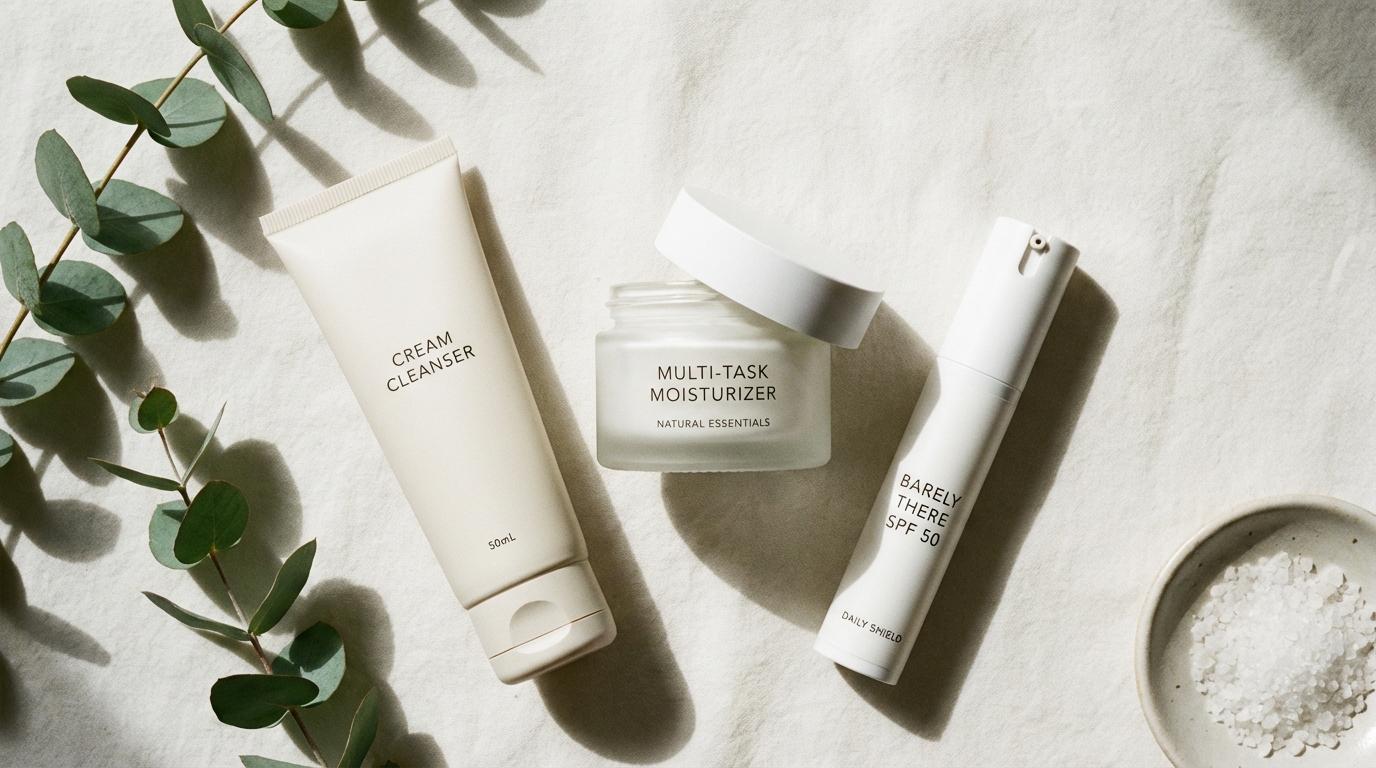
Bathroom counters across the world are cluttered with half-empty bottles, forgotten serums, and products that promised transformation but delivered confusion. The skincare industry has spent decades convincing us that more steps equal better skin, that every concern requires its own dedicated treatment, that a truly effective routine needs to be complicated. But there is another way to approach caring for your skin, one that honors both your time and your barrier function, and it only requires three thoughtfully chosen products.
The beauty of a minimal routine is not just about simplicity for its own sake. When you strip away the excess, you create space to actually notice how your skin responds to what you are using. You reduce the risk of irritation from layering too many active ingredients. You save money, bathroom space, and those precious morning minutes that could be spent enjoying your coffee or stretching before work. Most importantly, you give your skin permission to do what it naturally does well, which is maintain and repair itself when given the right support.
Your First Essential: A Cleanser That Respects Your Barrier
The foundation of any skincare routine, minimal or extensive, begins with how you cleanse. This step sets the tone for everything that follows, and choosing the wrong cleanser can undermine even the most expensive products you apply afterward. The goal is to remove dirt, excess oil, makeup, and environmental debris without stripping away the protective lipids that keep your skin healthy and resilient.
A gentle, pH-balanced cleanser is your best friend here. Look for formulas that leave your skin feeling clean but not tight, refreshed but not parched. The American Academy of Dermatology recommends washing your face no more than twice daily and using lukewarm water rather than hot, which can further compromise your skin barrier.
Cream and milk cleansers tend to work beautifully for those with dry or sensitive skin, while gel cleansers can be ideal for oilier skin types. The key is finding something you enjoy using, something that feels like a small ritual rather than a chore. When cleansing becomes pleasant, consistency follows naturally.
Avoid cleansers with high concentrations of sulfates like sodium lauryl sulfate, which can be overly stripping. Instead, look for gentler surfactants or consider cleansing balms and oils if your skin tends toward dryness. Double cleansing, where you use an oil-based cleanser followed by a water-based one, is wonderful for removing heavy makeup but is not necessary for everyone. Listen to what your skin tells you.
Your Second Essential: A Moisturizer That Multi-Tasks
Here is where the magic of minimalism really shines. Instead of layering a hydrating toner, an essence, a serum, an ampoule, and then a moisturizer, you can find a single product that accomplishes multiple goals. Modern formulations have become incredibly sophisticated, and many moisturizers now include ingredients that were once reserved for treatment products.
Look for a moisturizer that contains both humectants and occlusives. Humectants like hyaluronic acid, glycerin, and panthenol draw moisture into the skin, while occlusives like squalane, shea butter, and ceramides help seal that moisture in. This combination ensures your skin stays hydrated throughout the day without feeling heavy or greasy.
If you want to address specific concerns like fine lines, uneven texture, or dullness, seek out moisturizers that include gentle actives. Niacinamide is a wonderful all-rounder that helps with pore appearance, oil regulation, and overall skin tone. Research has shown that peptides can support collagen production over time. Low concentrations of retinol can provide anti-aging benefits without requiring a separate treatment step.
The texture of your moisturizer matters too. Those with oily skin might prefer lightweight gel creams or water-based formulas, while those with dry skin often thrive with richer creams and balms. There is no single correct answer here, only what works for your unique skin in your particular climate and lifestyle. In winter, you might reach for something heavier. In summer, something lighter. This flexibility is another gift of keeping your routine simple.
Your Third Essential: SPF That Feels Like Nothing
If there is one product that dermatologists universally agree upon, it is sunscreen. The Skin Cancer Foundation emphasizes that daily sunscreen use is one of the most effective ways to prevent premature aging and protect against skin cancer. But for many people, sunscreen has historically been the hardest step to embrace because of unpleasant textures, white casts, or that heavy, greasy feeling.
The good news is that sunscreen formulations have improved dramatically. There are now SPF products that feel genuinely weightless, that sink into the skin without leaving any residue, that work beautifully under makeup or as the final step of your morning routine. Finding the right one for you might take some experimentation, but when you discover your perfect match, applying it becomes second nature.
Look for broad-spectrum protection of at least SPF 30 for daily use. If you spend extended time outdoors, SPF 50 offers additional protection. Chemical sunscreens with ingredients like avobenzone, homosalate, and octinoxate tend to feel lighter and more cosmetically elegant. Mineral sunscreens with zinc oxide and titanium dioxide sit on top of the skin and reflect UV rays, which some people prefer, especially those with sensitive or reactive skin.
Tinted sunscreens can be particularly lovely because the iron oxides in the tint provide additional protection against visible light, which can contribute to hyperpigmentation, especially in deeper skin tones. Many people find that a good tinted SPF replaces their need for foundation entirely, further simplifying their routine. Studies have demonstrated the benefits of iron oxide for protecting against visible light damage.
Why More Is Not Better
The ten-step skincare routine became popular partly because it was novel and exciting, and partly because it generated enormous profits for the beauty industry. Each new step represented another product to purchase, another promise to believe in. But dermatologists have long cautioned against over-complicating skincare, noting that too many products, especially those with active ingredients, can lead to irritation, sensitization, and compromised barrier function.
Your skin barrier is like a protective wall made of skin cells held together by lipids. When you apply too many products, especially those that contain acids, retinoids, or other actives, you risk breaking down that wall. The result can be redness, sensitivity, breakouts, and skin that seems to react to everything. Simplifying your routine gives your barrier a chance to repair and strengthen itself.
There is also something to be said for the mental clarity that comes with having fewer choices. Decision fatigue is real, and facing a crowded medicine cabinet every morning and night can feel overwhelming. When you have just three products you trust and enjoy using, your skincare routine becomes a small moment of peace rather than a complicated obligation.
Making This Routine Your Own
The three-product framework is flexible enough to accommodate almost everyone. If you have acne-prone skin, you might choose a cleanser with salicylic acid and a moisturizer with niacinamide. If anti-aging is your focus, perhaps a cleanser with gentle exfoliating properties and a moisturizer with retinol and peptides. If hydration is your primary concern, a cream cleanser and a rich barrier-supporting moisturizer would serve you well.
The key is understanding your skin’s primary needs and selecting products that address them without overwhelming your routine with redundancy. One good cleanser that suits your skin type. One multi-tasking moisturizer that hydrates and treats. One sunscreen that you actually want to wear. That is the entire foundation.
Of course, there may be times when you want to add something extra. A treatment for an occasional breakout. A mask for a bit of self-care on a Sunday evening. An eye cream if that feels important to you. These additions are perfectly fine, but they are extras rather than essentials. The core of your routine remains beautifully simple.
Starting Fresh
If you currently have a complicated routine and want to simplify, consider a gentle transition. Finish what you are using or share it with friends who might enjoy it, then gradually pare down to your three essentials. Pay attention to how your skin responds over the following weeks. Many people find that their skin actually improves when they stop bombarding it with multiple products.
Give your new minimal routine at least four to six weeks before judging its effectiveness. Skin cell turnover takes time, and the benefits of barrier repair and reduced irritation unfold gradually. Take photos in consistent lighting so you can accurately compare before and after, rather than relying on memory alone.
A three-product routine is not about deprivation or doing less for your skin. It is about doing exactly what your skin needs, nothing more and nothing less. It is about trusting in quality over quantity, about finding products that work hard so you do not have to overthink every step. Your skin has an incredible capacity to care for itself when given the right environment, and a gentle cleanser, a thoughtful moisturizer, and consistent sun protection create exactly that environment. Sometimes the most profound acts of self-care are also the simplest ones.