
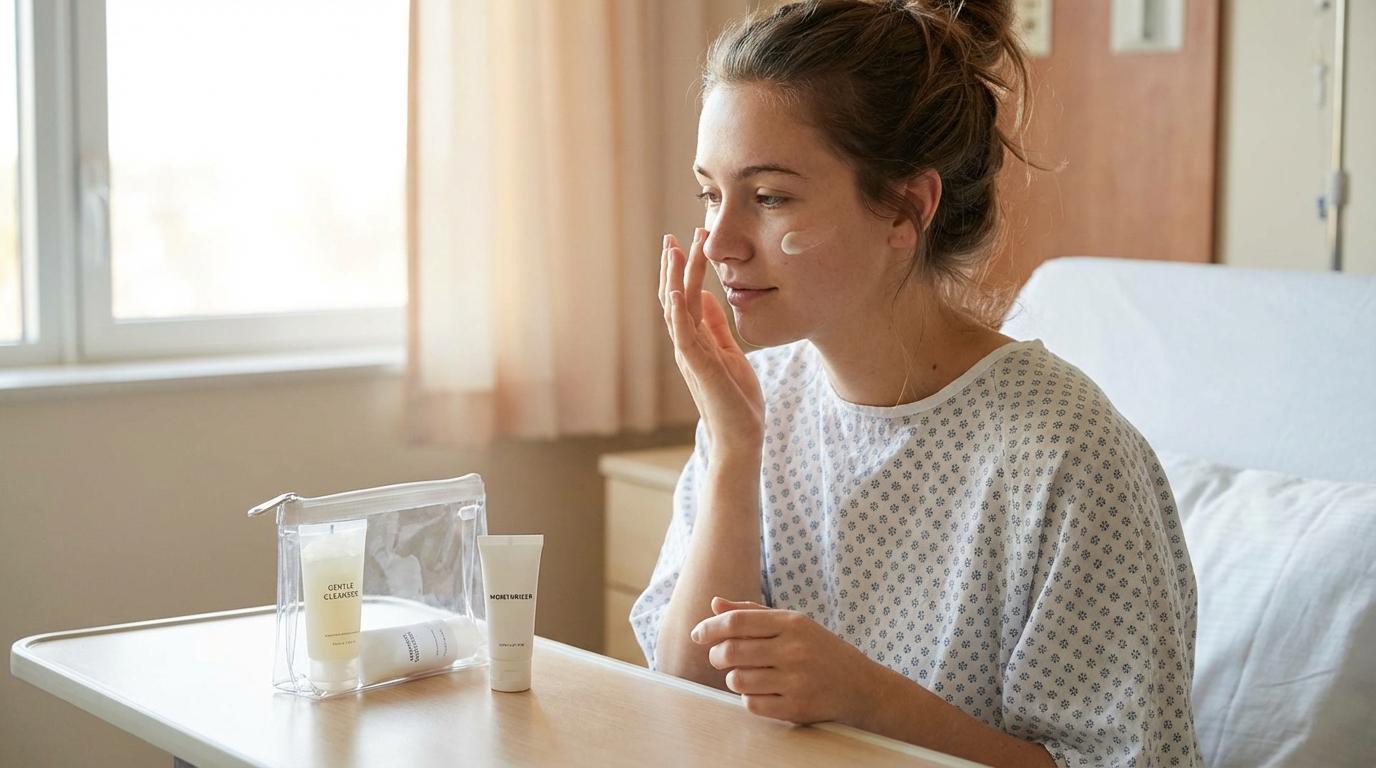
Nobody packs for a hospital stay thinking about their skin. You’re focused on the big stuff: the surgery, the treatment, the recovery ahead. But here’s something I learned the hard way after my own unexpected week in the hospital: your skin still needs you, even when everything else feels overwhelming. The good news? You only need the absolute basics.
Hospital environments are uniquely harsh on skin. The air conditioning runs constantly, fluorescent lights hum overhead, and those thin cotton sheets aren’t exactly spa-quality. Add in the stress your body is already managing, and your skin can go from normal to desert-dry in a matter of days. But this isn’t the time for your seven-step routine. This is the time for gentle, minimal, effective care.
Why Your Skin Acts Differently in the Hospital
Before we talk about what to do, it helps to understand what’s happening. Hospital air is notoriously dry. According to Memorial Sloan Kettering Cancer Center, the combination of air conditioning, heating systems, and low humidity can rapidly strip moisture from your skin. If you’re receiving IV fluids, you might assume you’re hydrated, but that internal hydration doesn’t always translate to your skin’s surface.
Stress hormones also play a role. When your body is healing, it prioritizes internal repair over external concerns like skin barrier maintenance. Your skin might become more reactive than usual, breaking out or becoming irritated by products you normally tolerate just fine. This is why stress affects your skin even during physical recovery.
Then there’s the practical reality: you might not be able to shower. Many patients rely on bed baths or no-rinse cleansing wipes, which means your normal cleansing routine simply isn’t possible. Working with what you have, rather than against it, becomes essential.
The Three Products That Actually Matter
When I talk about minimum viable skincare, I mean exactly that: the fewest possible products that will keep your skin healthy and comfortable. For a hospital stay, that breaks down to three items.
A gentle, fragrance-free cleanser. If you can shower, use it. If you can’t, look for micellar water or cleansing cloths that don’t require rinsing. The key word here is gentle. Your skin is already stressed; this isn’t the time for anything exfoliating or deep-cleansing. Something simple, with minimal ingredients, works best.
A rich, barrier-supporting moisturizer. Ceramide-based creams are excellent choices because they actually help repair your skin’s protective barrier rather than just sitting on top. Look for products labeled “fragrance-free” rather than “unscented,” as the latter sometimes contains masking fragrances that can still irritate sensitive skin. Apply after any cleansing, and reapply whenever your skin feels tight or dry.
Lip balm. Seriously. Hospital air will chap your lips faster than you’d believe. A simple petroleum-based or lanolin-based balm, applied frequently, prevents the cracking and discomfort that can become genuinely painful during a longer stay.
What to Skip (For Now)
This is where the minimalist approach really matters. Your retinol? Leave it at home. That vitamin C serum you love? Not now. Any actives, whether that’s acids, retinoids, or strong antioxidants, should stay out of your hospital bag.
The reasoning is simple. Active ingredients increase skin sensitivity, and hospital environments already make your skin more vulnerable. If you develop an irritation or reaction while you’re trying to recover from something else, you’ve just added another problem your body has to manage. Additionally, according to the American Academy of Dermatology, simplifying your routine when skin is stressed helps prevent unnecessary irritation.
Skip anything with fragrance. Many hospitals have scent-free policies for good reason: patients with respiratory issues, allergies, or heightened sensitivities can react badly to perfumed products. Even if your roommate doesn’t complain, your own healing body might. Fragrance-free everything is the safest approach.
Also skip any complicated multi-step processes. If you’re recovering from surgery, you might have limited mobility. If you’re exhausted from treatment, you won’t have energy for layering serums. One cleanser, one moisturizer, one lip balm. That’s the routine.
Practical Tips for Limited Mobility
Depending on why you’re in the hospital, you might not be able to do your own skincare at all, at least not initially. Here are some workarounds that can help.
Keep products within arm’s reach. If you’re confined to bed, having your moisturizer on the bedside table means you can apply it without waiting for help. Small, travel-sized containers are easier to manage with one hand if you have an IV or limited arm movement.
Micellar water on cotton pads can replace traditional cleansing entirely. No water, no sink, no problem. You wipe it across your face and you’re done. For those who can’t get to a bathroom, this is often the most realistic cleansing option.
Ask for help without embarrassment. If you can’t reach your face comfortably, a nurse or family member can apply moisturizer for you. Your skin staying healthy isn’t vanity; maintaining skin integrity actually matters for healing, especially if you’re bedridden for extended periods. According to wound care specialists, well-hydrated skin heals faster and is more resistant to pressure injuries.
If You Have Time to Prepare
For planned hospital stays, like scheduled surgeries, you have the advantage of preparation. Here’s what I’d suggest putting in your bag.
A small toiletry bag with your three essential products, all in travel sizes. Check that nothing will leak and that containers are easy to open even with slightly clumsy or weak hands.
Facial cleansing wipes or micellar water for the days you can’t shower. Hospital “bath wipes” are available, but having your own can feel more comfortable and familiar.
Your own pillow from home, if allowed. Not skincare exactly, but a familiar pillowcase can be gentler on your face than hospital linens, and the comfort factor matters more than you’d think.
Consider washing your face and applying a good layer of moisturizer right before you leave for the hospital. Starting with a well-hydrated skin barrier gives you a better foundation for the potentially dry environment ahead.
A Note on Nutrition and Hydration
While external products matter, what’s happening internally affects your skin too. If you’re able to eat and drink normally, staying hydrated supports skin health from the inside out. According to Healthline, adequate water intake helps maintain skin elasticity and supports the healing process.
Hospital food isn’t known for being gourmet, but if you have choices, lean toward options with protein and vitamins that support healing. Vitamin C, zinc, and protein all play roles in tissue repair. This won’t magically transform your skin, but it supports the foundation that everything else is built on.
Coming Home: Transitioning Back
Once you’re discharged, resist the urge to immediately return to your full routine. Your skin has been in “survival mode,” and it needs time to readjust.
Stick with your minimal routine for at least a few more days at home. Continue with gentle cleanser and rich moisturizer. Let your skin settle before reintroducing any actives.
When you do start adding products back, go slowly. One product at a time, with at least a few days in between, lets you monitor for any new sensitivities. Your skin’s tolerance might have shifted during your hospital stay, and what worked perfectly before might need reintroduction gradually.
Prioritize sleep and low stress if possible. Your skin is part of your body’s overall system, and giving yourself time to recover fully, rather than rushing back to “normal,” benefits everything including your skin.
Your Skin Can Wait
Here’s the thing I want you to remember if you’re facing a hospital stay: your skin is remarkably resilient. A week or two of minimal care won’t undo months or years of good habits. Your skin can handle a temporary pause in your usual routine.
What matters most is keeping it comfortable and protected while your body focuses on the bigger job of healing. A gentle cleanser to remove the day, a good moisturizer to maintain the barrier, and lip balm to prevent painful chapping. That’s genuinely all you need.
Take care of yourself first. The elaborate routine will be there waiting when you’re ready for it again.