
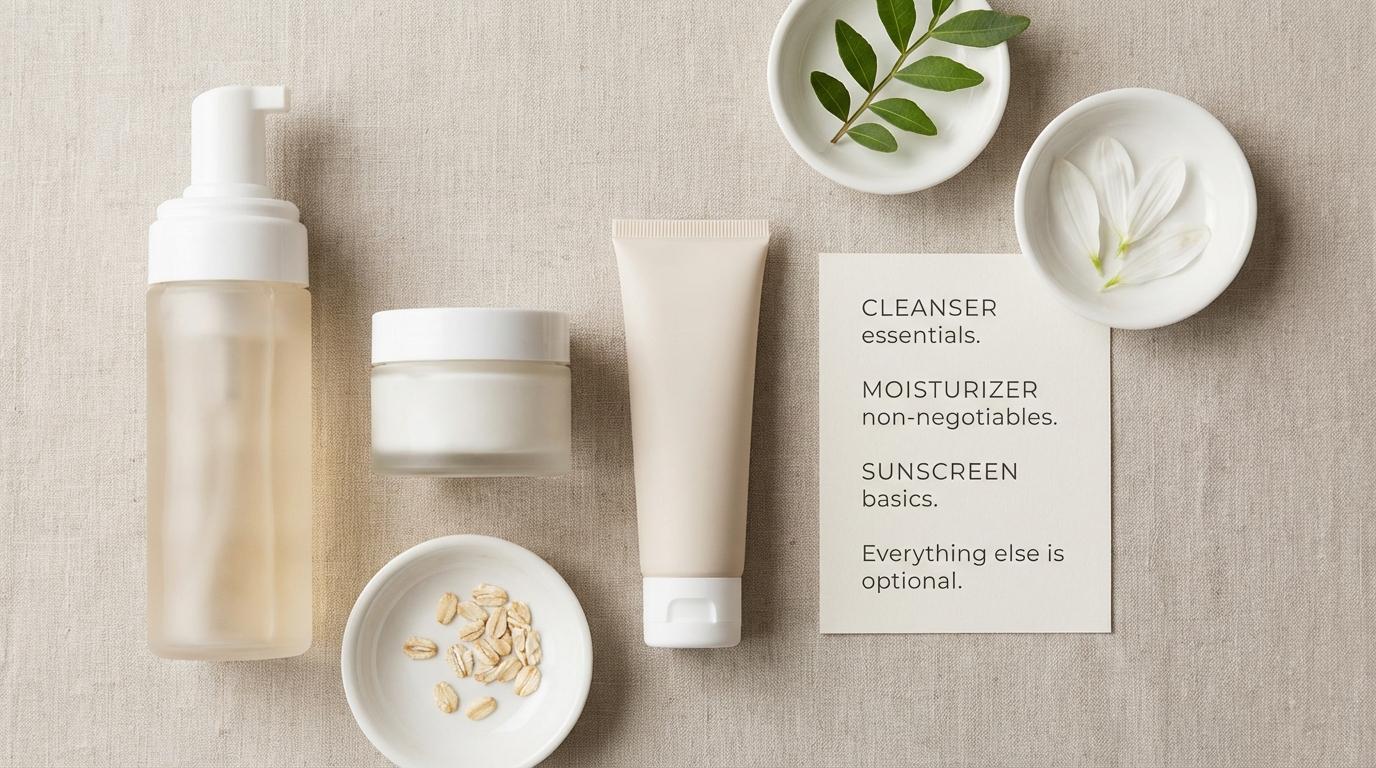
I spent five years as a beauty editor testing products, reading ingredient lists, and watching skincare routines that could rival a chemistry lab. You know what I learned? Most of it is unnecessary.
The skincare industry wants you to believe you need a 10-step routine. They want you buying serums, essences, toners, ampoules, and whatever new category they invent next week. But here’s the truth: your skin needs three things to be healthy. That’s it. Three.
Step One: A Gentle Cleanser
Your cleanser has one job: remove dirt, makeup, and excess oil without stripping your skin. That’s it. You don’t need it to brighten, tighten, or transform anything.
Look for a cleanser with a pH between 4.5 and 6.5. Anything higher and you’re disrupting your skin’s acid mantle, the protective barrier that keeps bacteria out and moisture in. Most bar soaps have a pH around 9 or 10, which is why they leave your face feeling tight and dry.
Avoid cleansers with sulfates like sodium lauryl sulfate (SLS) if your skin is sensitive or dry. These surfactants are great at cleaning, but they can be harsh. Gentle alternatives include coco-glucoside or decyl glucoside.
Double cleansing? Only if you wear heavy makeup or waterproof sunscreen. Otherwise, one wash is plenty.
Step Two: A Basic Moisturizer
Moisturizers do three things: attract water to your skin (humectants), trap it there (occlusives), and smooth things out (emollients). A decent moisturizer contains some combination of all three.
Common humectants include glycerin and hyaluronic acid. Occlusives include petrolatum, dimethicone, and oils. Emollients include fatty alcohols like cetyl and cetearyl alcohol.
You don’t need to spend a fortune. A basic drugstore moisturizer with glycerin and dimethicone will do the same job as a 0 cream. According to dermatologists at the AAD, what matters is that you use it consistently, not what the price tag says.
Apply to damp skin right after cleansing. This helps lock in that extra moisture.
Step Three: Sunscreen Every Day
This is non-negotiable. UV damage causes up to 90% of visible skin aging. We’re talking wrinkles, dark spots, uneven texture. All the serums in the world won’t undo what unprotected sun exposure does.
Use SPF 30 or higher, broad spectrum (that means it protects against both UVA and UVB rays). Apply a quarter teaspoon for your face alone. Most people use way too little, which means they’re getting maybe SPF 10 protection at best.
Yes, you need it on cloudy days. Yes, you need it in winter. Yes, you need it if you sit near windows. UVA rays penetrate glass and clouds.
Reapply every two hours if you’re outside. If you’re indoors all day, morning application is enough.
What About Everything Else?
Serums, toners, essences, masks, and exfoliants? They’re extras. Optional. Bonus content.
If you have specific concerns, like persistent acne, hyperpigmentation, or early signs of aging, certain actives can help. Retinoids, vitamin C, niacinamide, and AHAs all have solid research behind them. But they’re additions to your core three steps, not replacements.
Check out our other articles if you want to learn more about specific ingredients and when they actually make sense.
Here’s my rule: start with the basics. Use them consistently for a month. If your skin is healthy and you’re happy with it, you don’t need to add anything. If you want to address something specific, add one product at a time and give it at least six weeks before deciding if it works.
The Bottom Line
Three products. That’s what you need for healthy skin:
- A gentle, pH-balanced cleanser
- A basic moisturizer with humectants and occlusives
- Broad-spectrum SPF 30+ sunscreen, every single day
Everything else is marketing. Some of it is useful marketing, based on real science and proven ingredients. But none of it is essential.
Stop overcomplicating this. Your skin isn’t a project that needs constant intervention. It’s an organ that mostly knows what it’s doing. Give it the basics, protect it from the sun, and let it do its job.