
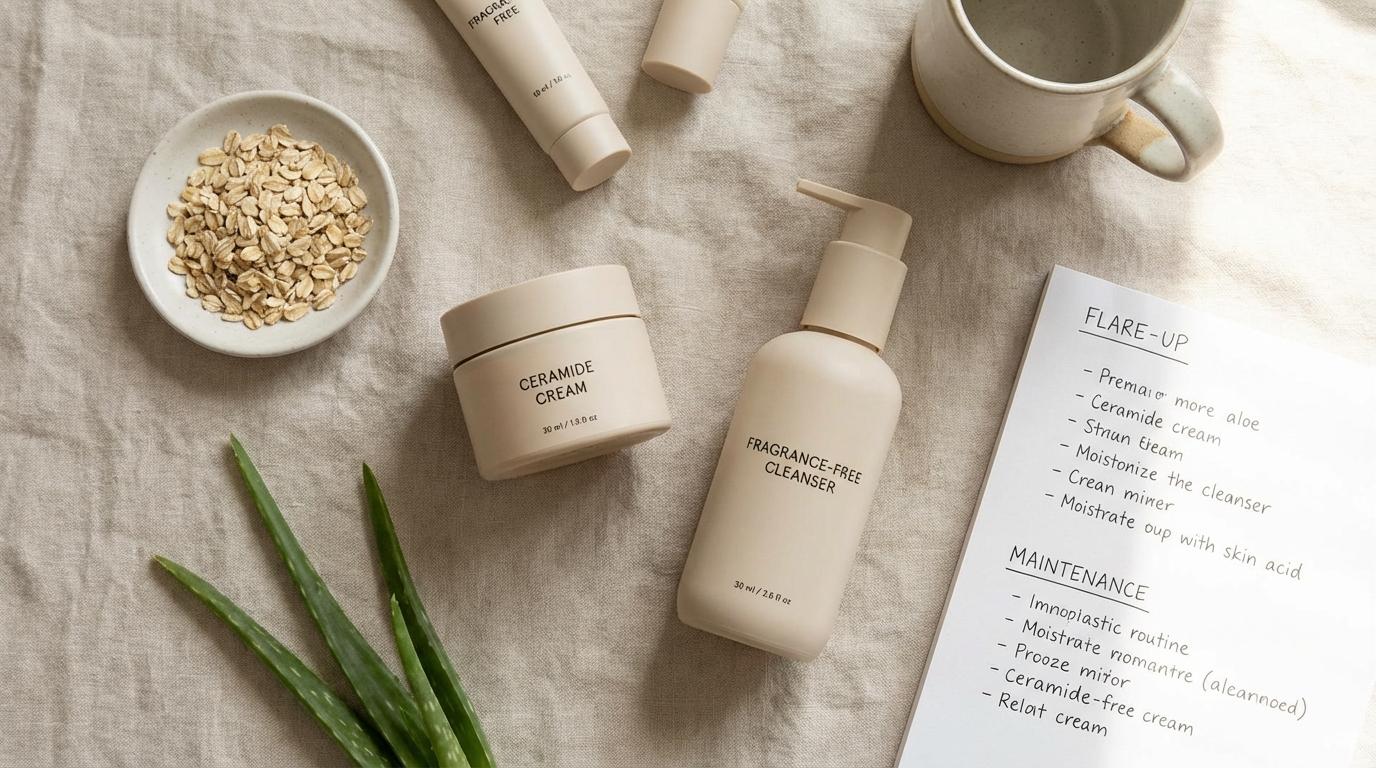
If you have eczema, you already know that skincare can feel like walking through a minefield. One wrong product, one surprise fragrance, and suddenly your skin is red, itchy, and angry. I have been there, spending way too much money on products that promised to be “gentle” only to find out my skin completely disagreed.
The good news? Building a skincare routine that works with eczema is absolutely possible. It just requires a different approach than what most beauty content will tell you. Forget the 10-step routines and the mountain of actives. When you have eczema, simplicity is not just nice to have. It is essential.
Understanding Your Eczema Before Building a Routine
Before we get into products, let us talk about what eczema actually needs. Eczema, or atopic dermatitis, means your skin barrier is compromised. Think of your skin barrier like a brick wall. In healthy skin, the “bricks” (skin cells) are held together tightly by “mortar” (lipids and ceramides). In eczema-prone skin, that mortar is weak, crumbly, and full of gaps.
This is why water escapes your skin so easily (hello, constant dryness) and why irritants get in so quickly (hello, inflammation). Your entire routine should focus on one primary goal: protecting and rebuilding that barrier.
This means your approach needs to be radically different from someone with normal or oily skin. While they might be layering vitamin C serums and retinol, you need to focus on barrier repair and gentle hydration. That is not a limitation. It is just a different path to healthy skin.
The Non-Negotiables: What Every Product Must Have (and Avoid)
Fragrance-Free is Not Optional
Let me be direct about this: fragrance is your enemy. Not “maybe avoid if possible.” Not “some fragrances are okay.” All fragrance, whether synthetic or natural, is a potential trigger for eczema flares. This includes essential oils, which are often marketed as “natural” and “gentle” but can be just as irritating as synthetic fragrances.
When shopping, look for products labeled “fragrance-free,” not “unscented.” These terms are not the same. “Unscented” products can still contain masking fragrances to cover up the smell of other ingredients. “Fragrance-free” means no scent compounds were added at all.
Minimal Ingredients Lists
The longer the ingredient list, the higher the chance something in there will irritate your skin. This is just probability. Look for products with shorter, simpler formulas. You do not need 47 botanical extracts. You need a handful of proven, gentle ingredients that do their job without causing chaos.
Ceramide Focus
Remember that crumbling mortar I mentioned? Ceramides are what repair it. These are lipids that naturally occur in your skin barrier, and supplementing them through skincare can genuinely help restore barrier function. Understanding how your skin barrier works makes it easier to care for it. Look for products that list ceramides (ceramide NP, ceramide AP, ceramide EOP) in their ingredient lists.
Your Maintenance Routine: The Basics
When your skin is calm and not in the middle of a flare, here is what a solid maintenance routine looks like. Notice how short it is. That is intentional.
Morning Routine
Step 1: Gentle Cleanse (or Just Water)
In the morning, you might not need a cleanser at all. If your skin feels fine, splashing with lukewarm water is enough. Over-cleansing strips away the natural oils your eczema-prone skin desperately needs. If you do cleanse, use a gentle, fragrance-free cleanser with a creamy or milky texture. Avoid anything that foams aggressively or contains sulfates.
Step 2: Moisturize While Damp
This is the most important step. Apply your moisturizer while your skin is still slightly damp from washing. This helps trap that water in your skin. Look for a ceramide-rich moisturizer with a thick, creamy texture. Lotions are usually too lightweight for eczema. You want something substantial.
Step 3: Sunscreen (If Going Outside)
Sun protection matters for everyone, but finding a sunscreen that does not irritate eczema can be tricky. Mineral sunscreens with zinc oxide or titanium dioxide tend to be gentler than chemical filters. Look for fragrance-free formulas designed for sensitive skin.
Evening Routine
Step 1: Cleanse
In the evening, you do need to cleanse, especially if you wore sunscreen or makeup. Use the same gentle cleanser from morning, or try micellar water as a first step if you need more makeup removal power. Keep the water lukewarm, not hot. Hot water feels nice but damages an already fragile barrier.
Step 2: Seal Everything In
Evening is when you can really layer on moisture. Apply your ceramide moisturizer to damp skin, then consider adding an occlusive layer on top. Petroleum jelly, while not glamorous, is one of the most effective occlusives for eczema. It creates a physical barrier that prevents water loss while you sleep. If petroleum jelly feels too heavy, look for products with dimethicone or shea butter as alternatives.
The Flare-Up Routine: When Things Go Wrong
Even with the best routine, flares happen. Stress, weather changes, accidental contact with irritants. Sometimes skin just decides to rebel. When that happens, you need to strip your routine back even further.
During an Active Flare
Stop All Actives Immediately: If you were using any treatment products, stop. Now is not the time.
Simplify to Two Products: A gentle cleanser and a thick, bland moisturizer. That is it. Your skin is inflamed and reactive. Even products that normally work fine might cause problems during a flare.
Cool Compresses: A clean washcloth soaked in cool water can help calm itching and reduce inflammation. Press gently, do not rub.
Moisturize Constantly: During flares, you might need to apply moisturizer multiple times throughout the day. Your skin is losing water rapidly. Keep replacing it.
Consider Colloidal Oatmeal: Products with colloidal oatmeal have been shown to help calm eczema flares. It is one of the few “active” ingredients that tends to be well-tolerated even during inflammation.
When to See a Dermatologist
Some flares need medical intervention. See a doctor if your flare does not improve after a week of simplified care, if your skin is cracked and bleeding, if there are signs of infection like oozing, crusting, or increased warmth, if the itch is so severe it is affecting your sleep, or if over-the-counter methods are not providing any relief.
Prescription treatments like topical steroids or newer non-steroidal options can provide relief when regular skincare cannot. There is no shame in needing medical help. Eczema is a medical condition, and sometimes it requires medical treatment.
Products to Consider
I am not going to give you a definitive product list because eczema is so individual. What works beautifully for one person might cause a reaction in another. However, some brands have solid reputations for eczema-friendly formulations: CeraVe, Vanicream, La Roche-Posay Toleriane, Eucerin, and Aveeno (specifically their eczema therapy line).
When trying any new product, even from these brands, patch test first. Apply a small amount to your inner arm and wait 24-48 hours before putting it on your face or larger areas. Yes, this is tedious. Yes, it is worth it to avoid a full-body flare.
What to Avoid Completely
Some ingredients are particularly problematic for eczema-prone skin and should probably be avoided entirely.
Fragrances and essential oils: Already covered, but worth repeating.
Sodium lauryl sulfate (SLS): A harsh surfactant found in many cleansers that strips the skin barrier.
Alcohol (denatured/SD alcohol): Extremely drying. Fatty alcohols like cetyl alcohol are fine.
Strong acids: AHAs and BHAs at high concentrations can be too much for compromised barriers.
Retinoids: While great for some skin concerns, they increase cell turnover and can be very irritating to eczema skin.
Physical exfoliants: Scrubs and brushes can damage an already compromised barrier.
Lifestyle Factors That Affect Eczema
Your routine extends beyond what you put on your face. Some lifestyle factors can make a significant difference.
Humidity: Eczema often worsens in dry environments. Consider a humidifier for your bedroom during winter months.
Shower habits: Keep showers short (under 10 minutes) and use lukewarm water. Apply moisturizer immediately after, before your skin fully dries.
Laundry: Use fragrance-free, dye-free laundry detergent. Skip fabric softeners and dryer sheets.
Stress management: Stress is a known eczema trigger (and it shows on your face in more ways than you think). Whatever helps you manage stress, whether that is yoga, walks, journaling, or watching terrible reality TV, make time for it.
Sleep: Your skin repairs itself during sleep. Prioritizing rest can genuinely help your skin recover.
Building Your Routine Gradually
If you are just starting to build an eczema-friendly routine, do not introduce everything at once. Start with just a cleanser and moisturizer. Use those for at least two weeks before adding anything else. This way, if you have a reaction, you will know exactly what caused it.
Once your basics are established and your skin is stable, you can consider adding other products one at a time, with patch testing and slow introduction. But honestly? Many people with eczema find that a simple cleanser-moisturizer-sunscreen routine is all they ever need. And that is completely fine. More products do not equal better skin.
Living with eczema means accepting that your skincare journey will look different from most of what you see on social media. But it also means you get to skip all the complicated, expensive routines that probably were not necessary anyway. Sometimes the simplest path really is the best one.