
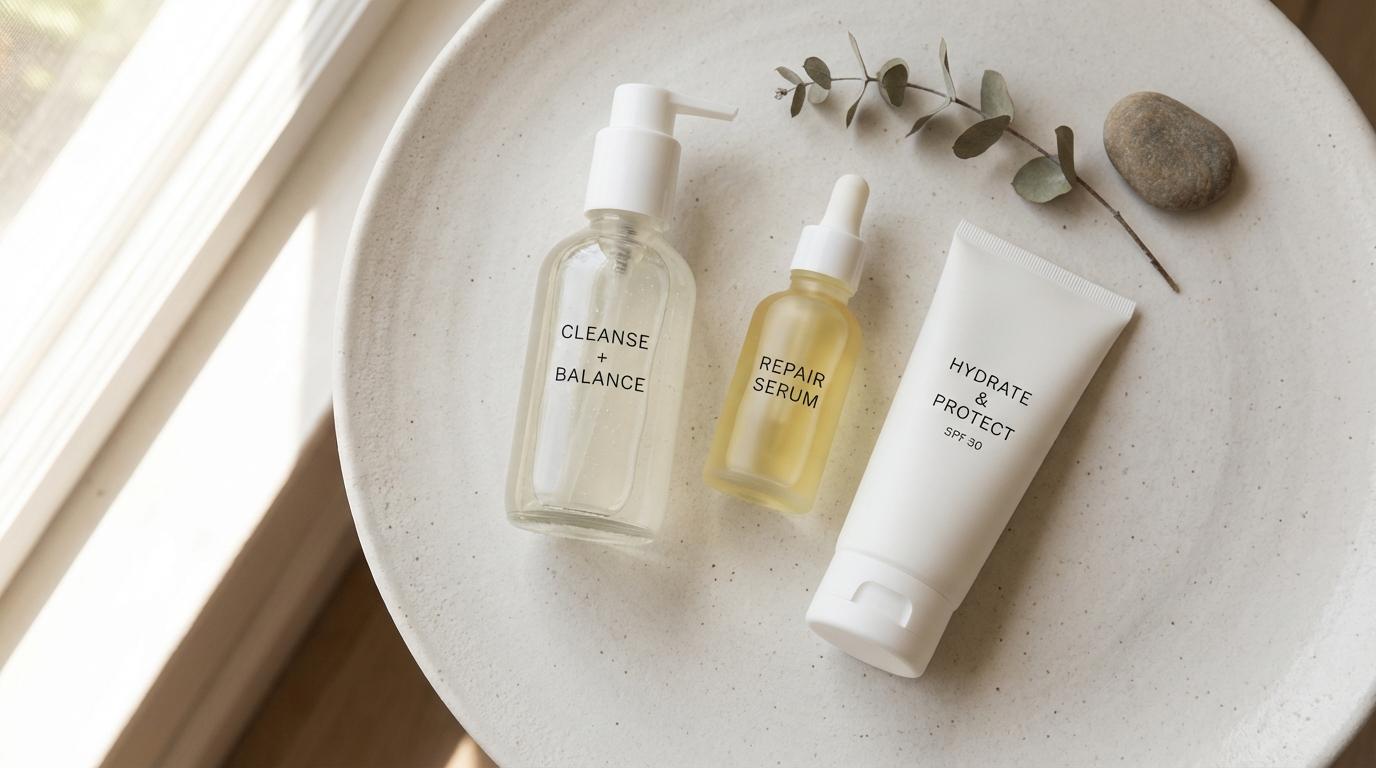
There’s a quiet relief in simplicity. If you’ve ever stood in front of a bathroom counter covered in bottles, serums, and treatments, wondering which order they go in, you know the feeling. The skincare world often tells us that more is better. More steps, more products, more actives. But what if the path to healthy skin is actually much simpler than that?
A minimalist skincare routine isn’t about deprivation or settling for less effective results. It’s about clarity. It’s about choosing what truly serves your skin and letting go of what doesn’t. And for many of us, this approach not only simplifies our mornings and evenings, it actually leads to better skin.
The Three-Product Foundation
At its core, healthy skin needs three things: cleansing, moisture, and sun protection. Everything else is supplementary. That’s not to say serums and treatments don’t have value. They do. But they build on this foundation, they don’t replace it.
A gentle cleanser removes the day’s dirt, oil, and environmental pollutants without stripping your skin barrier. Look for something that leaves your skin feeling clean but not tight. Healthline has a guide to gentle cleansers that can help you find one suited to your skin type.
A moisturizer supports your skin barrier and helps maintain hydration. Your skin barrier is a protective layer of lipids that keeps moisture in and irritants out. When it’s healthy, your skin looks plump, calm, and balanced. When it’s compromised, you might experience dryness, sensitivity, or increased breakouts.
Sunscreen protects against UV damage, which is responsible for the majority of visible skin aging and, more importantly, reduces skin cancer risk. The American Academy of Dermatology recommends broad-spectrum SPF 30 or higher for daily use.
These three products, used consistently, create the conditions for healthy skin. If you stripped everything else away and just did this, your skin would likely thank you.
Choosing Products That Do More
When you’re working with fewer products, each one matters more. This is where choosing thoughtful formulations becomes valuable. Multi-tasking products can deliver additional benefits without adding extra steps.
A moisturizer with ceramides and niacinamide, for example, does more than just hydrate. Ceramides help repair and strengthen your skin barrier, while niacinamide can help with texture, pores, and mild discoloration. You get multiple benefits from one product applied once.
Similarly, mineral sunscreens often contain zinc oxide, which has natural anti-inflammatory properties. Some tinted sunscreens include iron oxides that protect against visible light damage. One product, several functions.
This doesn’t mean you need expensive products with lengthy ingredient lists. Sometimes the simplest formulations work best. What matters is choosing products that align with your specific skin needs. If your primary concern is dryness, a rich moisturizer with hyaluronic acid might be perfect. If you’re dealing with sensitivity, fragrance-free formulas with minimal ingredients could be ideal.
Paula’s Choice Ingredient Dictionary is a helpful resource if you want to understand what different ingredients do and whether they might benefit your skin.
Why Less Often Works Better
There’s a practical side to minimalism that often gets overlooked: consistency becomes easier when your routine is simple. A 10-step routine requires time, energy, and commitment. A 3-step routine is something you can do even when you’re tired, traveling, or stressed.
Consistency matters more than complexity. Using three well-chosen products every day, morning and night, will likely give you better results than using 10 products inconsistently.
There’s also the matter of skin tolerance. Every product you layer on is a potential source of irritation. Fragrance, preservatives, certain active ingredients, they all add up. Some people’s skin handles lots of products without issue. Others find their skin becomes reactive, red, or breakout-prone with too many products in the mix.
If you’ve been experiencing persistent skin issues despite (or maybe because of) an extensive routine, simplifying might be worth trying. Give your skin a break from the constant input and see how it responds when given space to just be.
When Minimalism Serves You Best
A minimalist approach is particularly valuable in certain situations.
If you’re new to skincare, starting simple gives you a foundation to build on. You’ll learn what your skin likes and doesn’t like without the confusion of too many variables. Once you’ve established a solid basic routine, you can thoughtfully add one product at a time if you feel the need.
If your skin is sensitive or reactive, fewer products mean fewer potential triggers. It also makes it easier to identify what might be causing problems if issues do arise.
If you’re dealing with a damaged skin barrier (often showing up as increased sensitivity, persistent dryness, or skin that seems to react to everything), minimalism supports healing. Your skin needs time and space to repair itself. Bombarding it with actives and treatments, however well-intentioned, can slow that process.
If you’re on a budget, a minimalist routine costs less. You can put your money toward higher quality basics rather than spreading it thin across many products.
If you’re short on time, simplicity is a gift. Five minutes morning and evening is enough for an effective minimalist routine.
And if you simply feel overwhelmed by the noise of the skincare world, minimalism offers quiet. It’s permission to stop chasing the latest product or trend and trust that enough is enough.
Building Your Own Minimal Routine
Start with the foundation: cleanser, moisturizer, sunscreen (morning). That’s your morning routine. At night, it’s even simpler: cleanser, moisturizer.
If you want to add one active, choose based on your primary skin concern. Retinol is often considered the most versatile, addressing texture, fine lines, and even acne. But it’s not essential for everyone, and it requires patience and sun protection.
Give each product time. Your skin takes about 28 days to complete one turnover cycle. Changes from skincare products often take at least that long to become visible. The temptation to keep trying new things is strong, but consistency reveals what actually works.
Trust the process. Healthy skin isn’t about perfection. It’s not about poreless, filtered, ideal skin. It’s about skin that’s balanced, resilient, and comfortable. A simple routine, followed consistently, can get you there.
There’s beauty in doing less, in choosing carefully, in giving your skin what it needs and nothing more. Your routine doesn’t have to be complicated to be effective. Sometimes, the simplest path is the one that leads where you want to go.