
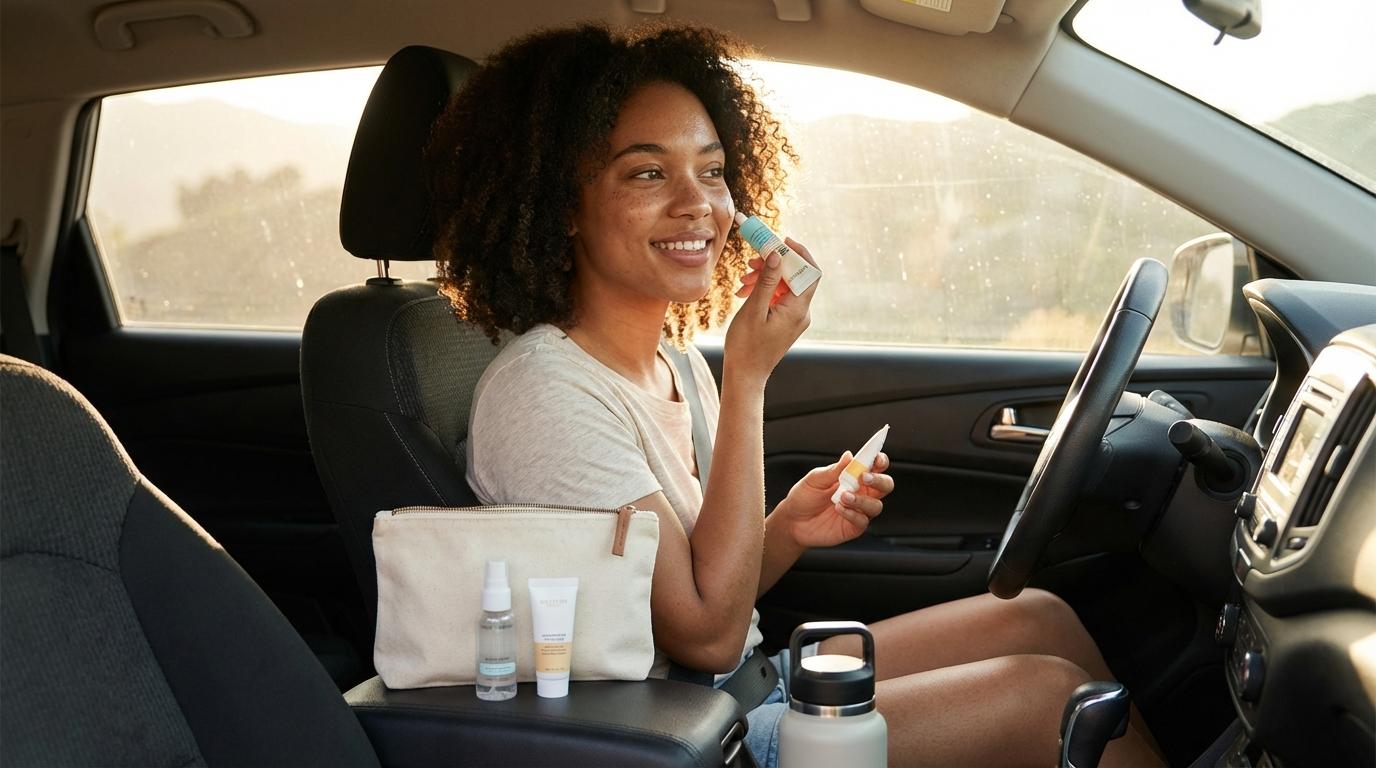
Last summer, I drove from Texas to California with my best friend. We stopped at every questionable gas station, slept in two different motels, and somewhere around Arizona, I realized my skin looked like I had aged five years in three days. My face was dry, my lips were cracked, and the left side of my face had a weird tan line from the car window. Lesson learned. If you’re planning a road trip, your skincare routine needs some serious adjustments, and I’m going to tell you exactly what to pack and what to do at every stop.
The Hidden Danger: Car Window Sun Exposure
Here’s something most people don’t realize: you can absolutely get sun damage while sitting in your car. Your front windshield is made of laminated glass that blocks about 96-98% of UVA rays. But your side windows? Those are tempered glass, and they only block around 71% of UVA according to the Skin Cancer Foundation. That means almost 30% of aging, cancer-causing UVA rays are hitting your face every single time you drive.
This is why truck drivers and people with long commutes often show more sun damage on the left side of their face and body. If you’re about to spend 8+ hours in a car for multiple days, that cumulative exposure adds up fast. UVA doesn’t just cause sunburn. It causes wrinkles, dark spots, and increases your risk of skin cancer. And unlike UVB rays, UVA penetrates clouds and even passes through windows.
So what do you do? First, wear sunscreen even inside the car. I know it feels weird to put on SPF when you’re not technically “outside,” but your skin doesn’t care about technicalities. Second, if you’re really serious about protection, consider UV window film for your car. It can block over 99% of UVA rays and it’s not that expensive. Third, keep your windows up. Even untinted windows reduce exposure more than having the window down with your arm hanging out.
What to Pack: Your Road Trip Skincare Kit
Space is limited when you’re living out of a car, so you need to be strategic about what makes the cut. Here’s my non-negotiable list:
- Broad-spectrum SPF 30 or higher: Get one that protects against both UVA and UVB. Check the label because not all sunscreens are created equal. Mineral sunscreens with zinc oxide tend to hold up better in hot cars.
- Gentle cleanser: You’ll be washing your face in gas station bathrooms and sketchy hotel sinks. A simple, non-foaming cleanser that doesn’t require perfect water temperature is your friend.
- Hydrating moisturizer: Car AC is brutal on your skin. Pack something with hyaluronic acid or glycerin to combat the dryness.
- Lip balm with SPF: Your lips don’t produce melanin, so they’re extra vulnerable to sun damage. Get one with at least SPF 15.
- Facial mist: This sounds bougie, but trust me. A quick spritz of thermal water or a hydrating mist can revive your skin during long stretches without needing to do a full routine.
- Micellar water and cotton pads: For those nights when you’re too tired to properly wash your face or the water situation is questionable.
Skip the actives for your trip. Retinol, AHAs, and vitamin C serums are great at home, but they make your skin more sensitive to sun exposure. The last thing you need during a road trip is to deal with irritation or increased photosensitivity. Stick to basics: cleanse, moisturize, protect.
The Rest Stop Skincare Strategy
Every time you stop for gas or food, you have an opportunity to take care of your skin. I’m not saying you need to do a full routine at every Buc-ee’s, but small actions throughout the day make a huge difference.
Every 2-3 hours: Reapply sunscreen. I know, nobody actually does this, but try. Keep a small tube in the center console so it’s always within reach. Pay special attention to your left arm and the left side of your face if you’re driving.
At lunch stops: Use a facial mist to add some hydration back to your skin. The air conditioning in your car is constantly pulling moisture out of your skin. A quick spritz takes two seconds and feels amazing.
At longer stops: If you have 10+ minutes, splash some water on your face, pat dry with a clean tissue (not those rough paper towels), and apply a thin layer of moisturizer before getting back on the road.
Keep sanitizer or hand wipes in your kit specifically for before you touch your face. Gas station bathrooms aren’t exactly known for their cleanliness, and the last thing you want is to introduce bacteria to your skin while trying to take care of it.
Hotel Room Essentials
When you finally check into your hotel or motel for the night, this is your chance to actually do your routine properly. Don’t skip it because you’re tired. Your skin has been through a lot.
Step one: Double cleanse. Use your micellar water first to break down the sunscreen and any grime from the day. Then follow up with your regular cleanser. Car travel is surprisingly dirty between the AC, the gas stations, and the general road dust.
Step two: Hydrate aggressively. After cleansing, your skin is going to be thirsty. Apply your moisturizer while your skin is still slightly damp to lock in extra hydration. If you brought a sleeping mask or heavier night cream, now’s the time to use it.
Step three: Don’t forget your body. Your hands are on the steering wheel all day, exposed to sun through the windshield. Your arms get blasted if you’re driving with the window cracked. Apply body lotion before bed, especially on any areas that got sun exposure.
One hack I’ve learned: bring your own pillowcase. Hotel pillows have been used by hundreds of people, and even “clean” ones can harbor bacteria, dust mites, and residue from harsh detergents. A silk or satin pillowcase from home protects your face and your hair while you sleep.
Keeping Your Routine While Mobile
The biggest challenge of road trip skincare isn’t knowing what to do. It’s actually doing it when everything feels chaotic and temporary. Here are some strategies that help me stay consistent:
Simplify ruthlessly. Your road trip routine should be the stripped-down version of your regular routine. Morning: cleanser, moisturizer, sunscreen. Night: micellar water, cleanser, moisturizer. That’s it. Anything else is a bonus, not a requirement.
Use travel containers. Decant your products into small bottles before you leave. Those TSA-approved containers work perfectly even if you’re not flying. Full-size bottles take up too much space and might leak in a hot car.
Keep your skincare bag accessible. Don’t bury it at the bottom of your suitcase. Put it in the backseat or in a bag you bring into every stop. If it’s easy to grab, you’re more likely to actually use it.
Set phone reminders. This sounds excessive, but if you’re someone who forgets to reapply sunscreen, set an alarm for every 2-3 hours. Eventually it becomes habit.
Drink water constantly. Hydration isn’t just about what you put on your skin. Dehydration shows up on your face fast, and long drives tend to make people forget to drink water. Keep a reusable water bottle in the car and actually use it.
Dealing with Specific Road Trip Skin Issues
Even with the best preparation, things happen. Here’s how to handle common problems:
Dry, flaky patches: The AC is probably the culprit. Layer a hydrating serum under your moisturizer and consider switching to a heavier cream for the duration of the trip. Avoid products with alcohol which will make it worse.
Breakouts: Stress, irregular sleep, and touching your face more often can all trigger acne. Bring a few pimple patches for emergencies. Don’t pick at your skin, even though you’re bored in the car. Keep your hands clean and off your face as much as possible.
Redness or irritation: Could be from sun exposure, dry air, or a reaction to something new. A basic moisturizer with centella asiatica or aloe can help calm things down. Avoid trying any new products until your skin settles.
Chapped lips: Reapply lip balm constantly. If your lips are already cracked, look for something with lanolin or petroleum jelly to create a serious barrier. Avoid licking your lips, which makes it worse.
The Long Game: Protecting Yourself on Extended Trips
If you’re doing a serious road trip lasting a week or more, the stakes get higher. Dermatologists note that cumulative UV-A exposure is a major risk factor for melanoma, nonmelanoma skin cancer, and photoaging. Since the average American spends a lot of time in their car, this adds up over a lifetime.
For extended trips, consider wearing UV-protective clothing. A long-sleeved shirt made from UPF fabric weighs almost nothing and provides consistent protection without needing to reapply anything. Dermatologists recommend combining physical barriers with sunscreen for the best results.
Sunglasses aren’t optional either. Your eyes can absorb UVA light, and prolonged exposure contributes to cataracts and macular degeneration. Plus, squinting for hours causes those lines between your eyebrows that nobody wants. Get polarized sunglasses with UV protection and actually wear them.
When you’re mapping out your route, consider the timing of your drives. The sun is strongest between 10am and 4pm. If you can do some of your driving in early morning or evening, you’ll reduce your overall exposure. This isn’t always possible with tight schedules, but it’s worth thinking about.
After the Trip: Recovery Mode
Once you’re finally home, give your skin some extra love. Return to your normal routine gradually, especially if you’ve simplified for travel. Your skin might need a few days to readjust.
If you got more sun than intended, use products with niacinamide to help with any hyperpigmentation. A gentle exfoliant can help clear out any buildup from being on the road, but wait a day or two before using anything harsh. Hydrating sheet masks are great for giving your skin a reset after travel stress.
The most important thing is to pay attention to your skin and respond to what it needs. Road trips are unpredictable, and your skincare might need to be flexible too. The goal isn’t perfection. The goal is keeping your skin healthy and protected while you’re out having adventures.
Pack smart, reapply sunscreen more than you think you need to, drink your water, and enjoy the ride. Your skin will survive the journey if you just give it a little attention along the way.