
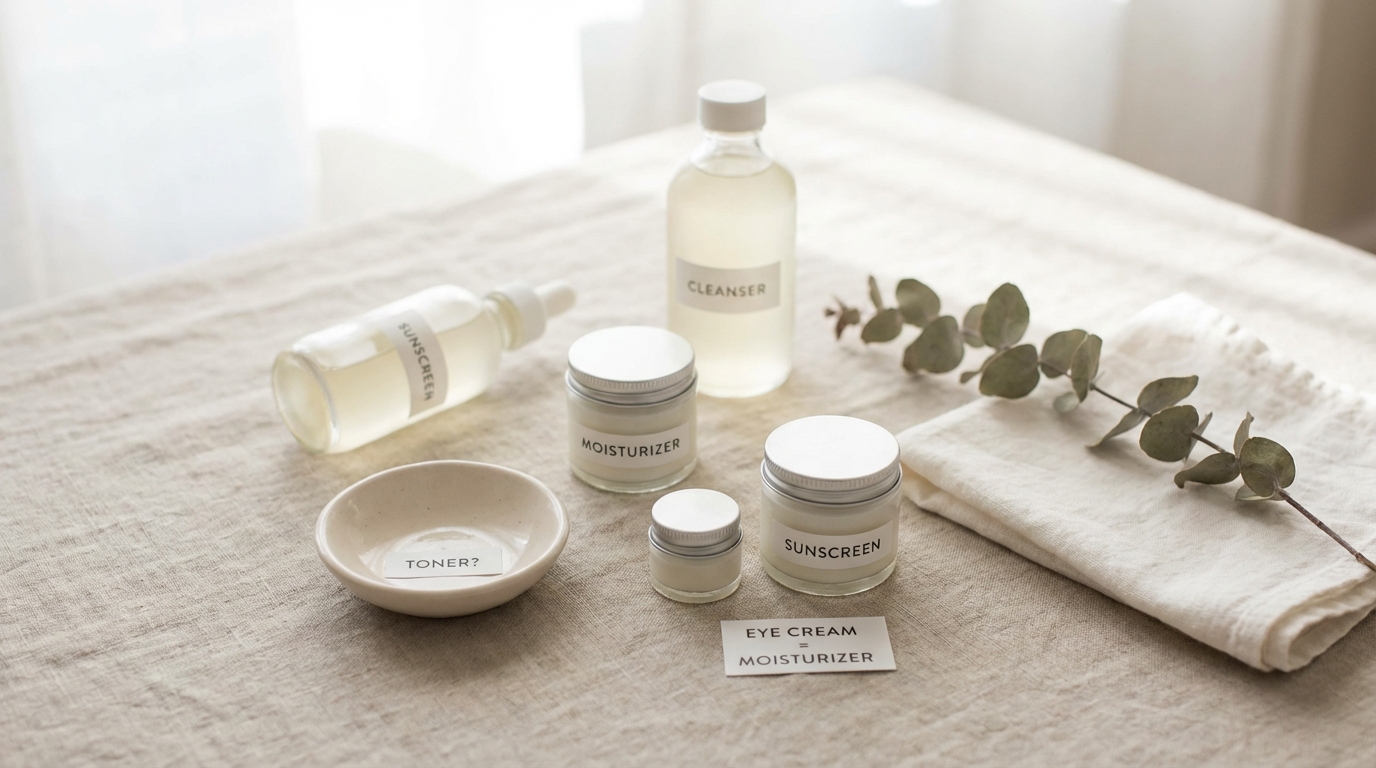
Look, I get it. You scroll through skincare content and suddenly you need seven products minimum or your skin will apparently fall off. As a broke college student who has tried way too many products I could not afford, I am here to tell you: most of that is marketing. Let me save you some money and counter space.
Some steps in the “ideal” skincare routine were invented to sell you more products. Others are genuinely useful but have cheaper alternatives you already own. Here is what you can actually skip without your skin suffering.
Toner Is Not Mandatory
Toners originally existed to remove leftover residue from harsh cleansers and restore your skin’s pH. Modern cleansers are formulated better. They clean effectively without wrecking your skin’s natural balance. If your cleanser rinses clean and your skin feels normal (not tight, not greasy), you do not need a toner to fix anything.
Some toners do have benefits beyond just “prep.” Hydrating toners with ingredients like hyaluronic acid or glycerin add a layer of moisture. Exfoliating toners with AHAs or BHAs can help with texture. But these are specific products doing specific jobs, not an essential “step.”
When you can skip it:
- Your cleanser does not leave residue
- You do not have specific concerns that a treatment toner addresses
- Your routine already includes the active ingredients you need in other forms
If you want the benefits of a hydrating toner, try applying your serum to slightly damp skin instead. You get similar results without buying another product.
Eye Cream Can Be Your Regular Moisturizer
This one drives me nuts. Eye creams are often just regular moisturizers in smaller, more expensive packaging. Look at the ingredient lists side by side sometime. Many drugstore eye creams have nearly identical formulas to their regular moisturizers, just marked up because it says “eye” on the label.
The skin around your eyes is thinner and more delicate, yes. But that does not mean it requires a completely different product. A gentle, fragrance-free moisturizer works perfectly fine on your eye area. I have been using the same basic moisturizer everywhere, including my eyes, for years.
When a dedicated eye cream might actually help:
- You need specific ingredients in higher concentrations (like caffeine for puffiness or retinol for fine lines)
- Your regular moisturizer irritates your eye area due to fragrances or certain actives
- You have very specific concerns like dark circles that benefit from targeted formulas
But for basic hydration and moisture barrier support? Your regular moisturizer handles it just fine. Put that fifteen dollars toward something else.
Essence Confusion, Clarified
Essences come from Korean skincare routines, where they are a standard step between toner and serum. They are typically watery, lightweight products meant to add hydration and help other products absorb better.
Here is the thing: in Western skincare, the lines between toner, essence, and serum are completely blurred. Products labeled as “hydrating toners” often have essence-like formulas. Products labeled as “watery serums” are basically essences. The category matters less than what the product actually contains.
You do not need a separate essence if:
- Your serum or toner already provides hydration
- You use a hydrating toner before other products
- Your skin is not dry or dehydrated
Essences are not bad products. They are just not a necessary step for everyone. If your skin feels hydrated and your serums absorb well, adding an essence is redundant. Save the step and the money.
What Marketing Invented
Some skincare steps exist because companies needed more products to sell. Understanding this helps you make smarter choices about what actually deserves your money.
Makeup primer as a separate skincare step: A good moisturizer or sunscreen with a smooth finish does the same thing. Primers that claim to “blur pores” or “extend wear” are basically silicone-based moisturizers. Some sunscreens have a finish that works perfectly under makeup without an extra product.
Day cream vs night cream: The main difference is usually that day creams have SPF and lighter textures, while night creams are richer. You can use your regular moisturizer for both and just add sunscreen in the morning. The idea that your skin needs fundamentally different products at different times of day is mostly invented for your wallet.
Lip sleeping masks: These are often just thicker lip balms with fancier marketing. Regular petroleum jelly or a heavy lip balm does the same job of occlusion and moisture retention. The original petroleum jelly has been keeping lips hydrated for over a century.
Setting sprays and facial mists as skincare: These can feel nice, but spraying water (or water with some added ingredients) on your face is not a skincare step. It does not meaningfully hydrate. Most of it evaporates, potentially taking moisture with it. If you like the sensation, fine, but it is not doing much for your skin.
What Actually Matters
After trying countless products and wasting money I did not have, here is what I have learned actually makes a difference:
- A gentle cleanser that removes dirt and makeup without stripping
- A moisturizer appropriate for your skin type
- Sunscreen during the day (this one is non-negotiable)
- One or two treatment products for specific concerns if you have them (like acne, hyperpigmentation, or aging)
That is it. Everything else is optional. Anyone telling you that you NEED eight steps or your skin will suffer is trying to sell you something.
Start simple. Use what you have. Add products only when you have a specific problem that needs solving, not because a routine chart told you to. Your skin (and your bank account) will be better for it.
For more on building a budget-friendly routine that actually works, check out our other guides. No expensive products required.