
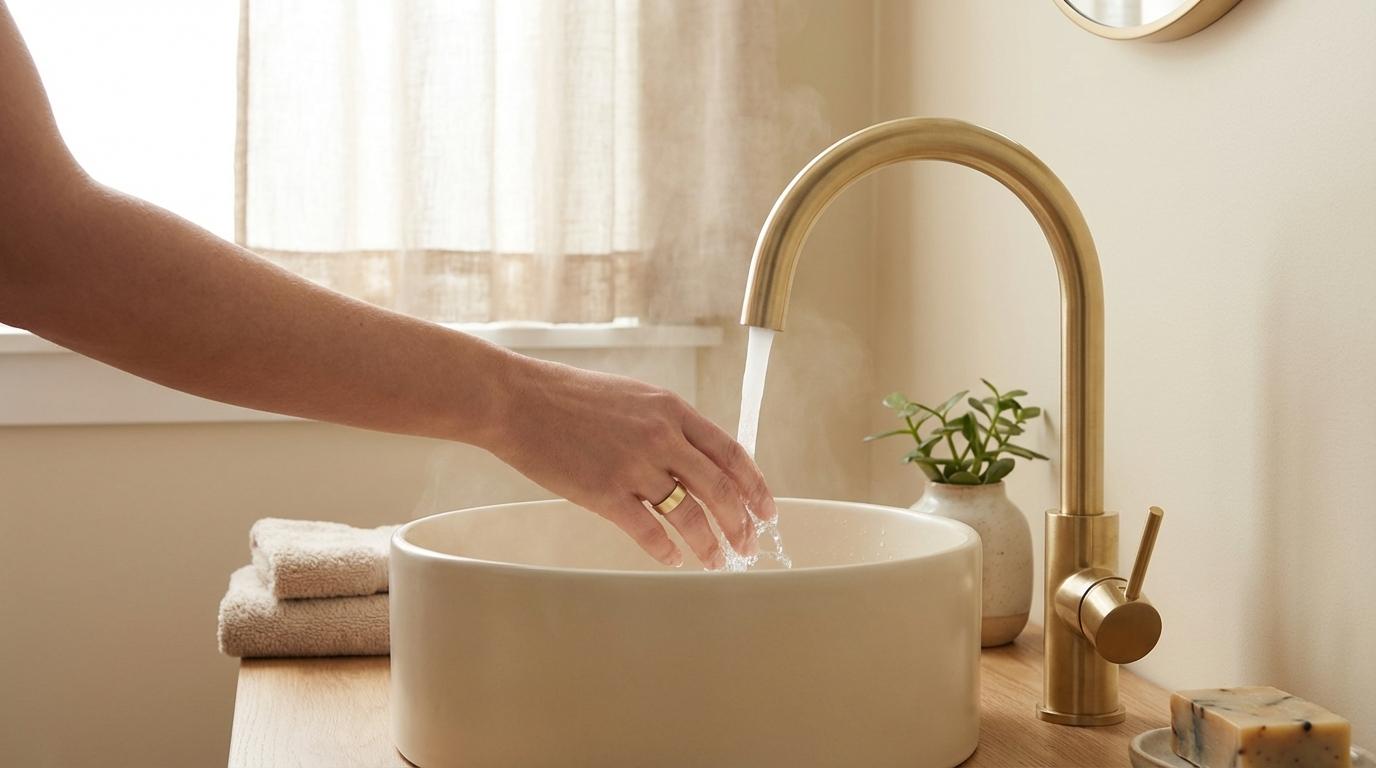
Every time you turn on the faucet to wash your face, a chain of thermal reactions begins on your skin’s surface before any cleanser even touches it. The water temperature alone triggers vasodilation or vasoconstriction in the tiny blood vessels beneath your epidermis, alters the behavior of your skin’s natural oils, and shifts how effectively your cleanser can do its job. Most people never think twice about the dial they turn, but the temperature of that water is doing more than you might expect.
What Hot Water Actually Does to Your Skin
When water above roughly 40 degrees Celsius (104 degrees Fahrenheit) hits your face, your capillaries dilate. Blood rushes closer to the surface, which is why your skin flushes pink or red during a hot shower. That dilation is a normal thermoregulatory response, but when it happens repeatedly, it can aggravate conditions like rosacea or make already-sensitive skin more reactive over time.
Hot water also strips sebum more aggressively. Your skin’s natural lipid layer becomes more fluid at higher temperatures, making it easier for surfactants in your cleanser to emulsify and wash away those oils. That sounds efficient, but here’s the catch: you’re removing protective lipids your acid mantle needs to recover after washing. Stripping too much of that lipid barrier means your skin has to work harder to rebuild it, which can take anywhere from 30 minutes to several hours depending on how compromised the barrier already is.
A 2019 study in the Journal of Clinical Medicine found that hot water exposure significantly increased transepidermal water loss (TEWL) compared to lukewarm water. Higher TEWL means your skin is losing moisture through the surface faster, which over time contributes to dehydration, flaking, and that tight feeling nobody enjoys.
The Cold Water Argument
Cold water has its own set of trade-offs. When water below about 20 degrees Celsius hits your skin, those same capillaries constrict. Less blood flow to the surface can temporarily reduce puffiness and redness, which is why some people swear by cold water splashes in the morning for a “tightened” appearance. That effect is real but temporary, lasting maybe 15 to 20 minutes before your skin returns to baseline.
The bigger issue with cold water is cleansing efficacy. Sebum is a semi-solid at lower temperatures. Think about washing a greasy pan with cold water versus warm water. The grease clings. The same principle applies to the oils on your face. Cold water makes it harder for your cleanser to properly emulsify and remove dirt, sunscreen residue, and excess sebum. If you’re using a gentle, low-surfactant cleanser (which you should be), cold water makes it even less effective because that cleanser is already designed to be mild.
There’s a persistent myth that cold water “closes pores.” Pores are not muscles. They don’t open and close. What cold water does is cause slight swelling of the surrounding tissue, which can make pores appear temporarily smaller. But structurally, nothing has changed. If you’re interested in why pore size is largely genetic, there’s a solid breakdown in this piece on why you can’t shrink your pores permanently.
Why Lukewarm Wins
Lukewarm water, roughly between 32 and 37 degrees Celsius (about 89 to 99 degrees Fahrenheit), hits the sweet spot. It’s warm enough to help surfactants work effectively against sebum without stripping the lipid barrier down to nothing. It allows your cleanser to do its job at the level it was formulated for, because most cleansers are tested and developed with the assumption of lukewarm application.
At lukewarm temperatures, your capillaries experience minimal disturbance. There’s no dramatic flushing, no excessive vasoconstriction. Your skin stays relatively calm throughout the process, which is especially important if you’re dealing with sensitivity, rosacea, or post-procedure recovery.
The other advantage is that lukewarm water doesn’t significantly alter your skin’s pH during washing. Extreme temperatures can shift the skin’s surface pH more dramatically, and since your acid mantle functions best at around pH 4.5 to 5.5, keeping disruption minimal helps it bounce back faster after cleansing.
When Temperature Matters Most
Not all skin situations are equal when it comes to water temperature sensitivity. There are specific circumstances where paying attention to that faucet dial genuinely makes a measurable difference.
Active acne inflammation: If you’re dealing with red, inflamed breakouts, hot water will increase blood flow to those already-irritated areas and can worsen the inflammatory response. Stick with lukewarm or slightly cool water. Your inflamed skin is already in a heightened immune state, and adding thermal stress on top of that just prolongs healing.
Post-treatment skin: After chemical peels, microneedling, laser treatments, or even aggressive retinoid use, your barrier is already compromised. Hot water on a weakened barrier accelerates moisture loss dramatically. Lukewarm to slightly cool is the safest range during recovery periods.
Rosacea and vascular sensitivity: If you have rosacea or visible broken capillaries, hot water is one of the most common triggers for flare-ups. The repeated vasodilation can, over years, contribute to persistent redness and telangiectasia (those tiny visible blood vessels). Cool to lukewarm water is your best friend here.
Winter and dry climates: When humidity is low, your skin is already losing moisture to the environment faster than usual. Adding hot water to your wash routine compounds the problem. Keeping water temperature moderate during colder months can prevent that seasonal tightness and flaking that seems to appear every November.
The Double Cleanse Temperature Strategy
If you double cleanse (oil or balm first, then water-based cleanser), temperature plays a role at each step. For the oil cleanse, slightly warmer water helps emulsify the oil cleanser more effectively when you rinse. The warmth helps the oil-water emulsion break apart and wash away cleanly. For the second cleanse, you can drop the temperature down to true lukewarm, since you’ve already removed the bulk of the oil-based debris and now you just need a gentle clean.
This isn’t about being fussy. It’s about understanding that each step has different chemistry happening, and temperature influences how those reactions proceed. A good analogy: you wouldn’t wash wool the same temperature as cotton, because the fibers respond differently. Your skin, at different stages of cleansing, responds differently to heat too.
What About Rinsing After Actives?
If you use rinse-off products with active ingredients, like a salicylic acid wash or a benzoyl peroxide cleanser, water temperature affects how quickly those ingredients are removed. Warmer water speeds up the rinse, which means less contact time. Cooler water slows it down. Neither is necessarily better or worse, but if your active cleanser has a recommended contact time (say, 60 seconds), using very hot water and rushing the rinse might reduce its effectiveness.
For enzyme-based cleansers, temperature matters even more. Enzymatic activity increases with heat up to a point, so slightly warmer water can actually boost the product’s exfoliating power. But that same principle means using hot water with an enzyme cleanser could push it past comfortable exfoliation into irritation territory.
A Practical Approach
You don’t need a thermometer by your sink. The simplest test: if the water feels warm but not hot on the inside of your wrist, you’re in the right range. Your wrist is more temperature-sensitive than your hands, which become desensitized from frequent washing, cooking, and general use throughout the day.
If you’ve been washing with hot water for years and your skin has been chronically dry, tight, or reactive, try dropping the temperature for two weeks and see what happens. It’s one of those changes that costs nothing but can make a noticeable difference in how your skin feels, how fast it recovers from cleansing, and how well your subsequent products absorb.
The research is pretty clear on this one: lukewarm is the pragmatic, evidence-backed choice for the vast majority of skin types and conditions. It’s not glamorous advice. There’s no new product to buy. But sometimes the most effective adjustments are the ones that seem almost too simple to matter.