
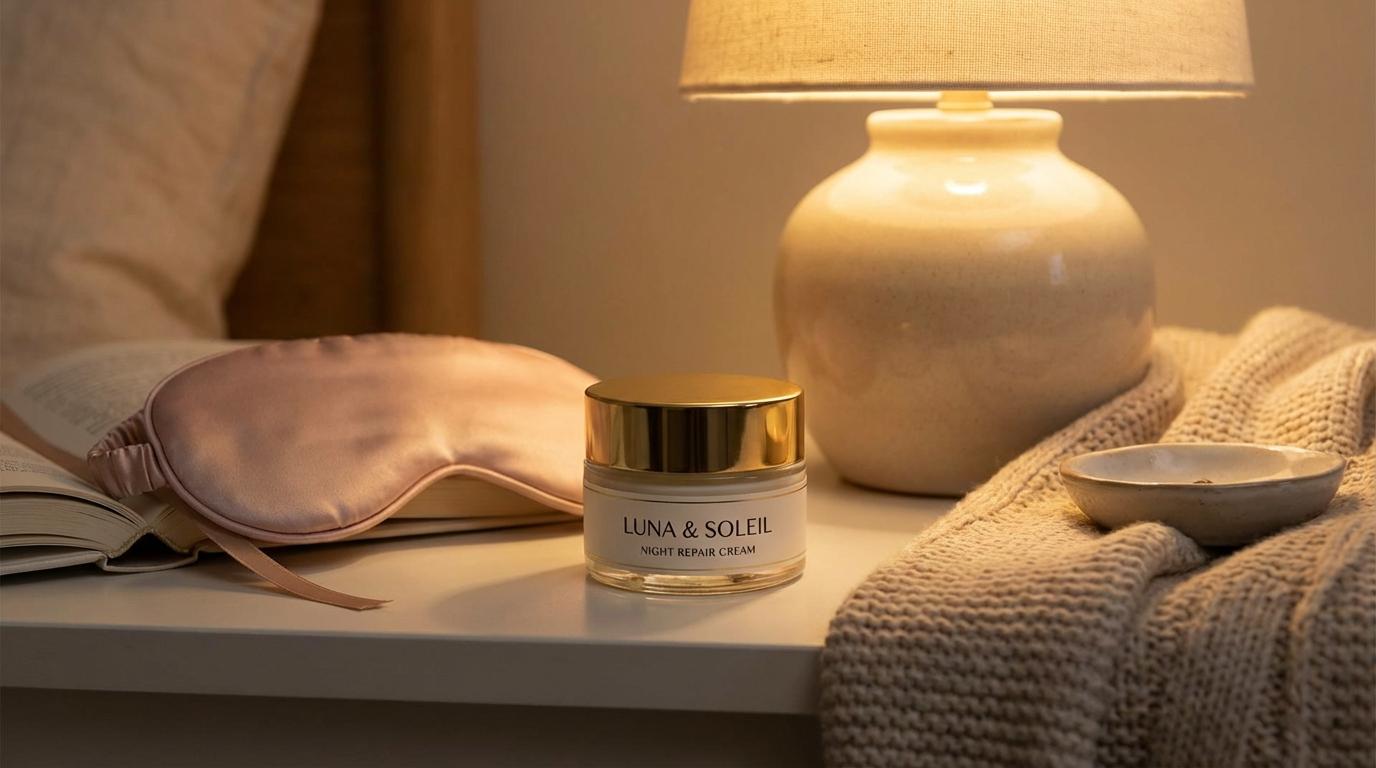
Your skin’s circadian rhythm causes a significant shift in barrier permeability after sundown, which leads to increased moisture loss during sleep. This is one of the main reasons night creams exist as a separate category from daytime moisturizers, and why they tend to be noticeably thicker and richer in texture.
The difference between a day cream and a night cream is not just marketing. It reflects real biological changes that happen in your skin based on the time of day. Your skin is not doing the same work at 2pm that it does at 2am, so it makes sense that the products supporting it would be formulated differently. Let me walk you through the science behind this.
Your Skin Has a Clock
Your skin follows a circadian rhythm, just like your sleep-wake cycle. During the day, your skin is in defense mode. It prioritizes protection against UV radiation, pollution, and environmental stressors. Sebum production peaks in the early afternoon. Antioxidant defenses are more active. The barrier functions as a shield.
At night, the priorities flip. Your skin switches into repair and regeneration mode. Cell division rates increase significantly, with some research showing epidermal cell proliferation is substantially higher in the evening hours compared to daytime. Fibroblasts, the cells responsible for producing collagen and elastin, are most active while you sleep. DNA repair processes accelerate. Your skin is literally rebuilding itself overnight.
This repair cycle is one reason peptide-based products are often recommended for nighttime use. The cells doing the repair work are more active and more receptive to signals that support collagen production and tissue regeneration during sleep hours.
TEWL Increases While You Sleep
Transepidermal water loss (TEWL) is the process by which water evaporates from the deeper layers of your skin through the epidermis and into the surrounding environment. It happens constantly, but the rate is not consistent throughout the day.
At night, TEWL increases. Several factors contribute to this. Your core body temperature drops during sleep, but your skin surface temperature actually rises slightly as blood flow redistributes. This temperature differential promotes more water movement toward the skin’s surface. Additionally, your skin becomes slightly more permeable at night as barrier function shifts to accommodate repair processes. The pH of your skin also drops slightly (becomes more acidic) during overnight cellular activity, which can further affect barrier permeability.
The practical result is that your skin loses more moisture while you sleep than it does during equivalent hours of daytime activity. If your evening moisturizer is too lightweight, you can wake up with skin that feels tight, dry, and dehydrated, even if it felt perfectly hydrated when you went to bed.
Why Heavier Formulations Help at Night
Night creams are formulated to address this increased moisture loss through two main strategies: occlusion and enhanced hydration.
Occlusive ingredients create a physical film on the skin’s surface that slows down water evaporation. Common occlusives in night creams include petrolatum, dimethicone, shea butter, squalane, and mineral oil. These ingredients do not add water to your skin. They prevent the water already in your skin from escaping. Think of it as putting a lid on a pot of boiling water: the water is still there, but the steam (evaporation) slows dramatically.
This is why night creams feel heavier. They contain higher concentrations of these film-forming ingredients compared to day creams. A day cream with the same level of occlusion would feel greasy under makeup, interfere with sunscreen application, and leave your face looking shiny. At night, none of that matters. You are lying on a pillow, not facing the world.
Hydrating ingredients like hyaluronic acid, glycerin, and urea are often present in higher concentrations in night formulations. These humectants pull water from the environment and from deeper skin layers into the epidermis. Combined with occlusive ingredients that prevent that water from evaporating, you get a two-pronged approach: attract moisture in, then seal it there.
Many night creams also include repair-supporting ingredients like ceramides, fatty acids, and cholesterol. These are the lipids that make up the “mortar” between your skin cells. Replenishing them at night, when your skin is actively rebuilding, supports barrier restoration more effectively than applying them during the day when your skin is in defense mode.
Texture Differences Are Functional, Not Cosmetic
The heavier texture of night creams is not about luxury or perceived value. It is a direct consequence of the ingredient profile needed to counteract nighttime moisture loss and support repair.
Day creams are typically lighter because they need to:
- Sit well under sunscreen and makeup
- Not feel heavy during physical activity
- Allow the skin’s natural daytime sebum production to function without excessive occlusion
- Include UV filters or antioxidants as the primary active ingredients
Night creams are heavier because they need to:
- Compensate for increased TEWL during sleep
- Provide occlusion without worrying about cosmetic elegance
- Deliver repair-focused ingredients (retinoids, peptides, ceramides) in formulations that optimize their absorption during the skin’s repair phase
- Support barrier rebuilding over a continuous 7-8 hour application period
The texture difference is not a gimmick. It is engineering that matches the product’s function to the skin’s biological state.
Do You Actually Need Two Separate Products?
Not necessarily. If your skin is well-balanced and your daytime moisturizer provides adequate hydration, you might not need a dedicated night cream. Some people do perfectly well using the same moisturizer morning and night, particularly if they have oily or combination skin that does not experience significant overnight dryness.
However, if you regularly wake up with tight or dry-feeling skin, or if you use active ingredients at night (retinoids, exfoliating acids) that increase TEWL, a richer evening moisturizer can make a measurable difference. Recent research on nighttime moisturizer application supports the idea that matching product weight to your skin’s circadian needs improves hydration outcomes.
The simplest test: if your skin feels comfortable when you wake up, your current approach is working. If it consistently feels dry or tight in the morning, your evening moisture delivery is insufficient, and a heavier product or an additional layer of occlusion would likely help.
Active Ingredients and Nighttime Delivery
Beyond moisture, night creams often serve as vehicles for active ingredients that work best during the repair phase. Retinoids are the most obvious example. They are photosensitive (degraded by UV light) and can increase sun sensitivity, making nighttime application the standard recommendation. But beyond those practical concerns, retinoids also synergize with your skin’s natural nighttime cell turnover, enhancing a process that is already happening.
Peptides, growth factors, and ceramides similarly benefit from nighttime delivery. The increased cell activity and repair focus during sleep hours creates an environment where these ingredients can be utilized more effectively. You are not just applying them. You are applying them when your skin is primed to use them.
This is also why many dermatologists recommend applying retinoids and other actives to slightly damp skin followed by a heavier moisturizer as the final step. The moisturizer acts as an occlusive seal, keeping the active ingredient in contact with the skin longer and reducing the evaporation that would dilute its effectiveness.
Choosing Based on Your Skin, Not the Label
The day cream versus night cream distinction is useful, but it is not a rigid rule. What matters is matching the weight of your moisturizer to what your skin needs at that time of day. If you have very dry skin, you might need a heavier product even during the day. If you have oily skin, a lightweight gel moisturizer might be sufficient at night.
Pay attention to how your skin feels at different times. If your morning skin is happy and hydrated, your nighttime routine is working. If you consistently wake up dry despite moisturizing, increase the occlusive component of your evening routine. If your daytime moisturizer pills under sunscreen, it might be too heavy for daytime use and would serve you better as a night product.
The formulation science behind day and night creams is real and grounded in biology. But the best product for your skin is ultimately the one that addresses your specific moisture needs at the time you are using it, regardless of what the label says.