
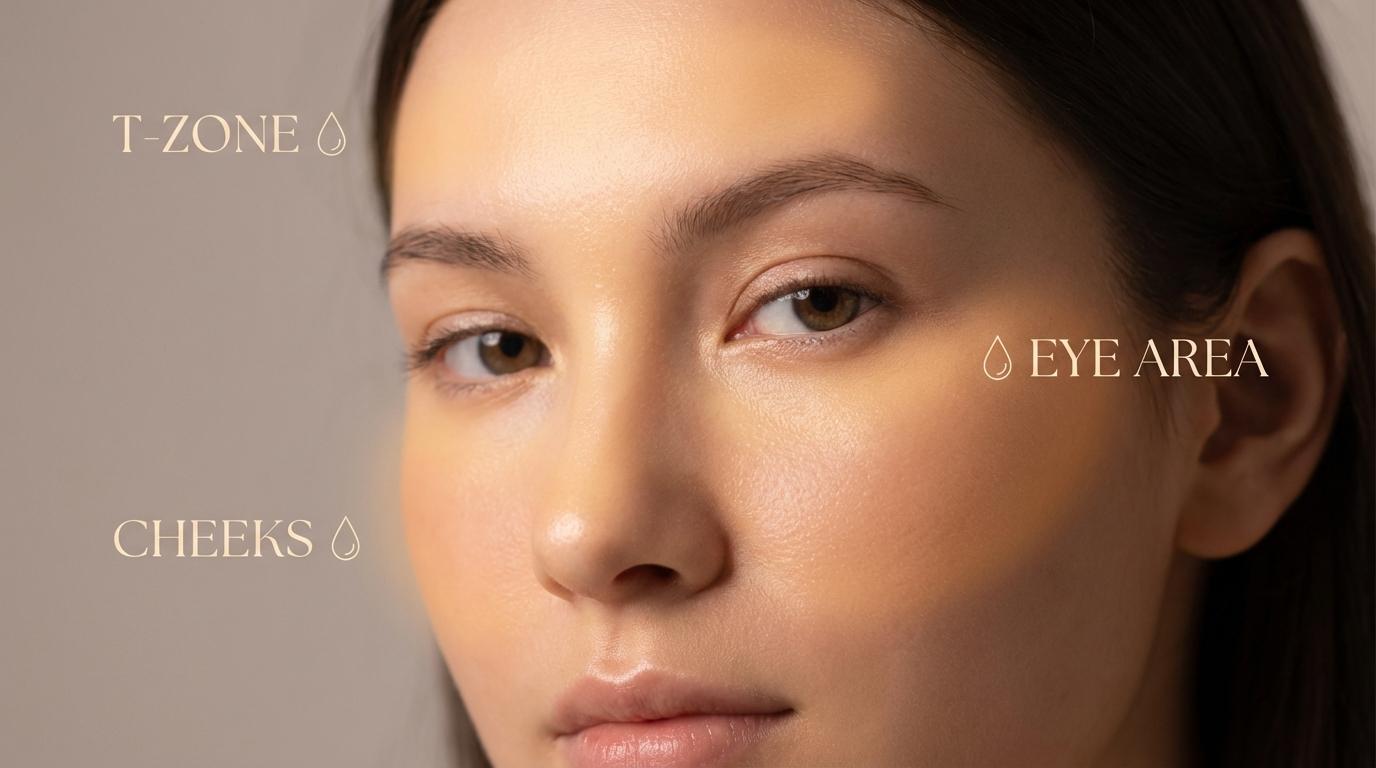
Have you ever wondered why your forehead could fry an egg while your cheeks feel like sandpaper? I spent way too long thinking my skin was just confused before I realized there’s actual biology behind this frustrating phenomenon. Turns out, your face is basically a patchwork quilt of different skin environments, and understanding why can totally change how you take care of it.
The T-Zone Oil Factory Explained
That shiny strip running down your forehead, nose, and chin? It’s not just your imagination working overtime. The T-zone has roughly 400 to 900 sebaceous glands per square centimeter, which is significantly more than other facial areas. These sebaceous glands are attached to hair follicles and their entire job is pumping out sebum, that waxy, oily substance that keeps your skin waterproof and protected.
The density difference is wild. Your forehead alone can have two to three times more oil glands than your cheeks. This is why by lunchtime your nose looks glazed while the sides of your face stay relatively matte. It’s pure anatomy, not some personal failing in your skincare routine.
Hormones also play a massive role here. Androgens, which everyone has regardless of gender, directly stimulate sebaceous glands. The T-zone glands are particularly sensitive to these hormonal signals, which is why stress, menstrual cycles, and life changes can turn your forehead into an oil slick seemingly overnight.
Why Your Cheeks March to a Different Drum
Your cheeks are playing a completely different game. They have fewer oil glands, thinner skin in some spots, and a different relationship with moisture. The cheek area also tends to have more prominent blood vessels closer to the surface, which is why redness, flushing, and sensitivity often show up there first.
The cheeks are also more exposed to environmental damage. Think about it: they’re the part of your face most likely to catch wind, sun, and cold air directly. This constant exposure can compromise the skin barrier faster than protected areas, leading to that tight, dry feeling even when your T-zone is swimming in oil.
Something I learned the hard way: treating your cheeks the same as your oily zones can actually make things worse. Using harsh, oil-stripping products all over when only your T-zone needs them can leave your cheeks dehydrated and irritated. If you’re dealing with that combo situation, our guide on managing oily skin with dry patches breaks it down perfectly.
The Delicate Situation Around Your Eyes
The skin around your eyes deserves its own category because it’s genuinely different from everywhere else on your face. This area is roughly 0.5 millimeters thick, compared to about 2 millimeters on the rest of your face. That’s four times thinner. Let that sink in.
This thin skin means fewer oil glands, less collagen, and basically no fat padding underneath. It’s also one of the most active areas of your face because you blink around 15,000 to 20,000 times per day. All that movement on such delicate tissue explains why fine lines, dark circles, and puffiness tend to show up here before anywhere else.
The eye area also lacks the robust barrier function that thicker skin has. Products that work fine on your forehead can cause stinging, irritation, or even milia (those tiny white bumps) around your eyes. This is why dedicated eye products exist, and honestly, this is one area where I do think a separate product makes sense.
Oil Gland Distribution: The Full Picture
Let’s map this out properly. Your face has roughly 900 sebaceous glands per square centimeter on the forehead and nose, dropping to about 400 to 600 on the chin, and then around 100 to 200 on the cheeks. The jawline and hairline fall somewhere in between, which is why you might notice different behavior in these transition zones.
This gradient isn’t random. Evolutionary biologists think the T-zone concentration developed because these areas need extra protection. The forehead shields your brain from impacts and temperature changes. The nose is a major entry point for breathing and needs its passages protected. The chin probably just got dragged along for the ride.
Your pores also vary in size based on this distribution. More oil glands mean more visible pores, which is why forehead and nose pores tend to look larger than cheek pores. When those pores get clogged, you get different types of breakouts in different zones too.
Zone-Specific Care Actually Works
Once I stopped fighting my skin’s natural geography and started working with it, everything improved. The concept is sometimes called multi-masking or zone skincare, but the principle is simple: different areas need different treatments.
For oily T-zones, ingredients like niacinamide, salicylic acid, and lightweight hydrators make sense. Niacinamide specifically can help regulate sebum production over time, making it a solid long-term solution rather than just blotting and hoping.
For drier cheeks, focus on barrier repair. Ceramides, hyaluronic acid, and richer moisturizers can go here even if you avoid them elsewhere. You don’t have to use the same amount of product on every area. Seriously, I put a pea-sized amount of moisturizer on my cheeks and barely graze my forehead.
For the eye area, keep it simple and gentle. Fragrance-free, basic hydration is usually enough. Heavy anti-aging treatments can wait until you actually need them, and even then, less is more.
Practical Application Without Breaking the Bank
You don’t need a separate product for every facial zone. That’s a marketing trap. What you need is awareness of how to use what you have more strategically.
Start with your cleanser. If you’re using something foamy and stripping, maybe only use it on your T-zone and use water or micellar solution on your cheeks. Or use your regular cleanser but spend less time on drier areas and more time on oily ones.
With moisturizer, apply a thin layer to oily zones and build up on dry zones. With serums, target them to where they’re needed. Retinol on your forehead where oil production is high? Great. Retinol on your already irritated cheeks? Maybe skip or buffer heavily.
Even with sunscreen, you can adjust. Make sure you’re getting full coverage everywhere, but if your mineral sunscreen is too drying for your cheeks, look for a hydrating formula or add a moisturizer underneath in those specific spots.
When Zone Differences Signal Something More
Sometimes dramatic differences between zones can point to underlying conditions. Extremely oily T-zones combined with flaky cheeks might indicate seborrheic dermatitis. Persistent redness on cheeks that doesn’t match elsewhere could be early rosacea. Sudden changes in oil production can reflect hormonal shifts worth discussing with a doctor.
As dermatologist Dr. Mamina Turegano often points out, knowing what’s normal for your skin helps you spot when something changes. If your zones have always behaved differently, that’s just your anatomy. If the behavior shifts suddenly, pay attention.
Making Peace With Your Patchwork Face
I used to feel frustrated that my skin couldn’t just pick a lane. Oily or dry, I could handle. Both simultaneously felt like my face was trolling me. But once I understood the actual biology, it started making sense. Your face has different zones because those zones have different jobs and different structures.
Working with this instead of against it means less irritation, fewer breakouts, and honestly less money wasted on products that promise to fix everything with one formula. Your forehead isn’t broken for being oily. Your cheeks aren’t failing for being dry. They’re both doing exactly what they’re supposed to do, just in their own specific ways.
The best skincare routine acknowledges this reality. Treat each zone based on what it actually needs, adjust as seasons and hormones shift things around, and stop expecting uniform behavior from a face that was never designed to be uniform. Once you embrace the patchwork, taking care of it gets so much simpler.