
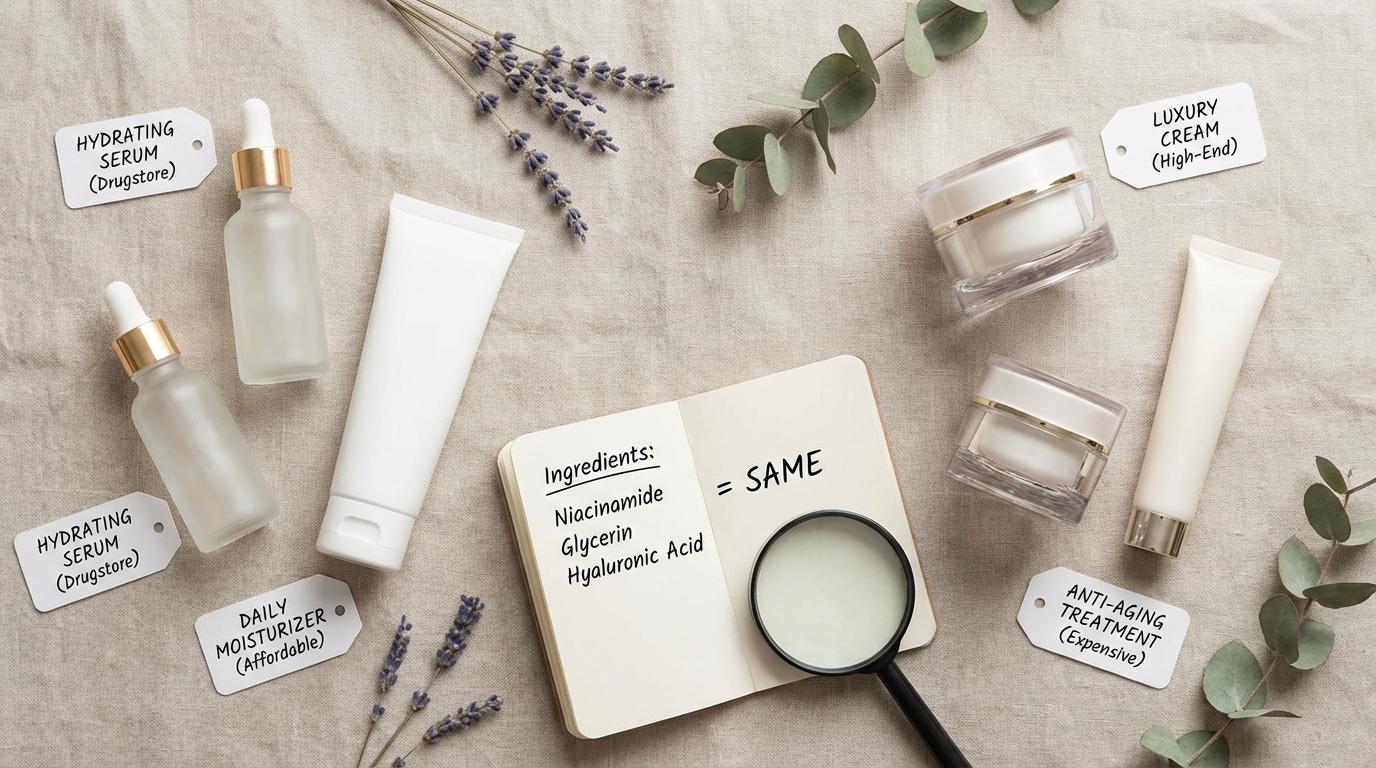
I spent four years as a beauty editor. I tested products that cost more than my phone bill. And here is the uncomfortable truth the industry does not want you to know: most of that money went straight into packaging and marketing.
Not into better ingredients. Not into superior formulations. Into convincing you that luxury equals results.
Let me show you exactly why that is nonsense.
The Ingredient List Does Not Lie
Pick up a $90 vitamin C serum and a $15 one from the drugstore. Flip them over. Read the ingredient list.
In most cases, you will find the same active ingredients in the same concentration ranges. PubMed research databases are full of studies showing that L-ascorbic acid is L-ascorbic acid, whether it comes in a gold-trimmed bottle or a plastic tube.
The FDA requires companies to list ingredients in order of concentration. This means you can actually see what you are paying for. And spoiler alert: the first several ingredients in competing products are often identical.
CeraVe and La Mer both use ceramides. The Ordinary and Estee Lauder both use retinol. Neutrogena and Lancome both use hyaluronic acid. The molecules do not care about the price tag on the bottle.
What differs? The experience. The scent. The packaging. The tiny extra ingredients that make up less than 1% of the formula. These things might feel nice, but they rarely affect actual skin outcomes.
What You Are Actually Paying For
A 2019 analysis by Cosmetics Design broke down where your skincare dollars go when you buy prestige products:
- Marketing and advertising: 25-40%
- Packaging: 15-25%
- Retailer markup: 20-30%
- Actual product formulation: 10-15%
Read that again. The stuff that goes on your face represents the smallest slice of what you pay for.
Luxury brands spend millions on celebrity endorsements, glossy campaigns, and those beautiful heavy glass jars. That jar alone can cost more to manufacture than the serum inside it.
Meanwhile, drugstore brands like CeraVe, La Roche-Posay, and The Ordinary skip the expensive packaging and celebrity deals. They put their budget into formulation. That is why dermatologists recommend them constantly.
I am not saying luxury brands are scams. Some of them make excellent products. I am saying the price tag does not guarantee superiority.
The Research Says Price Does Not Predict Performance
In 2018, researchers published a study comparing consumer perception of skincare effectiveness against actual clinical results. The findings were clear: people assumed expensive products worked better, but objective measurements showed no correlation between price and performance.
The American Academy of Dermatology has repeatedly stated that many affordable over-the-counter products contain the same clinically proven ingredients as their expensive counterparts.
Dr. Shereene Idriss, a board-certified dermatologist, has built a following by calling out this exact issue. Her stance is straightforward: look at what is in the bottle, not what is on the price tag.
Consumer Reports and similar organizations have run blind tests where dermatologists evaluate products without knowing the price. Time after time, budget options perform equally well or better than luxury versions.
The placebo effect is real. If you spend $200 on a cream, you want it to work. You might perceive improvements that are not actually there, or attribute natural skin cycles to the product. Our brains are wired to justify expensive purchases.
When Splurging Actually Makes Sense
I promised you honesty, so here it is: there are a few situations where paying more might be worth it.
Prescription-strength retinoids. If you have stubborn acne or want serious anti-aging results, prescription tretinoin is more effective than over-the-counter retinol. This requires a dermatologist visit, but it is still cheaper than most luxury serums.
Specific sensitivities. If your skin reacts to common preservatives or fragrances, you might need to pay more for products that exclude those ingredients. But even here, brands like Vanicream offer affordable options.
Professional treatments. Chemical peels, laser treatments, and microneedling done by licensed professionals deliver results that no topical product can match at any price point. If you want dramatic changes, this is where your money should go.
Sustainability and ethics. Some people pay more for brands with verified sustainable practices, cruelty-free certifications, or fair labor standards. That is a personal value choice, not a skin effectiveness choice.
Notice what is not on that list? Paying $150 for a moisturizer that does the same job as a $12 one.
Building an Effective Budget Routine
Let me tell you what actually works, regardless of price:
Cleanser: Gentle, non-stripping, pH-balanced. Vanicream, CeraVe, or La Roche-Posay all make excellent options under $15.
Moisturizer: Look for ceramides, glycerin, or hyaluronic acid. CeraVe PM or Neutrogena Hydro Boost. Both under $20.
Sunscreen: SPF 30 or higher, broad spectrum. The Environmental Working Group rates dozens of affordable options highly.
One active (if needed): A retinoid for anti-aging, salicylic acid for acne, or vitamin C for brightening. The Ordinary sells effective versions for under $10.
That is it. Four products. Probably under $50 total. This routine will outperform a $500 luxury regimen if used consistently.
Consistency matters more than cost. A cheap product you use every day beats an expensive one that sits on your shelf because you are “saving it” for special occasions.
The Bottom Line
The beauty industry profits from making you feel like you need more, and more expensive, products. They count on the assumption that higher prices mean better quality.
That assumption is wrong.
Read ingredient lists. Look for clinical studies. Listen to dermatologists who have no financial stake in what you buy. Your skin responds to molecules, not marketing.
Save your money for things that actually improve your life. Your skincare routine does not need to be expensive to be effective.
That is the truth the industry does not advertise.