
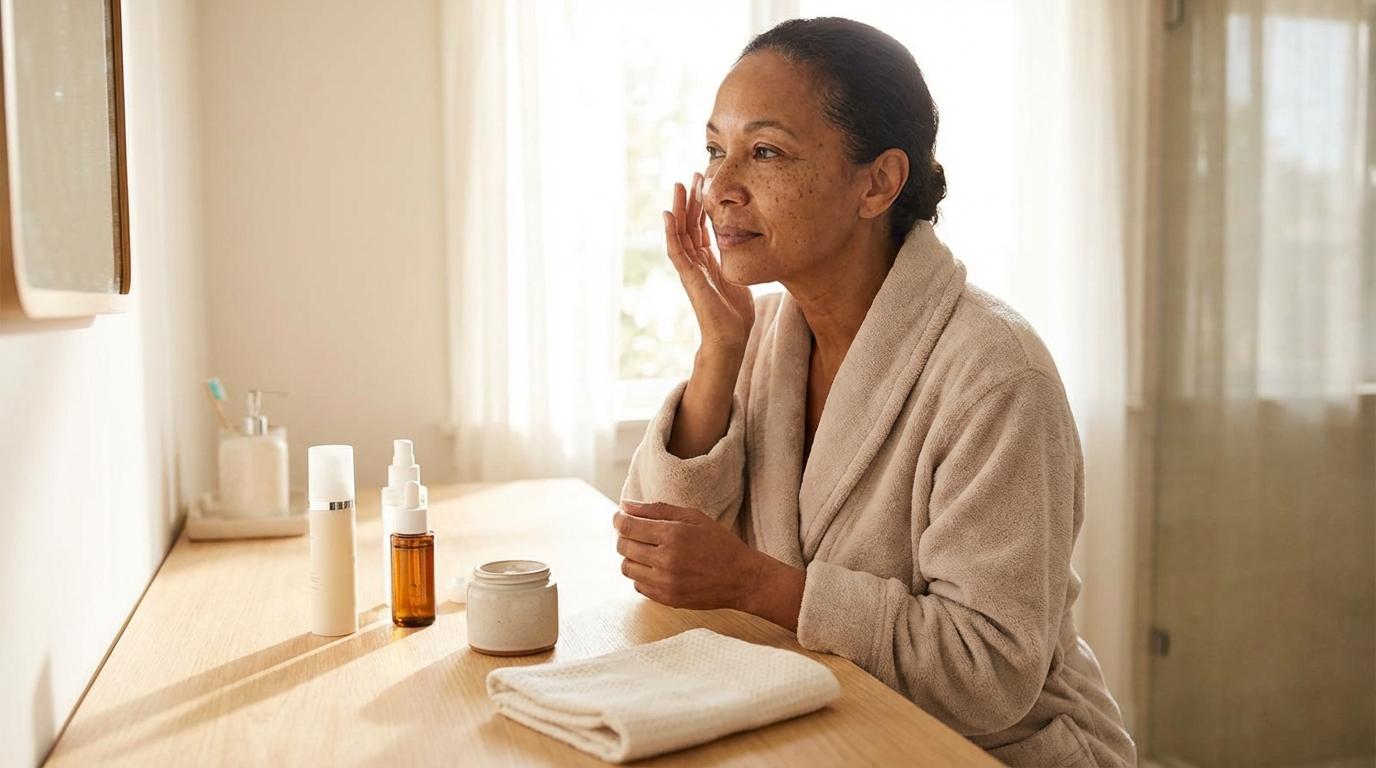
If you’ve noticed your skin acting completely different lately, and you’re somewhere in your 40s or 50s, there’s a good chance your hormones are behind it. Menopause doesn’t just bring hot flashes and mood swings. It fundamentally changes your skin at a cellular level. But here’s the thing: understanding what’s happening makes it so much easier to adapt your routine and actually get results.
I’m going to break down exactly what’s going on hormonally, what your skin needs during this transition, and how to build a routine that works with your changing skin instead of against it. No complicated 12-step routines required.
What’s Actually Happening to Your Skin During Menopause
Estrogen is basically your skin’s best friend, and during menopause, those levels drop significantly. According to the American Academy of Dermatology, estrogen plays a major role in regulating skin physiology, from moisture retention to collagen production.
Here’s what happens when estrogen decreases:
- Collagen loss accelerates dramatically. Studies show you can lose up to 30% of your skin’s collagen in the first five years after menopause. That’s not a typo. Thirty percent.
- Your skin barrier weakens. Ceramide levels (the lipids that keep your skin barrier intact) decline, making your skin more vulnerable to irritation and moisture loss.
- Oil production drops. Those sebaceous glands slow down, which means less natural lubrication for your skin.
- Cell turnover slows. Your skin takes longer to shed old cells and generate new ones, leading to dullness and uneven texture.
- Skin becomes thinner. The dermis (middle layer) loses thickness, making skin more fragile and prone to showing blood vessels.
Understanding these changes isn’t meant to be discouraging. It’s actually empowering because once you know what’s happening, you can target each issue specifically.
The Dryness Problem (And Why It’s Different Now)
If you’ve always had oily or combination skin, the sudden dryness during menopause can feel disorienting. Your trusty mattifying moisturizer? Probably not cutting it anymore. And if you already had dry skin, it might feel like nothing is enough.
The dryness you’re experiencing during menopause is different from regular dehydration. It’s structural. Your skin is literally producing fewer natural oils and has fewer ceramides to lock in moisture. This means you need to approach hydration from multiple angles.
First, look for humectants that draw water into your skin. Hyaluronic acid and glycerin are the heavy hitters here. They pull moisture from the environment and from deeper skin layers to plump up the outer layer.
Second, you need emollients and occlusives to seal that moisture in. Ceramides, squalane, and fatty acids fill in the gaps in your skin barrier. Think of them as mortar between the bricks of your skin cells.
A good menopausal skincare moisturizer will contain both humectants AND emollients. Reading ingredient labels becomes especially important during this stage.
Your Morning Routine: Protection First
During menopause, sun protection becomes even more critical than before. With thinner skin and less natural protection, UV damage happens faster and more severely. Here’s what your morning should look like:
Step 1: Gentle Cleanser
Wash with lukewarm (not hot) water and a creamy, hydrating cleanser. Look for formulas with ceramides, glycerin, or hyaluronic acid built in. Skip anything that foams aggressively or leaves your skin feeling “squeaky clean.” That squeaky feeling? That’s your skin barrier crying.
Step 2: Vitamin C Serum
A topical antioxidant in the morning does double duty. Vitamin C protects against environmental damage from UV rays and pollution while also stimulating collagen production and helping with dark spots. It’s one of the most well-researched ingredients for aging skin, according to dermatologists featured on Healthline.
If your skin is sensitive (which it might be more now), look for a stabilized vitamin C formula or start with a lower concentration like 10%.
Step 3: Moisturizer
Apply a rich moisturizer while your skin is still slightly damp from the serum. This helps lock everything in. During the day, you might prefer something that layers well under sunscreen and makeup.
Step 4: Sunscreen (Non-Negotiable)
Every single day. Rain or shine. Even if you’re staying inside (UV rays penetrate windows). A broad-spectrum SPF 30 or higher is essential for menopausal skin. This single step prevents more visible aging than almost any other product you could use.
Your Evening Routine: Repair and Rebuild
Nighttime is when your skin does most of its repair work, so this is when you bring out the active ingredients.
Step 1: Double Cleanse (If You Wore Sunscreen)
Start with an oil-based cleanser or micellar water to break down sunscreen and makeup, then follow with your gentle hydrating cleanser. If you didn’t wear sunscreen (though you should have), one cleanse is enough.
Step 2: Retinoid
If there’s one ingredient dermatologists consistently recommend for menopausal skin, it’s a retinoid. As Dr. Renita Ahluwalia told The Globe and Mail, retinoids “remain the single best topical for structural anti-aging changes.”
Retinoids (including prescription tretinoin and over-the-counter retinol) work by:
- Increasing cell turnover to combat dullness
- Stimulating collagen production
- Improving skin texture and reducing fine lines
- Helping with uneven pigmentation
If you’re new to retinoids, start slowly. Apply every third night for the first two weeks, then every other night, then work up to nightly use. Your skin needs time to adjust, and pushing too fast leads to irritation, flaking, and potentially giving up on a really effective ingredient.
Step 3: Niacinamide (Optional But Helpful)
Niacinamide (vitamin B3) is particularly useful for menopausal skin. It boosts ceramide production, reduces inflammation and redness, and helps even out skin tone. You can use it in the same routine as retinoids since it’s generally well-tolerated and can actually help reduce retinoid irritation.
Step 4: Rich Night Moisturizer
Your nighttime moisturizer can be heavier than your daytime one since you’re not layering sunscreen or makeup over it. Look for formulas with ceramides, peptides, and fatty acids. Some people also like to add a few drops of facial oil on top for extra barrier support.
What to Prioritize When You’re Building Your Routine
If you’re feeling overwhelmed by all these steps and ingredients, here’s how to prioritize:
Tier 1 (Do These First):
- Gentle cleanser
- Moisturizer with ceramides and hyaluronic acid
- Daily SPF 30+
Tier 2 (Add These Next):
- Retinoid at night
- Vitamin C in the morning
Tier 3 (Nice to Have):
- Niacinamide
- Facial oil
- Weekly hydrating mask
You don’t need to do everything at once. Start with Tier 1 for a few weeks, make sure your skin is comfortable, then add one Tier 2 product at a time. Slow and steady actually gets better results because you can identify what works and what doesn’t.
Ingredients to Avoid During Menopause
Your skin is more sensitive now, so some things that worked fine before might cause problems:
Harsh cleansers: Anything that strips your skin or contains sulfates like sodium lauryl sulfate. Your skin barrier is already compromised, and these make it worse.
Heavy fragrance: Fragranced products are more likely to cause irritation in sensitive, menopausal skin. Look for “fragrance-free” (not just “unscented,” which can still contain masking fragrances).
Over-exfoliation: With slower cell turnover, it’s tempting to exfoliate more. Don’t. Once or twice a week with a gentle exfoliant is plenty. More than that damages your barrier.
Alcohol-heavy products: Denatured alcohol can be extremely drying for already-dry menopausal skin.
Beyond Topicals: Other Factors That Matter
Your skincare routine is important, but it’s not the whole picture. A few other things can make a significant difference:
Hydration from the inside: Drink enough water. Seriously. It won’t replace topical hydration, but chronic dehydration shows up in your skin.
Humidity matters: If you live in a dry climate or use heating/AC heavily, a humidifier in your bedroom can help prevent overnight moisture loss.
Sleep position: Side and stomach sleeping can contribute to sleep wrinkles, which become more pronounced when skin loses elasticity. Sleeping on your back or using a silk pillowcase can help.
Diet: Omega-3 fatty acids (from fish, walnuts, or flaxseed) support skin barrier function. Cutting back on sugar may help with any hormonal acne you’re experiencing during perimenopause.
A Note on Perimenopause
If you’re in perimenopause (the transition years before menopause), you might be dealing with a frustrating combination of issues: breakouts AND dryness, oily T-zone AND flaky cheeks. This is because your hormones are fluctuating wildly rather than steadily declining.
During perimenopause, you might need to adjust your routine more frequently. Some weeks your skin needs more hydration, other weeks you’re dealing with congestion. It’s annoying, but it’s temporary. Keep your routine flexible and pay attention to what your skin is telling you day to day.
As Dr. Ahluwalia notes, perimenopause is actually the ideal time to be proactive about your skincare. Introducing supportive ingredients and consistent sun protection now helps preserve skin function and makes the transition smoother.
The Bottom Line
Menopausal skin changes are real, significant, and completely manageable with the right approach. The key points to remember:
- Prioritize hydration and barrier repair with ceramides, hyaluronic acid, and gentle formulas
- Add a retinoid for collagen support and cell turnover
- Never skip sunscreen (your skin is more vulnerable now)
- Be gentle with your skin and avoid harsh products
- Build your routine gradually rather than overhauling everything at once
Your skin is changing, but that doesn’t mean it can’t look and feel great. It just needs a different kind of support than it used to. Work with your skin instead of fighting against it, and you’ll see real improvements.