
So you’ve decided to actually take care of your skin. Maybe you’re tired of washing your face with whatever bar soap is in the shower, or you finally looked in the mirror and thought, “I should probably do something here.” Either way, welcome. I’m not going to overwhelm you with a 12-step routine or tell you that you need to spend your rent money on serums. Starting a skincare routine is way simpler than the internet makes it seem.
I remember standing in the skincare aisle at Target feeling completely lost. There were walls of products with words like “hyaluronic” and “retinol” and “AHA/BHA” and I genuinely considered just walking out. But here’s what I’ve learned since then: you don’t need to understand everything to start. You just need three products and a little consistency.
Where to Actually Start (Hint: Not With the Fancy Stuff)
Here’s the thing nobody tells you: most of skincare is just not messing up the basics. Before you even think about serums or treatments or whatever that TikTok told you to buy, you need to nail down the foundation. And that foundation is embarrassingly simple.
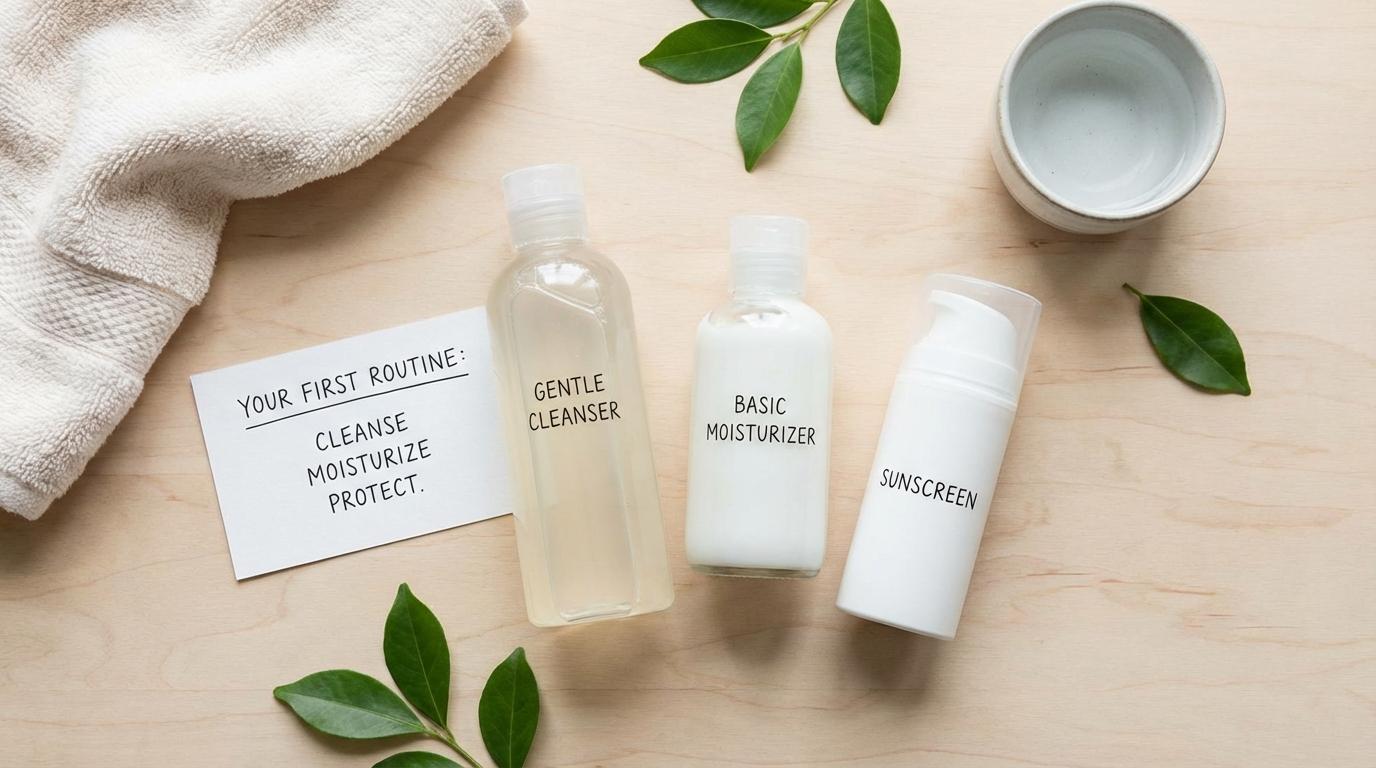
According to Cleveland Clinic dermatologists, the core routine that actually matters comes down to three things: cleanse, moisturize, and protect. That’s it. Everything else is extra credit.
I know it feels like you’re missing out by not having 10 products lined up on your bathroom counter. But dermatologist Dr. Karan Lal puts it perfectly: “Less is more when it comes to your skin. In reality, our skin chemistry needs hydration and moisture to maintain a good skin barrier, which you can get from just a few products.” So if anyone makes you feel bad for having a “boring” routine, remember that an actual skin doctor said this.
The Three Products You Actually Need
Let’s break down your starter kit. These are the only three products you need to buy right now. Seriously. Put your wallet away after this.
Product One: A Gentle Cleanser
Your cleanser’s job is to remove dirt, oil, sunscreen, and whatever else accumulated on your face throughout the day. That’s it. It doesn’t need to be fancy. It doesn’t need to tingle. It definitely doesn’t need to make your face feel “squeaky clean” because that squeaky feeling usually means you’ve stripped your skin and now it’s going to overcompensate by producing more oil.
Look for something labeled “gentle” or “for sensitive skin” even if you don’t have sensitive skin. These formulas are less likely to irritate you while you’re figuring out what your skin likes. Good drugstore options include CeraVe Hydrating Cleanser, Vanicream Gentle Facial Cleanser, or La Roche-Posay Toleriane Hydrating Gentle Cleanser. All of these are under $20 and will last you months.
Product Two: A Basic Moisturizer
Every skin type needs moisturizer. Yes, even oily skin. Yes, even if you think your face is already “moist enough.” When your skin is properly hydrated, it works better. It heals faster. It’s less likely to freak out and break out.
For daytime, look for something lightweight that absorbs quickly. For nighttime, you can go a bit thicker if you want. Or just use the same thing morning and night because honestly, that works too. CeraVe Moisturizing Cream, Neutrogena Hydro Boost, or even the basic Cetaphil Moisturizing Lotion are all solid picks that won’t break the bank.
Product Three: Sunscreen (Yes, Really)
I’m going to be honest with you: if you skip everything else and only do one thing, make it sunscreen. According to the American Academy of Dermatology, daily sun protection is the single most effective anti-aging step you can take. It also helps prevent skin cancer, which is kind of important.
Look for SPF 30 or higher with “broad spectrum” on the label. This means it protects against both UVA rays (which cause aging and can penetrate through windows) and UVB rays (which cause sunburn). And yes, you need to wear it even on cloudy days. Dermatologists note that 80% of UV rays can penetrate cloud cover. If you hate the feeling of sunscreen, try the newer formulas that feel more like moisturizers. Supergoop, La Roche-Posay, and even Neutrogena have options that don’t feel like you’re wearing a layer of grease.
Building From This Foundation
Once you’ve got your three basics down and you’ve been consistent for at least a month, then you can think about adding things. The key word here is “think.” You don’t have to add anything. Your skin might be perfectly happy with just these three products forever.
But if you do want to level up eventually, here’s a smart order to consider:
- Month 2-3: Maybe add a simple serum like niacinamide or vitamin C in the morning. These are pretty gentle and work for most skin types.
- Month 4+: If you want to tackle specific concerns like acne or texture, this is when you might look into actives like salicylic acid or retinol. But go slow. Like, really slow.
Dr. Karen Kagha, a board-certified dermatologist, emphasizes introducing products slowly. By adding one new thing at a time and waiting a few weeks between additions, you can actually tell what’s working and what might be causing problems. If you add five products at once and your skin freaks out, good luck figuring out which one is the culprit.
Your Morning Routine (Takes 2 Minutes)
Let’s put this into practice. Here’s what your morning looks like:
- Cleanse: Splash your face with water or use your gentle cleanser. Some people find that water alone is fine in the morning since you weren’t doing anything dirty in your sleep. Try both and see what feels right.
- Moisturize: Apply your moisturizer to slightly damp skin. This helps lock in hydration.
- Sunscreen: Apply SPF as your last step. Give it a minute to absorb before makeup if you wear any.
That’s genuinely it. Two minutes, three products, done.
Your Evening Routine (Takes 3 Minutes)
Nighttime is even simpler because you don’t need sunscreen:
- Cleanse: This one is non-negotiable. You need to get the day off your face, including any sunscreen and makeup. If you wear heavy makeup, you might want to do a double cleanse with an oil-based cleanser first, then your regular cleanser. But if you just wore sunscreen, one cleanse is usually enough.
- Moisturize: Apply your moisturizer. You can use the same one as morning or something heavier if you like. Dermatologists often say to think of your nighttime routine as “repair time” while your morning routine is about “protection.”
Go to sleep. Let your skin do its thing. It’s actually pretty good at taking care of itself when you give it the basics.
Common Beginner Mistakes (Learn From Mine)
I made a lot of mistakes when I first started. Here are the ones I wish someone had warned me about:
Mistake 1: Doing Too Much Too Fast
This is the big one. You get excited, you buy seven products, you use them all on the same night, and suddenly your face is red and angry and you have more pimples than you started with. The skinimalism trend exists for a reason. Using lots of different products with many active ingredients can actually weaken your skin barrier, leading to dryness, sensitivity, and inflammation.
Mistake 2: Expecting Overnight Results
Your skin turns over about every 28 days. This means you’re not going to see dramatic changes for at least a month, and more realistically, visible improvements often take eight to twelve weeks. If you’re switching products every two weeks because you don’t see results, you’re never giving anything a fair chance.
Mistake 3: Skipping Sunscreen Because It’s Cloudy
I already mentioned this but I’m saying it again because I used to be that person. “It’s January. It’s raining. I’m not going outside.” Your face doesn’t care. UV rays don’t care. Wear the sunscreen.
Mistake 4: Thinking Expensive Equals Better
Some of the best products in skincare are also the cheapest. CeraVe was literally developed with dermatologists and costs like $15. That $90 moisturizer at Sephora might feel fancy, but the basic Cetaphil is doing the same job. Don’t let marketing make you think you need to spend more to get results.
Mistake 5: Touching Your Face All Day
Your hands are dirty. Your phone is dirty. That pen you’ve been chewing on is really dirty. Every time you touch your face, you’re transferring bacteria and oil. Try to be aware of it, especially if you’re dealing with breakouts.
What About All Those Other Products?
I know you’re probably wondering about toners, essences, serums, masks, exfoliants, eye creams, spot treatments, and whatever new category the beauty industry invented this week. Here’s my honest take: you don’t need any of them to start.
Toners were originally designed to remove leftover cleanser residue, but modern cleansers rinse off cleanly. Eye creams are usually just moisturizer in smaller, more expensive packaging. Masks are fun but not essential. You can add these things later if you want to, but please don’t feel like your routine is somehow incomplete without them.
The skincare industry makes money by convincing you that you need more products. But dermatologists, the people who actually went to medical school for this, keep saying the same thing: start simple, stay consistent, and protect yourself from the sun.
The Real Secret Nobody Talks About
The best skincare routine is the one you’ll actually do. A $500 collection of products sitting on your counter because the routine is too complicated is doing nothing for your skin. Three basic products that you use every single day, morning and night, will get you further than any expensive serum you use occasionally.
So start with what you can afford. Start with what you can commit to. And stop comparing your routine to what you see on social media. Those bathroom shelves full of products are often sponsored content, not real life.
You’ve got this. Three products. Two minutes in the morning. Three minutes at night. That’s your first skincare routine, and honestly, it might be the only one you ever need.