
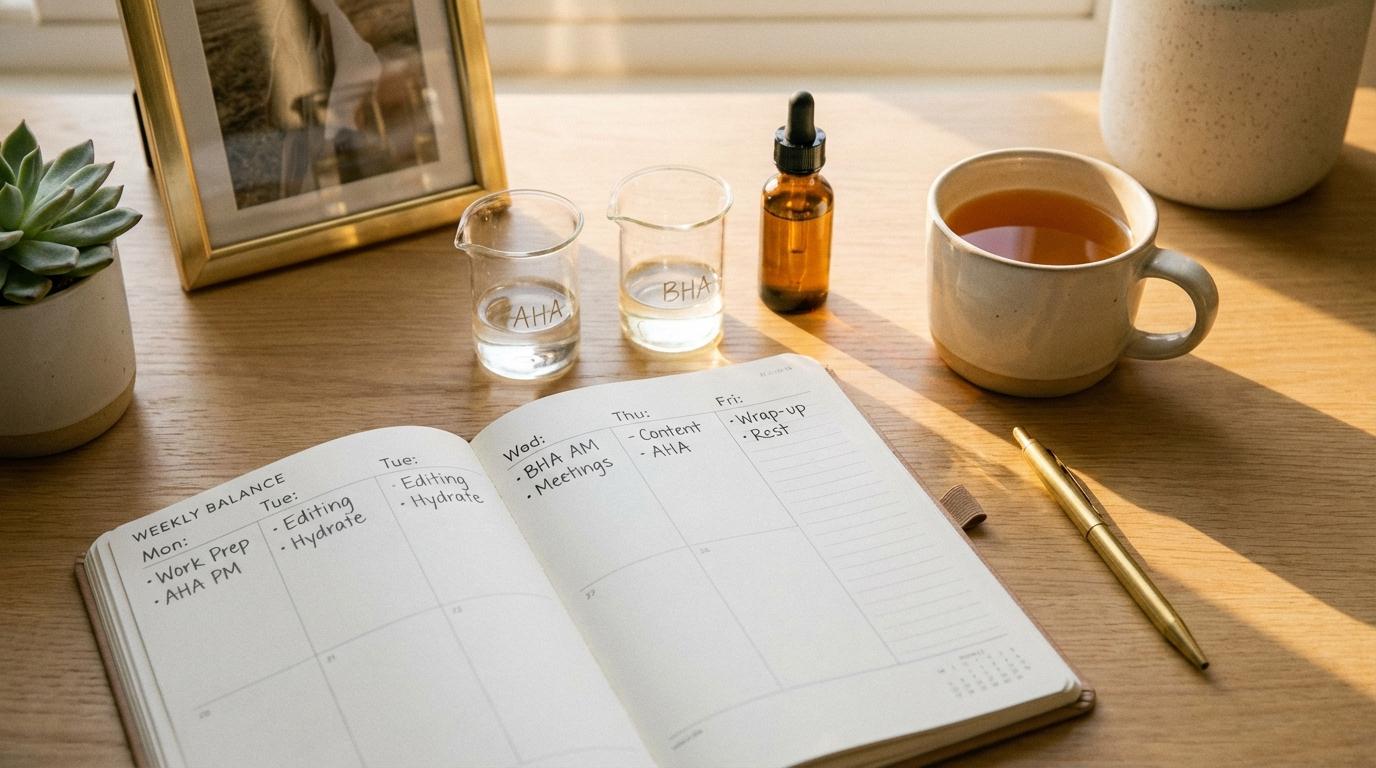
Why do people act like BHA and AHA are basically the same thing when they literally work in completely different ways? I’ve lost count of how many times I’ve seen someone ask “should I use AHA or BHA?” and get answers like “just use whichever one you have” as if they’re interchangeable products (they’re not, and I’m going to explain exactly why).
Understanding the difference between these two types of chemical exfoliants isn’t just skincare trivia. It’s genuinely the difference between getting the results you want and wondering why that expensive bottle of acid isn’t doing anything for your specific concerns. Let me break this down in a way that actually makes sense.
The Basic Science (Without the Boring Parts)
The most fundamental difference comes down to how these acids interact with oil and water. AHAs, which include glycolic acid, lactic acid, and mandelic acid, are water-soluble. BHAs, primarily salicylic acid, are oil-soluble. This sounds like a tiny detail, but it changes absolutely everything about how these ingredients work on your skin.
Water-soluble AHAs work on the skin’s surface. They dissolve the bonds between dead skin cells that are just hanging out on top, making them easier to slough off. According to dermatologists at the American Academy of Dermatology, this surface-level exfoliation is particularly helpful for addressing dullness, uneven texture, and fine lines.
Oil-soluble BHA can actually penetrate into your pores. Because sebum (the oily stuff your skin produces) is, well, oily, salicylic acid can cut right through it and get inside the pore to clean things out from the inside. This is why BHA is constantly recommended for acne-prone skin. It’s not just working on the surface; it’s getting in there and doing the real work.
What Your Skin Type Actually Needs
This is where things get personal (in a good way). Your skin type and your main concerns should drive your decision here, not what’s trending on skincare TikTok.
Go with BHA if:
- You’re dealing with blackheads or whiteheads on the regular
- Your pores look enlarged (BHA can help them appear smaller by clearing out the gunk)
- Your skin tends to be oily, especially in the T-zone
- You get hormonal breakouts around your chin or jawline
- Your skin is generally pretty resilient and not super sensitive
Go with AHA if:
- Your main concern is dull, tired-looking skin
- You’re noticing fine lines and want to improve texture
- You have dry skin that needs both exfoliation and a bit of hydration boost (AHAs like lactic acid are humectants)
- Sun damage has left you with uneven tone or dark spots
- Your skin feels rough even though you’re moisturizing
Research published in Clinical, Cosmetic and Investigational Dermatology found that AHAs can increase skin thickness over time while improving hydration levels. This makes them particularly solid for anyone whose skin is feeling thin, dry, or just generally depleted.
The Combination Skin Dilemma
If you have combination skin (oily in some areas, dry in others), you might be sitting there thinking you need both. And honestly? You might be right. But there’s a smart way and a “why is my face on fire” way to approach this.
The multi-masking approach works really well here. Use a BHA product on your oily, congested areas (usually the nose, forehead, and chin) and an AHA on the drier areas (cheeks, around the mouth). You don’t have to apply everything everywhere. Your skin isn’t one uniform surface, so treat different zones differently.
Alternatively, you can alternate between them. BHA one night, AHA another night, with rest days in between where you just focus on hydration and skip the acids entirely. Your moisture barrier will thank you for the breaks.
Can You Actually Use Both in One Routine?
The short answer is yes, but the longer answer involves some important caveats (because of course it does).
Using AHA and BHA together can actually be really effective. Some products are formulated with both, and the combination can give you surface exfoliation plus pore-clearing power at the same time. Paula’s Choice explains that the key is paying attention to the overall concentration and pH of what you’re using.
That said, this isn’t a “more is more” situation. If you’re new to chemical exfoliants, please don’t start by slapping both on your face every day. Start with one, use it a few times a week, let your skin get used to it for a month or so, and then consider adding the other if you feel like you need it. If you’re curious about combining acids safely, we have a whole guide on layering acids without wrecking your face that covers this in detail.
Concentration Matters (A Lot)
Not all AHAs and BHAs are created equal, and the percentage on the bottle is something you should actually pay attention to.
For BHA, most products range from 0.5% to 2% salicylic acid. The 2% concentration is what’s typically recommended for addressing acne, but if your skin is sensitive, starting at 0.5% or 1% is completely valid. Higher isn’t automatically better; it’s just more intense.
AHAs have a wider range. Glycolic acid products can go from 5% all the way up to 30% (those higher percentages are usually for professional peels, not daily use). Lactic acid tends to be gentler and is often found in the 5-10% range for at-home products. Mandelic acid is even gentler still, making it a good option if you’ve tried glycolic and found it too harsh.
The pH of the product also affects how well the acid works. Generally, a pH between 3 and 4 is the sweet spot for effectiveness without being unnecessarily irritating. Most well-formulated products take care of this for you, but if you’re DIY-mixing or buying from less established brands, it’s worth checking.
Signs You’ve Picked the Wrong One
Sometimes you try a product and it just doesn’t click with your skin. Here’s how to tell if you might need to switch:
Your BHA isn’t working if: After 6-8 weeks of consistent use, your pores still look as congested as ever, or you’re not seeing any reduction in breakouts. It might also mean your congestion isn’t the oily kind that BHA targets. Some people have dry, flaky buildup that’s actually better addressed by AHA.
Your AHA isn’t working if: You’re still getting blackheads no matter how smooth and glowy the rest of your face looks. AHA works on the surface, but if your problems are happening inside the pore, it simply can’t reach them. That’s BHA territory.
Also, if either acid is causing persistent redness, flaking that doesn’t improve after the first few weeks, or a stinging sensation every time you apply it, you might be using it too often or the concentration might be too high for your skin. Scale back before you damage your moisture barrier (repairing that is a whole other project you don’t want to take on).
What About Sensitive Skin?
Sensitive skin types often worry that chemical exfoliants are off-limits entirely, but that’s not necessarily true. You just have to be pickier about which ones you use and how often.
For sensitive skin leaning towards AHAs, lactic acid and mandelic acid are your friends. They have larger molecule sizes, which means they penetrate more slowly and cause less irritation. Dermstore notes that mandelic acid in particular is well-tolerated even by those with rosacea-prone skin.
For sensitive skin that still needs pore-clearing, look for lower concentration BHA products (0.5-1%) or consider betaine salicylate, a gentler derivative of salicylic acid that some K-beauty brands use. It’s less potent, but that’s kind of the point.
If your skin is dealing with redness as a primary concern, you might also want to look into gentler alternatives like azelaic acid, which can address multiple concerns without the irritation potential of AHAs or BHAs.
Building Your Routine Around Your Choice
Once you’ve figured out which acid makes sense for you, here’s how to actually incorporate it into what you’re already doing.
Most acids work best on clean, dry skin before your other products. The general order is: cleanser, acid, let it sit for a minute or two, then follow with the rest of your routine (serums, moisturizer, etc.). Some people prefer to use acids at night because they can make your skin temporarily more sensitive to the sun, and you’re (hopefully) not going outside while you sleep.
Speaking of sun: please wear SPF the morning after using any acid. AHAs especially can increase photosensitivity for up to a week after use. This isn’t optional advice; it’s genuinely important if you don’t want to undo all the brightening work your AHA is doing by getting sun damage.
Start with using your chosen acid 2-3 times a week, not every day. Give your skin time to adjust, and increase frequency only if your skin tolerates it well. Some people work up to daily use; others find 2-3 times weekly is their permanent sweet spot. Both are fine.
What If You’re Still Not Sure?
If you’ve read all this and you’re still on the fence, start with what addresses your most annoying concern. Breakouts and oily skin? BHA first. Dullness and texture? AHA first. You’re not locked into your choice forever. Skincare is about responding to what your skin needs right now, and that can change with the seasons, your hormones, your stress levels, basically everything.
The worst thing you can do is buy both and use them haphazardly without paying attention to how your skin responds. Be intentional about it. Pick one, give it a real chance (at least 6-8 weeks of consistent use), and then reassess. That’s how you figure out what actually works for your skin instead of just collecting half-empty bottles of products that never quite delivered.