
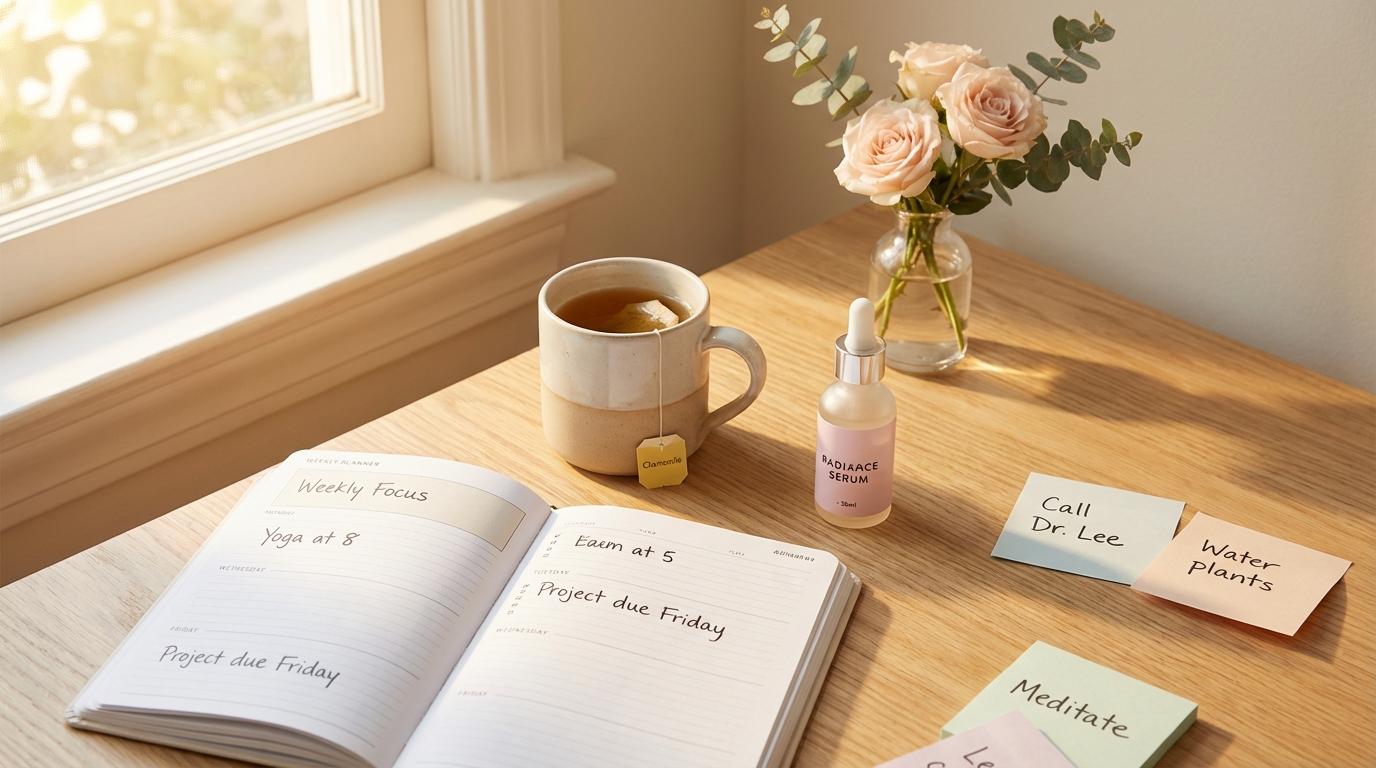
Scrolling through skincare content reveals bathroom shelves stacked with dozens of products, elaborate 10-step routines, and people who seemingly have hours each morning to layer serums. The reality for most women looks nothing like this. Between work, relationships, exercise, sleep, and whatever else fills the spaces between, skincare often becomes either an overwhelming chore or something that gets skipped entirely.
There is another way. A skincare routine built around your actual life, with your real schedule and genuine limitations, will always outperform the most photogenic collection of products you never use. This is about creating something sustainable, something that feels like self-care rather than another obligation on an already full list.
Taking an Honest Look at Your Time
Before purchasing anything new or restructuring what you already do, spend a week noticing your mornings and evenings. Not the ideal versions, but the real ones. The mornings where you hit snooze twice. The evenings when you collapse into bed barely able to brush your teeth. The lazy Sundays when you have more space. All of these matter when building a routine that actually works.
Ask yourself some straightforward questions. How many minutes do you genuinely have in the morning before you need to leave? What does your evening energy level look like after a typical day? Do you travel frequently? Do you have small children who interrupt bathroom time? These factors shape what is actually possible for you, and there is no shame in acknowledging limitations.
A routine that takes fifteen minutes is lovely in theory, but if you have seven minutes on a good day, fifteen-minute routines will simply not happen. Consistency matters more than complexity. The products you use four times a week will do more for your skin than the elaborate routine you manage twice a month when guilt finally catches up with you.
Matching Products to Your Reality
Once you understand your time constraints, you can choose products that fit within them. This is where being selective becomes genuinely valuable. The minimalist approach suggests that most skin types thrive with three core steps: cleanse, treat, and moisturize. Some dermatologists argue you can simplify even further.
For rushed mornings, consider what can be combined. A moisturizer with SPF eliminates one step. A cleanser that removes makeup means no separate makeup remover at night. A treatment serum that addresses multiple concerns saves you from layering three different products. Multi-tasking formulas exist precisely for people whose lives do not accommodate lengthy routines.
If you have only five minutes morning and night, a gentle cleanser, one treatment product (like vitamin C in the morning or retinol at night), and a moisturizer with sun protection is a complete routine. That is three products total. If you love the simplicity of just two products, you can even pare down further with a cleanser and a good moisturizer with SPF.
For those with a bit more time, perhaps ten to fifteen minutes, you might add a separate sunscreen, an eye cream, or an occasional exfoliating treatment. The point is matching your products to your actual available minutes, not the other way around.
Permission to Skip What Does Not Serve You
One of the most freeing shifts in skincare is recognizing that you do not need everything. Eye cream is optional if your moisturizer already hydrates the eye area well. Toner is optional if your cleanser is gentle and your skin feels balanced without it. Essence is optional, full stop. Sheet masks are nice but far from necessary.
Social media creates a false impression that more steps equal better skin. Research does not support this. Adding too many products can actually backfire, with ingredients interfering with each other or causing irritation from overuse. Your skin has limits on what it can absorb and process at once.
Consider what each product in your current routine actually does for you. If you cannot point to a specific benefit, it might be something you are using because you feel you should rather than because it helps. There is real value in removing steps that add time without adding results. A simplified approach might actually serve your skin better than an elaborate one you struggle to maintain.
Building for Different Days
Not every day needs to look the same. A realistic routine often has two or three versions: the bare minimum for exhausting days, the standard routine for typical days, and perhaps an expanded version for weekends or days when you have more space.
The bare minimum might be: remove makeup with micellar water, apply moisturizer. That is it. On days when everything else falls apart, this keeps your skin clean and hydrated. No guilt required for skipping other steps.
Your standard routine adds whatever treatment products matter most to you. Maybe that is a vitamin C serum in the morning and retinol a few nights per week. Maybe it is niacinamide for oil control or hyaluronic acid for hydration. Choose one or two targeted treatments rather than trying to address every possible concern simultaneously.
The expanded version might include a weekly exfoliant, an occasional mask, or extra time for facial massage. These are treats rather than requirements. They happen when life allows, not because a schedule demands them.
Choosing Consistency Over Perfection
The best skincare routine is the one you will actually do. This sounds obvious, but it contradicts much of what skincare content promotes. The most expensive products, the most innovative ingredients, the most comprehensive routines mean nothing if they sit unused on your shelf or become sources of stress.
Studies on skincare efficacy consistently show that consistency matters more than complexity. Using a basic moisturizer every single day will do more for your skin than using a fancy serum sporadically. Regular sunscreen application matters more than which specific sunscreen you choose.
This is good news for anyone feeling overwhelmed. You do not need the perfect routine. You need a routine that is good enough and that you can maintain through busy weeks, stressful months, and all the unpredictable moments that make up an actual life.
Adjusting as Life Changes
Your routine should evolve as your circumstances shift. A new job with earlier hours might mean simplifying your morning steps. A period of less stress might create space for more elaborate evening care. Moving to a different climate changes what your skin needs. Having a baby, starting a new relationship, changing your exercise habits: all of these can affect both your available time and your skin itself.
Check in with yourself every few months. Is your current routine still working? Do you skip steps regularly? Does your skin feel good? Are you enjoying the process or dreading it? Adjust based on honest answers rather than what you think you should be doing.
If something has become a chore, that is information. Either the product is not right for you, the step is unnecessary, or you need a simpler version of the routine. Pay attention to resistance rather than pushing through it with willpower that will eventually run out.
Finding Your Own Version
Ultimately, creating a skincare routine for your lifestyle means tuning out the noise and tuning into yourself. What does your skin actually need? What do you genuinely have time for? What feels like care rather than obligation?
The answers will be different for everyone. Someone working from home might have time for a more leisurely routine than someone commuting an hour each way. A night owl might prefer more steps in the evening and almost nothing in the morning. A parent of young children might need everything to happen in under three minutes. All of these are valid.
Instagram routines exist for Instagram. Your routine exists for you, for your skin, for your actual days and nights. When you build from that foundation, skincare becomes what it is meant to be: a small act of care woven into the fabric of daily life, sustainable and gentle rather than another item on an endless to-do list.
Start where you are. Use what you have. Do what you can maintain. That is enough. In fact, that is everything.