
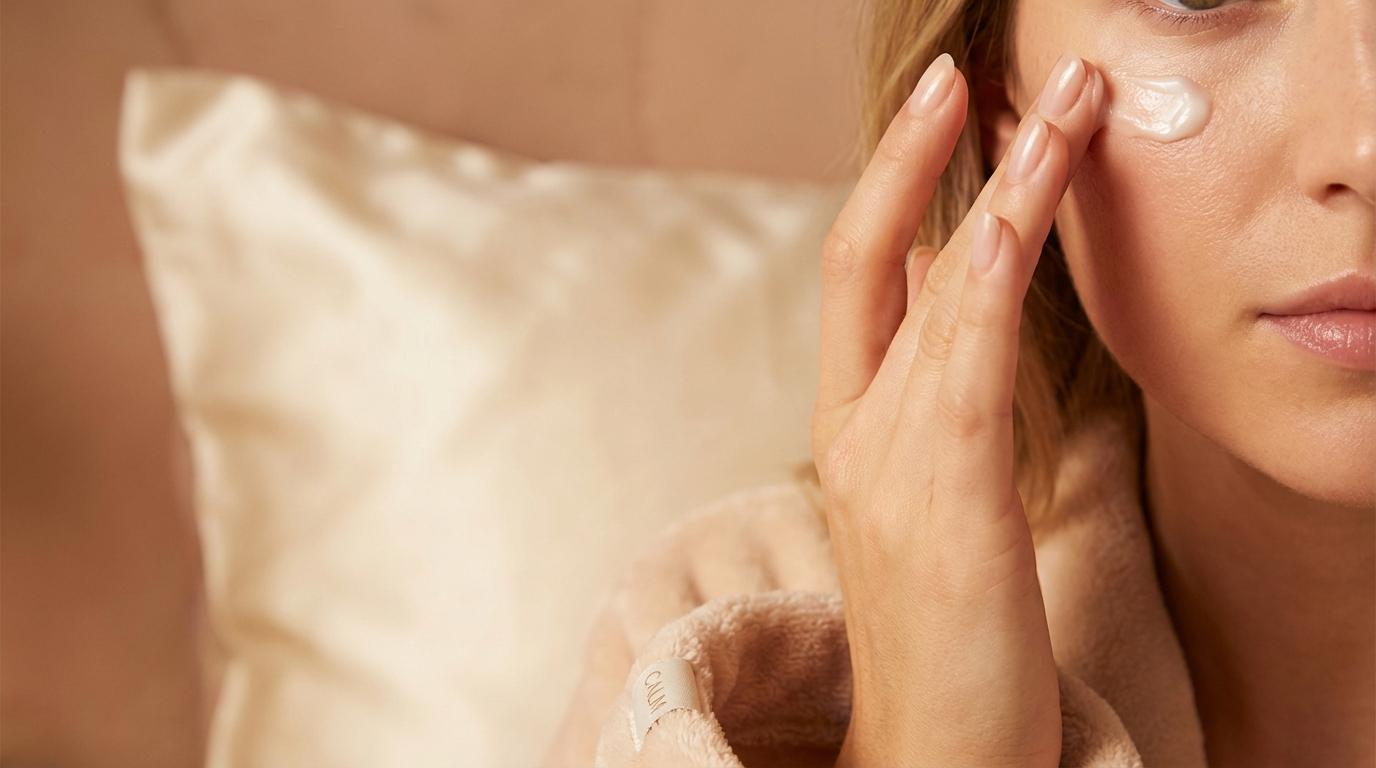
Everyone needs a dedicated eye cream to prevent wrinkles. That statement gets repeated so often in beauty marketing that most of us accept it as scientific fact without question.
But when I actually started reading dermatology research during my biochem degree, I discovered the reality is way more nuanced. The answer to whether you need an eye cream depends entirely on what you’re already using, what concerns you’re targeting, and honestly, your budget.
What Actually Makes the Eye Area Different
Before we can answer the eye cream question, we need to understand what makes periorbital skin (that’s the fancy term for the skin around your eyes) unique. And it genuinely is different from the rest of your face.
According to research published in the Journal of the European Academy of Dermatology and Venereology, the periorbital area measures approximately 52.7 micrometers thick. To put that in perspective, your palm skin is about 182.9 micrometers. We’re talking about skin that’s roughly three times thinner than the rest of your face.
This matters for several reasons:
- No sebaceous glands: The eye area and lips are the only facial zones without oil glands. This makes the skin naturally drier and more prone to showing signs of aging.
- Constant movement: You blink about 15,000 times per day. Every squint, smile, and expression works those tiny muscles, creating mechanical stress that other areas don’t experience.
- Thinner dermis: The dermis layer here contains less collagen and elastin to begin with, making it more vulnerable to breakdown.
- Visible blood vessels: That thin skin means blood vessels show through more easily, contributing to dark circles.
A 2025 study in the Journal of Cosmetic Dermatology used high-frequency ultrasonography to map the periorbital region and confirmed that the upper eyelid has the thinnest skin, followed by the lower eyelid. These anatomical differences are real and measurable.
When Your Regular Face Cream Works Just Fine
The beauty industry wants you to believe eye cream is non-negotiable. But many dermatologists point out something inconvenient for brands: hydrating eye creams often contain the exact same ingredients in the same proportions as regular moisturizers.
If you’re in your early twenties with no specific eye concerns, and you’re using a gentle, fragrance-free moisturizer, you can absolutely apply it around your eyes. The key word is gentle. Avoid anything with:
- High concentrations of AHAs or BHAs
- Strong fragrances
- Essential oils
- High-percentage vitamin C (above 15%)
If you’ve already invested in a solid minimalist routine, adding a separate eye cream for basic hydration is essentially paying for repackaged moisturizer in a smaller, more expensive container.
Research from a review published in PMC noted that there’s actually a lack of clinical trials specifically testing eye cream formulations on periorbital skin. Much of what we “know” about eye creams comes from general facial skincare research applied to the eye area.
When a Specialty Eye Product Actually Helps
That said, there are legitimate situations where a dedicated eye product makes sense. The key is understanding what you’re trying to achieve.
For Retinol Users
If you’re using retinol on your face (and you probably should be if you’re concerned about aging), the eye area needs special consideration. Most face retinols are formulated at 0.5% to 1%, which can be too aggressive for periorbital skin.
Eye-specific retinol products typically contain:
- Lower concentrations (0.025% to 0.3%)
- Encapsulated delivery systems for slower release
- Buffer ingredients to reduce irritation
The alternative? You can buffer your regular retinol by applying a thin layer of moisturizer first around the eyes, then the retinol on top. This essentially dilutes the concentration for that area. It works, but it requires more attention to application technique.
For Specific Concerns
Certain eye-area issues do benefit from targeted ingredients at specific concentrations:
Puffiness: Caffeine is a vasoconstrictor that temporarily reduces fluid retention. Research shows caffeine can reduce puffiness when formulated at around 3%. Most face creams don’t contain caffeine since it’s not particularly useful for the rest of your face.
Dark circles from pigmentation: Vitamin C, niacinamide, and arbutin can help with hyperpigmentation. However, you need stable formulations at effective concentrations. If you’re dealing with hereditary or vascular dark circles, check out this routine specifically for under-eye darkness.
Fine lines: Peptides like Matrixyl (palmitoyl pentapeptide-4) signal skin to produce more collagen. A study in the International Journal of Cosmetic Science found peptides significantly improved skin smoothness and reduced wrinkle depth. Peptides are gentle enough for daily use and rarely cause irritation, making them ideal for the eye area.
The Best Ingredients for Eyes (Based on Actual Research)
If you decide an eye cream makes sense for your situation, these are the ingredients with legitimate scientific backing:
Retinoids (For Fine Lines and Wrinkles)
Still the gold standard for anti-aging. Research confirms that topical retinol inhibits metalloproteinases (enzymes that break down collagen) and stimulates new collagen synthesis. For the eye area, look for products with:
- Retinol at 0.1% to 0.3%
- Retinaldehyde (gentler, converts to retinoic acid in one step)
- Encapsulated retinol for gradual release
Start with 2-3 times per week application and increase gradually. Always use sunscreen.
Peptides (For Firmness and Wrinkle Prevention)
Unlike retinoids, peptides don’t increase photosensitivity and rarely cause irritation. They work by signaling fibroblasts to produce more collagen. Key peptides to look for:
- Matrixyl: One of the most studied peptides for wrinkle reduction
- Argireline: Sometimes called “topical Botox” (though that’s an overstatement), it may help relax expression lines
- Copper peptides: Support skin repair and have antioxidant properties
Caffeine (For Puffiness)
Caffeine constricts blood vessels and reduces fluid accumulation. It also has antioxidant properties. Studies show caffeine can reduce dark circles and wrinkles while boosting elasticity. For maximum effect, look for products with at least 1-3% caffeine combined with:
- Hyaluronic acid for hydration
- Niacinamide for barrier support
- Cooling applicators (metal tips) to enhance the depuffing effect
One caveat: combining caffeine with retinol around the eyes may be too harsh for some people. If you’re using both, apply them at different times (caffeine in the morning, retinol at night).
Niacinamide (For Dark Circles and Barrier Function)
Niacinamide at 2-5% helps with multiple concerns:
- Inhibits melanin transfer (helps with pigmented dark circles)
- Strengthens the skin barrier
- Reduces transepidermal water loss
It’s also incredibly well-tolerated and plays nicely with basically every other ingredient.
Ceramides (For Dry, Crepey Skin)
Since the eye area lacks oil glands, ceramides help replace the lipids your skin can’t produce there. They’re especially helpful if your eye area looks dry or crepey rather than just wrinkled.
My Honest Recommendation
After reviewing the research, here’s my take:
Skip the eye cream if:
- You’re under 25 with no specific eye concerns
- Your moisturizer is gentle and fragrance-free
- You’re on a tight budget and need to prioritize
Consider an eye cream if:
- You use active ingredients (retinol, AHAs) on your face and need gentler alternatives for eyes
- You have specific concerns like puffiness, dark circles, or crow’s feet
- Your eye area is noticeably drier or more reactive than the rest of your face
The most important thing isn’t whether you use an eye cream. It’s whether you’re protecting the area from UV damage (sunscreen and sunglasses), staying hydrated, getting adequate sleep, and being gentle during application and makeup removal.
A $15 eye cream with good peptides will do more for you than a $100 one with trendy but unproven ingredients. Read the ingredient list, check the concentrations when possible, and don’t let marketing convince you that eye cream is a non-negotiable when science says otherwise.
The real answer to “do you need eye cream?” is: it depends. And that’s not the answer beauty brands want you to hear.