
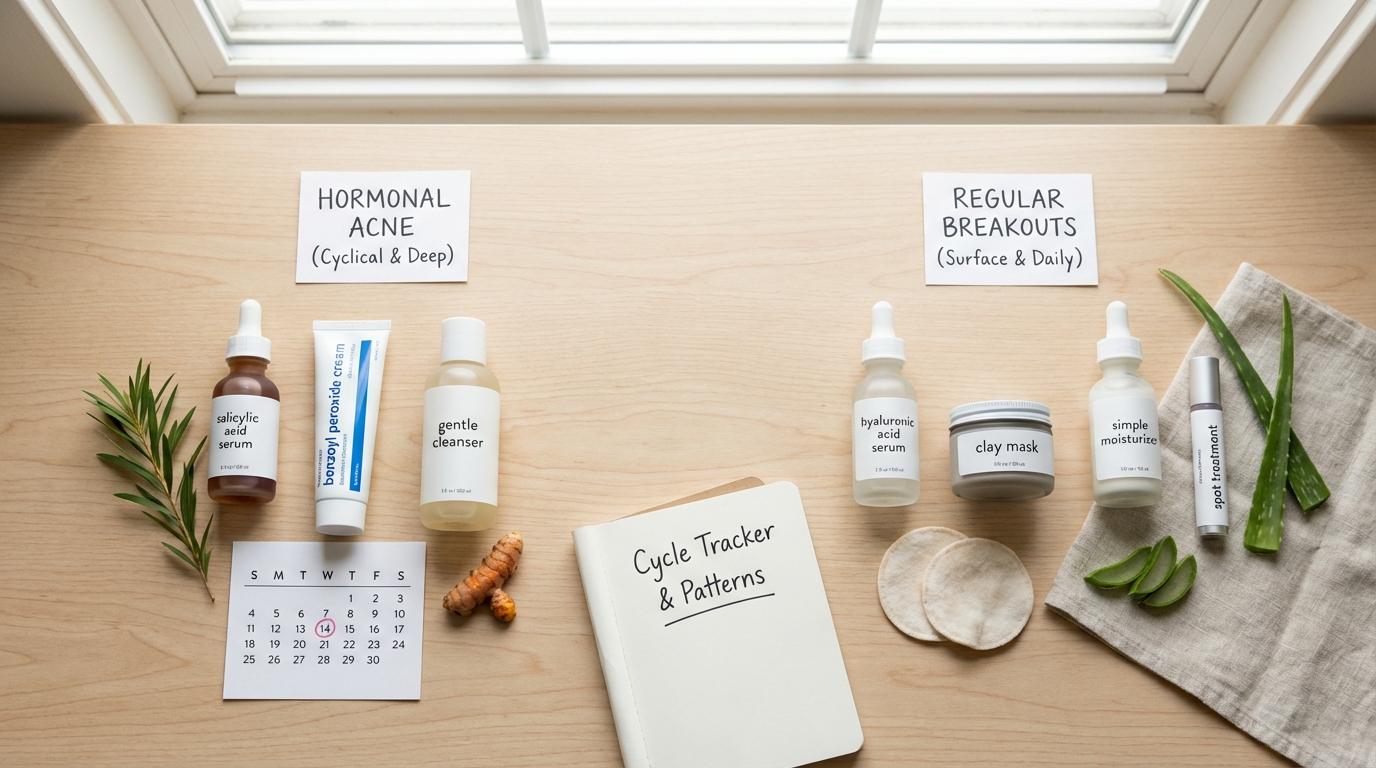
Look, I spent years as a beauty editor watching brands push the same acne treatments for completely different skin issues. Here’s the truth: hormonal acne and regular breakouts are not the same thing. They look different, act different, and need different approaches. Treating one like the other? That’s why your skincare routine might not be working.
Let me break down exactly how to tell these two apart so you can stop wasting money on products that were never going to help you in the first place.
Where Your Breakouts Show Up Matters More Than You Think
This is the biggest giveaway, and honestly, most people miss it.
Hormonal acne has a pattern. It shows up along your jawline, chin, and lower cheeks. Some people get it on their neck too. This isn’t random. These areas have more hormone receptors in the oil glands, which is why they respond so dramatically when your hormones fluctuate.
According to the American Academy of Dermatology, this lower face pattern is one of the most reliable indicators of hormonal involvement.
Regular breakouts are less predictable. They can pop up anywhere: your forehead, nose, cheeks, wherever your pores get clogged. If you’re breaking out in your T-zone or scattered across your face without a clear pattern, you’re probably dealing with regular acne triggered by things like:
- Product buildup
- Not removing makeup properly
- Touching your face
- Sweat and oil from workouts
- Comedogenic ingredients in your products
Quick test: grab a mirror and really look at where your breakouts cluster. Jawline and chin? Likely hormonal. Everywhere else or mainly your forehead and nose? Probably regular acne.
The Timing Connection Nobody Talks About Enough
Here’s where it gets interesting. Hormonal acne follows a schedule. Your schedule.
If you menstruate, pay attention to when your breakouts appear. Hormonal acne typically flares up during specific phases of your cycle:
- 7-10 days before your period (the luteal phase, when progesterone peaks)
- Right around your period (when both estrogen and progesterone drop)
- Around ovulation for some people (mid-cycle hormone surge)
Research published in the Archives of Dermatology found that over 60% of women with acne report premenstrual flares. That’s not a coincidence.
Regular breakouts don’t care about your cycle. They happen when something clogs your pores, whether that’s last Tuesday or three weeks from now. No pattern, no monthly schedule.
Start tracking your breakouts alongside your period for two to three months. The pattern, or lack of one, will tell you a lot.
Feel the Difference: Texture and Depth
This one requires you to actually pay attention to what your breakouts feel like, not just look at them in the mirror while panicking.
Hormonal acne tends to be deep, cystic, and painful. We’re talking those hard, underground bumps that hurt when you touch them and sometimes don’t even come to a head. They’re inflamed from the inside, caused by hormonal changes affecting oil production deep in the skin. According to StatPearls medical literature, these nodular and cystic lesions form when inflammation occurs deep within the follicle.
These are the ones that stick around for weeks, leave marks, and make you want to cancel plans.
Regular breakouts are usually more superficial. Whiteheads, blackheads, smaller pustules that come to a head relatively quickly. They’re closer to the surface and generally less painful. You might wake up with one and watch it resolve within a few days.
Here’s a comparison:
- Hormonal: Deep, tender, hard lumps. Often no visible head. Lasts 1-4 weeks. Leaves hyperpigmentation or scars.
- Regular: Surface-level, comes to a head, resolves in days. Less likely to scar unless you pick at it.
Why Your Treatment Strategy Needs to Change
This is where I see people waste the most money. And I get it. When you’re breaking out, you’ll try anything. But using the wrong approach is like bringing a knife to a gunfight.
For regular breakouts, your topical products can actually do the heavy lifting:
- Salicylic acid to clear pores
- Benzoyl peroxide to kill bacteria
- Retinoids for cell turnover
- Proper cleansing routine
- Non-comedogenic products only
These work because regular acne is largely a surface issue. Clogged pores, bacteria, dead skin cells. Topicals can reach the problem.
For hormonal acne, topicals alone often aren’t enough. The issue starts internally, so you might need to address it from the inside too. The Journal of the American Academy of Dermatology notes that hormonal treatments can be highly effective for adult women with acne concentrated on the lower face.
Options that actually help hormonal acne:
- Spironolactone (prescription, blocks androgen receptors)
- Certain birth control pills (regulate hormones)
- Topical retinoids (still helpful but not a complete solution alone)
- Azelaic acid (anti-inflammatory, good supporting player)
If you’ve been using every acne product on the shelf and your jawline is still a mess every month, it’s time to talk to a dermatologist about what’s happening internally. Topical products can help manage hormonal acne, but they’re fighting an uphill battle without addressing the hormonal component.
The Bottom Line
Knowing what you’re dealing with is half the battle. Hormonal acne sits on your jawline, follows your cycle, feels deep and painful, and needs more than drugstore products. Regular breakouts show up anywhere, happen randomly, are more surface-level, and respond well to topical treatments.
Stop treating all acne the same. Figure out which one you have, then build your strategy around it. And if you’re stuck, a dermatologist can run hormone panels and actually look at what’s going on beneath the surface.
Your skin isn’t broken. You might just be using the wrong tools for the job.