
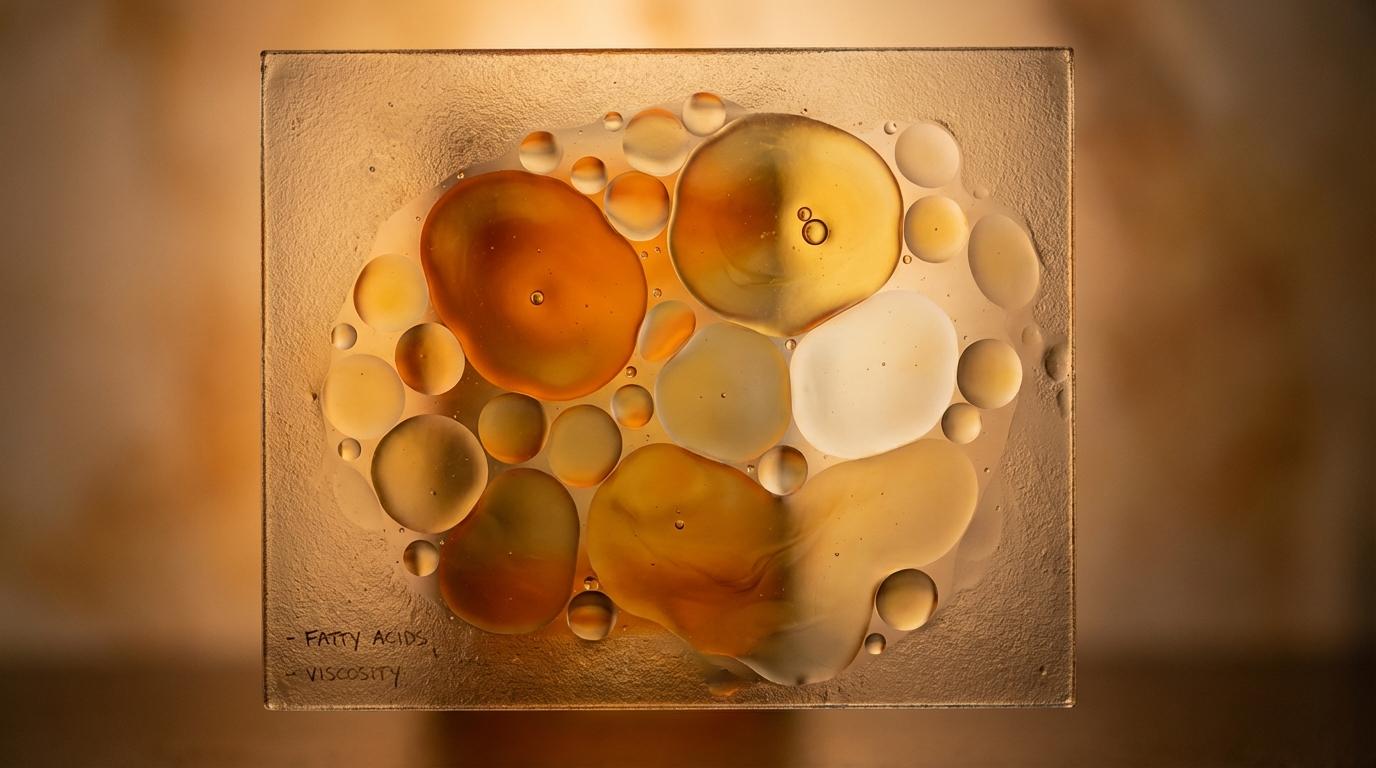
Have you ever wondered why rosehip oil makes your skin glow but coconut oil turns it into a breakout zone? The answer comes down to fatty acids, and once you understand how they work, picking the right face oil gets so much easier.
I spent way too long grabbing whatever oil was cheapest at the store, assuming oil is oil is oil. It took me two rounds of clogged pores and one really frustrating chin breakout to finally sit down and figure out what was going on. Turns out, the specific fatty acids in an oil determine almost everything about how your skin reacts to it.
Oleic Acid vs. Linoleic Acid: The Big Two
Most face oils are dominated by two types of fatty acids: oleic acid and linoleic acid. They have completely different properties, and your skin type determines which one you want more of.
Oleic acid is an omega-9 fatty acid. Your body can actually produce it on its own. Oils high in oleic acid tend to be thicker, richer, and more emollient. They sink in slowly and create a substantial moisture barrier. Think olive oil, avocado oil, and sweet almond oil. These are fantastic for dry, mature, or dehydrated skin because they really lock moisture in.
Linoleic acid is an omega-6 fatty acid. Your body cannot make this one, so it’s considered essential. Oils high in linoleic acid are lighter, absorb faster, and tend to be less likely to clog pores. Grapeseed oil, hemp seed oil, and rosehip oil all fall into this category. These are generally better for oily, combination, or acne-prone skin.
The ratio between these two fatty acids in any given oil is what determines how that oil behaves on your face. An oil that’s 70% oleic acid will feel and perform completely differently from one that’s 70% linoleic acid, even if the bottles look identical on a shelf.
Why This Matters So Much for Acne
Here’s the part that changed everything for me. Research has found that people with acne-prone skin tend to produce sebum with lower levels of linoleic acid and higher levels of oleic acid compared to people with clear skin. That imbalance is associated with thicker, stickier sebum that’s more likely to clog pores.
When you apply an oil that’s also high in oleic acid on top of sebum that’s already oleic-heavy, you’re basically doubling down on the problem. The oil feels too heavy, sits on top of your skin, and creates conditions where breakouts thrive.
But applying a linoleic-rich oil can actually help rebalance your sebum composition. It sounds counterintuitive to put oil on oily skin, but the right kind of oil can thin out your natural sebum and reduce congestion. This is why rosehip oil works so well for people with acne, even though they’d run screaming from olive oil on their face.
Matching Oils to Your Skin Type
Once you get the fatty acid concept, picking oils becomes almost formulaic. Here’s a practical breakdown:
Oily or acne-prone skin: Look for oils with high linoleic acid content. Good picks include grapeseed oil (about 65-70% linoleic), hemp seed oil (around 55-60% linoleic), and rosehip oil (roughly 44% linoleic). These absorb quickly and won’t leave a greasy layer.
If you want to experiment with blending your own face oils, starting with a linoleic-dominant base like hemp seed is a smart move for acne-prone types.
Dry or mature skin: You want oils rich in oleic acid. Avocado oil (about 60-70% oleic), marula oil (roughly 70% oleic), and argan oil (around 45% oleic) are solid choices. They provide deep, lasting moisture and help repair a damaged moisture barrier.
Combination skin: Look for oils that have a more balanced ratio, or mix a linoleic-rich oil with a small amount of an oleic-rich one. Jojoba oil is interesting here because it’s technically a wax ester, not a true oil, and its composition closely mimics human sebum. It works for most skin types without tipping the balance in either direction.
Sensitive skin: Fatty acid profile matters, but so does the presence of other compounds. Some oils contain naturally occurring fragrance compounds or allergens. Moringa oil is a good option for sensitive types because it’s oleic-rich but gentle, with natural antioxidant properties that help stabilize the formula.
Beyond the Big Two: Other Fatty Acids That Matter
Oleic and linoleic get the spotlight, but other fatty acids play supporting roles worth knowing about:
- Alpha-linolenic acid (ALA): An omega-3 found in chia seed and flaxseed oils. Anti-inflammatory and soothing, good for irritated or redness-prone skin.
- Palmitic acid: A saturated fatty acid common in palm oil and cocoa butter. Emollient and occlusive. Can be comedogenic in high amounts.
- Stearic acid: Another saturated fat found in shea butter. Helps reinforce the skin barrier and works well in balm-type products.
- Gamma-linolenic acid (GLA): Found in evening primrose and borage oils. Anti-inflammatory and may help with hormonal skin issues.
You don’t need to memorize all of these. The oleic-to-linoleic ratio is the single most useful thing to know when shopping for face oils. Everything else is bonus information.
How to Check an Oil’s Fatty Acid Profile
Most face oil brands don’t print fatty acid breakdowns on the label, which is annoying. But you can easily look up any carrier oil’s profile online. Just search the oil name plus “fatty acid composition” and you’ll find charts showing the percentages.
A few quick reference points to keep in your head:
- High linoleic (good for oily/acne skin): Grapeseed, safflower, hemp seed, evening primrose, rosehip
- High oleic (good for dry/mature skin): Olive, avocado, marula, sweet almond, macadamia
- Balanced or neutral: Jojoba (wax ester), argan, baobab
When a product is a blend of multiple oils, the first oil listed is present in the highest amount. Check that one’s profile first to get a general sense of how the blend will perform.
Price Doesn’t Determine Quality
This is the part that matters to my wallet. An expensive “luxury” face oil and a basic cold-pressed oil from a natural foods store can have identical fatty acid profiles. The grapeseed oil in a $60 serum is the same grapeseed oil you can buy for $8 at a grocery store.
What you’re paying for with pricier products is usually the blend formulation, added botanical extracts, nicer packaging, and the brand name. None of those things change the fundamental fatty acid composition.
If you’re on a budget and want to try face oils, start with a single, pure carrier oil that matches your skin type. A bottle of cold-pressed rosehip oil or hemp seed oil costs under $15 and will last months. You can always get fancy later, but the fatty acids do the same thing regardless of what the bottle looks like.
Understanding fatty acids turned face oils from a confusing gamble into something predictable for me. Once you know whether your skin needs more linoleic or oleic acid, you can stop guessing and start choosing oils that actually cooperate with your skin instead of fighting it.