
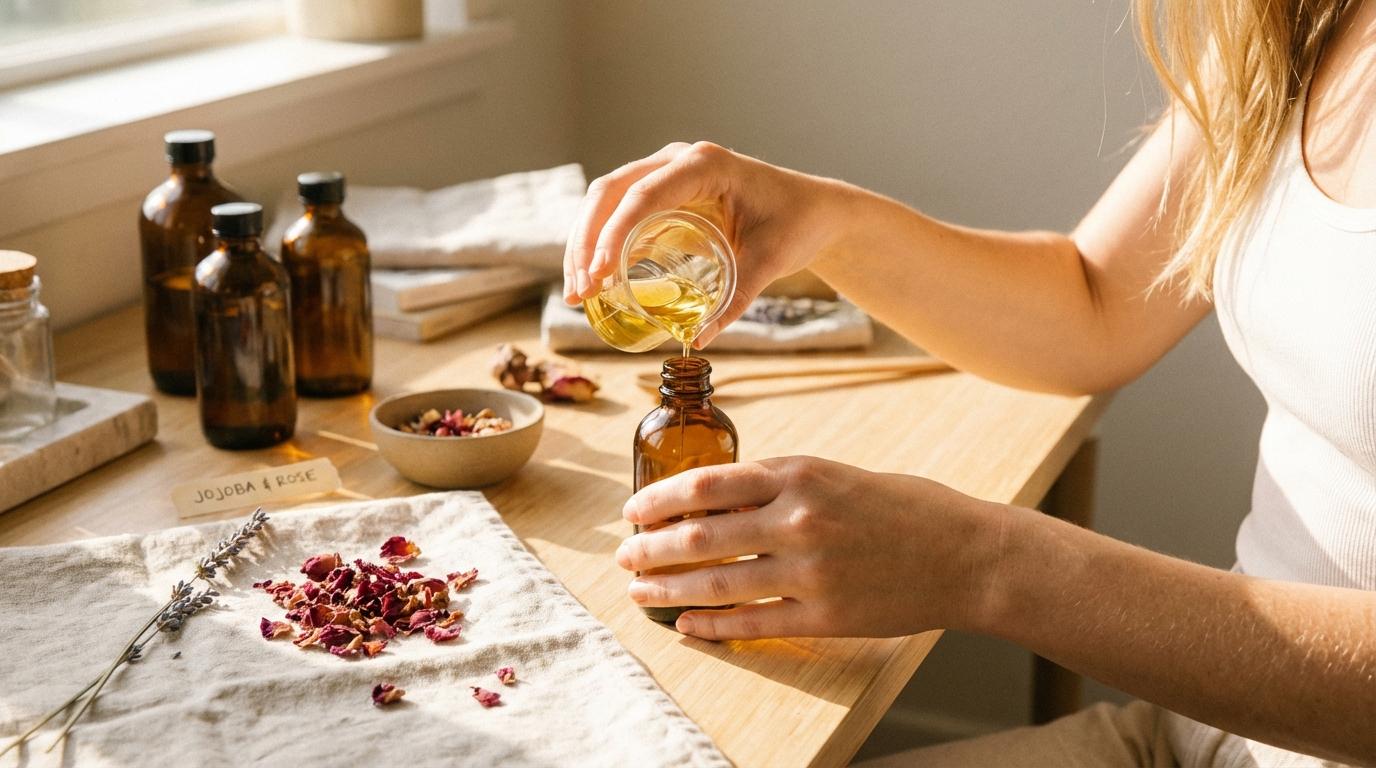
I spent $68 on a fancy face oil last year that turned out to be mostly jojoba with some lavender thrown in! When I looked at the ingredient list (after the fact, because I’m impulsive like that), I realized I could have made basically the same thing for about $12. That moment was the beginning of my DIY face oil obsession, and honestly, it’s one of the best skincare rabbit holes I’ve ever fallen into.
Making your own face oil blend sounds intimidating, but it’s actually one of the easiest DIY skincare projects you can tackle. You’re not dealing with preservatives, emulsifiers, or any of the complicated chemistry that makes DIY moisturizers risky. Oils are stable, straightforward, and pretty hard to mess up (within reason). Plus, you get to customize everything to your specific skin needs, which is something even the fanciest pre-made oils can’t offer.
Carrier Oils: Your Base Layer
Before we get into the fun stuff, let’s talk carrier oils. These are the foundation of any face oil blend, making up about 90-98% of your final product. They’re called “carrier” oils because they literally carry other ingredients (like essential oils, if you choose to use them) onto your skin safely. You never want to apply most concentrated oils directly to your face without diluting them first.
The carrier oil you choose matters a lot because it determines how your blend feels on your skin, how quickly it absorbs, and whether it’ll play nice with your skin type. Some carrier oils are “dry” and sink in fast, while others are richer and leave more of a noticeable layer. Neither is better, it just depends on what you’re going for.
For beginners, I always recommend starting with one of these five carrier oils:
- Jojoba oil: Works for almost everyone (more on this in a sec)
- Squalane: Lightweight, sinks in fast, great for oily skin
- Rosehip seed oil: Packed with vitamin A, wonderful for dry or aging skin
- Grapeseed oil: Light and affordable, good for combination skin
- Sweet almond oil: Gentle and moisturizing, nice for sensitive types
You can find all of these at health food stores, online, or even some grocery stores. Look for cold-pressed and unrefined versions when possible (they keep more of their beneficial compounds), but refined oils still work fine if that’s what’s available.
Why Jojoba Works for Most Skin Types
If I could only recommend one carrier oil for everyone, it would be jojoba. It’s technically not even an oil (it’s a liquid wax ester, if you want to get nerdy about it), and that’s exactly why it works so well. The molecular structure of jojoba is incredibly similar to your skin’s natural sebum, so your face basically recognizes it as something it already produces.
This means a few things. First, jojoba is non-comedogenic for most people, meaning it’s unlikely to clog pores. Second, it can actually help regulate oil production. I know that sounds backwards (putting oil on oily skin?), but when your skin gets adequate moisture and fatty acids from an oil that mimics its natural sebum, it often calms down and produces less of its own oil. According to the International Journal of Cosmetic Science, jojoba has been shown to have excellent skin compatibility and stability.
Jojoba also has a long shelf life (up to 2 years when stored properly), it’s shelf stable without refrigeration, and it mixes well with almost any other oil you want to add. For a complete overview of how different oils work with various skin types, check out our guide to matching oils with your skin.
If you’re just starting out and nervous about trying DIY oils, start with 100% jojoba. Use it for a few weeks, see how your skin responds, and then start experimenting with blends once you have a baseline.
Rosehip for Dry and Mature Skin
Rosehip seed oil (not to be confused with rosehip fruit oil, which is different) is the ingredient I recommend most for people dealing with dry skin, fine lines, or hyperpigmentation. It’s one of the few plant oils that naturally contains retinoic acid, which is a form of vitamin A similar to what’s in retinol products.
The vitamin A content means rosehip can help with cell turnover and collagen support, though it’s much gentler than prescription retinoids. It also contains high levels of linoleic acid, which is an omega-6 fatty acid that helps strengthen your skin barrier. A lot of people with dry, flaky skin are actually low in linoleic acid, so adding it topically can make a real difference.
The downside? Rosehip oil has a shorter shelf life (about 6 months once opened) and needs to be stored carefully. It’s also got a distinct earthy smell that some people find off-putting. I actually kind of like it, but my roommate describes it as “like a garden shed.” Fair enough.
If you have dry skin, a blend of about 70% jojoba and 30% rosehip is a great starting point. The jojoba gives you that sebum-mimicking base while the rosehip brings in those extra vitamins and fatty acids. If you’re curious about other options for dry skin, squalane is another excellent choice that absorbs incredibly well.
Getting Your Ratios Right
This is where most people get stuck, but I promise it’s simpler than it seems. The basic formula for a face oil blend is:
- Base carrier oil: 80-90% of your blend
- Secondary carrier oil(s): 10-20% of your blend
- Essential oils (optional): No more than 1% of total blend
Let’s break that down with actual numbers. Say you’re making 1 ounce (30ml) of face oil:
- Base: 24-27ml of your primary carrier oil
- Secondary: 3-6ml of a complementary oil
- Essential oils: Maximum 6 drops total (if using)
The 1% rule for essential oils is really important. Essential oils are extremely concentrated and can cause irritation or sensitization if overused. Dermatologists like Dr. Angelo Landriscina have talked extensively about essential oil safety, and most recommend keeping face products at 0.5-1% to minimize risk. When in doubt, use less.
Sample Recipes to Get You Started
I’ve tested a bunch of different combos over the past year, and here are my three favorites for different skin types:
For oily and combination skin:
- 80% jojoba oil
- 15% grapeseed oil
- 5% hemp seed oil
- No essential oils (they can be irritating for acne-prone skin)
For dry and dehydrated skin:
- 60% jojoba oil
- 30% rosehip seed oil
- 10% argan oil
- Optional: 2-3 drops lavender essential oil per ounce
For sensitive or reactive skin:
- 90% jojoba oil
- 10% squalane
- No essential oils
Start with these ratios and adjust based on how your skin feels. If the blend feels too heavy, increase the jojoba and decrease the richer oils. If it’s not moisturizing enough, add more of the nourishing secondary oils.
Tools and Storage
You don’t need fancy equipment to make face oils. Here’s the bare minimum:
- A dark glass dropper bottle (amber or cobalt blue)
- Measuring spoons or a small scale (scale is more accurate)
- A clean funnel (optional but makes things less messy)
- Labels (please label your blends, future you will thank present you)
The dark glass is important because light degrades many of the beneficial compounds in plant oils. Those cute clear bottles on Pinterest? They’re making your expensive oils go rancid faster. Not worth it.
Store your finished blend in a cool, dark place. The bathroom cabinet seems logical, but bathrooms get hot and humid, which speeds up oxidation. A bedroom drawer or closet shelf works better. If you’ve included rosehip or any other delicate oils, consider keeping it in the fridge to extend the shelf life.
Generally, homemade face oils will last 3-6 months when stored properly, depending on which oils you use. The oils with shorter shelf lives (like rosehip, hemp seed, and flaxseed) will determine how long your blend lasts overall. Make small batches at first until you figure out how quickly you go through them.
How to Actually Use Your Blend
The application method matters almost as much as the blend itself. A few tips I’ve learned through trial and error:
Timing: Apply face oil as the last step of your routine, after any water-based serums and before sunscreen in the morning. Oil creates a barrier that can prevent other products from absorbing properly, so it needs to go on top. Some people skip it in the morning entirely and just use it at night, which is totally valid if you find it too heavy for daytime.
Amount: Start with 3-4 drops. Warm the oil between your palms, then press it into slightly damp skin (right after your serum, while your face is still a little tacky). Pressing is better than rubbing because it helps the oil absorb without disturbing the products underneath.
Mixing with moisturizer: If face oil alone feels too rich or not enough, you can mix a few drops into your regular moisturizer. This is a great way to customize the richness level on the fly, especially when your skin’s needs change with the seasons.
If you’re working on building a complete affordable routine, our guide to putting together a routine under $30 has more ideas for budget-friendly products that pair well with DIY oils.
A Note on Purity and Sourcing
Not all carrier oils are created equal, and this is one area where I think spending a little more upfront is worth it. Look for oils that are:
- Cold-pressed: This extraction method uses minimal heat, which preserves more of the oil’s nutrients
- Unrefined: These haven’t been processed to remove color or scent, so they retain more of their natural properties
- Single-origin: Easier to verify quality when the source is traceable
- Fresh: Check for expiration dates and buy from retailers that move product regularly
Some good online sources include Garden of Wisdom, Lotion Crafter, and Mountain Rose Herbs. Health food stores like Whole Foods or Sprouts often carry quality options too. Amazon can be hit or miss (lots of diluted or old products), so read reviews carefully if you go that route.
Common Mistakes to Avoid
After making probably 15+ different blends over the past year (and having a few failures), here’s what I wish I’d known earlier:
Don’t go overboard with essential oils. I made a lavender blend once with way too many drops, and my face was red and irritated for days. The 1% rule exists for a reason. When in doubt, leave them out entirely.
Don’t mix too many oils at once. If you’re using five different carrier oils plus three essential oils and your skin breaks out, you’ll have no idea which ingredient caused the problem. Start simple with two oils max, test for a few weeks, then add one thing at a time.
Don’t assume natural equals safe for you. Some people react badly to rosehip, or coconut oil (please don’t put coconut oil on your face, it’s very comedogenic for most people), or certain essential oils. Patch test new oils on your inner arm before putting them on your face.
Don’t forget to shake the bottle. Some oils are heavier than others, and they can separate over time. A quick shake before each use ensures you’re getting a consistent blend.
What Making My Own Oil Taught Me
Beyond saving money (which is real, I’ve probably saved $200+ this year compared to buying fancy pre-made oils), making my own blends taught me a lot about what my skin actually needs versus what marketing told me it needed.
I realized I don’t need a complicated 47-ingredient formula. My skin is happiest with simple, pure jojoba and a bit of rosehip. That’s it. No fragrance, no fancy botanical extracts, no “proprietary complex.” Just oil that my skin recognizes and absorbs without drama.
Making your own face oil isn’t about being a DIY purist or rejecting all commercial products. It’s about understanding what you’re putting on your face, saving some money, and getting exactly what works for you. Start with one bottle of jojoba, give it a few weeks, and see what happens. Your skin (and your wallet) might surprise you.