
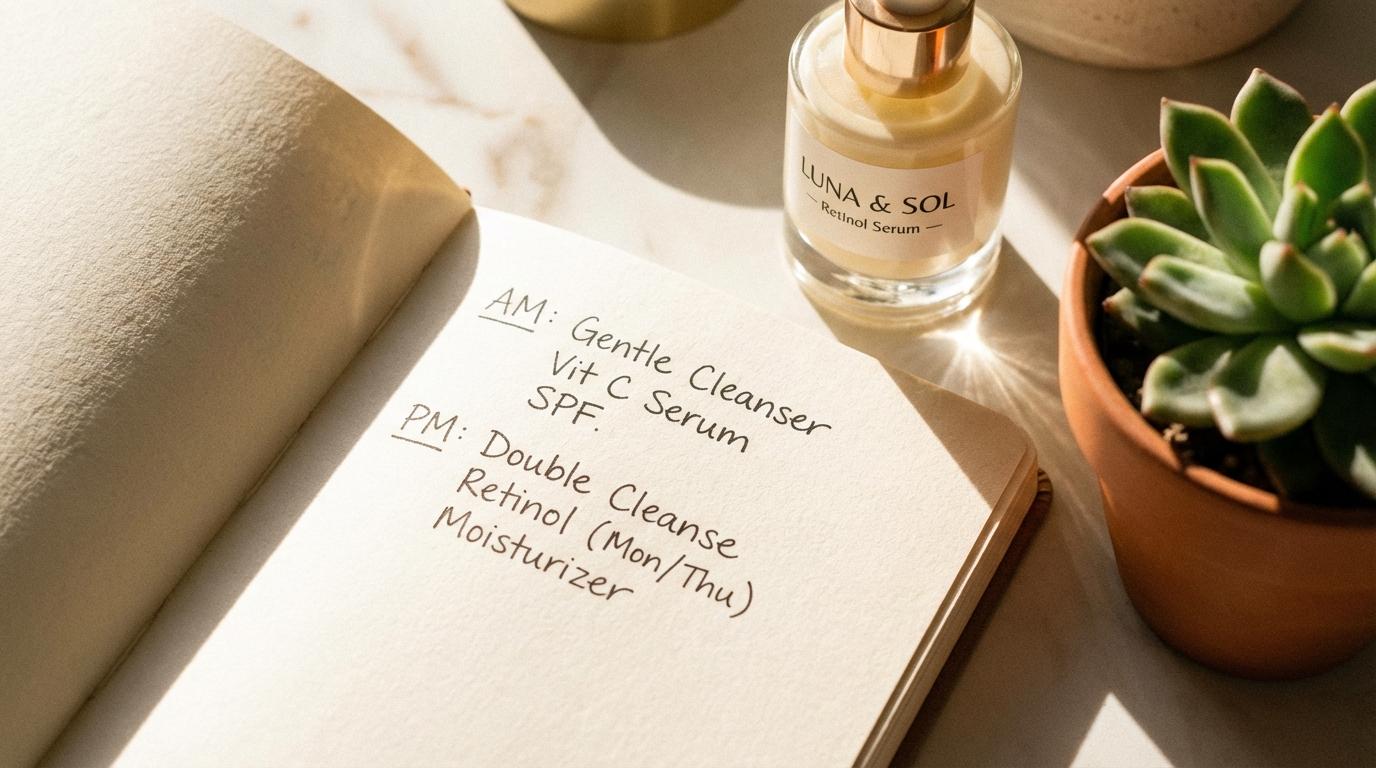
Most people think retinol works by resurfacing your skin, like some kind of gentle chemical peel happening every night while you sleep. That is not really what is going on. The real reason dermatologists have been recommending retinol for decades has almost nothing to do with surface-level exfoliation and everything to do with what is happening deep in your dermis, at the level of your actual cells, where collagen gets made.
I spent an embarrassing amount of time assuming my retinol was just “speeding up cell turnover” (which, okay, it does do that too) before I actually looked into the collagen piece. And honestly? The science is kind of wild. Your skin is basically running a tiny construction project every time you apply this stuff, and understanding how that works changes the way you think about the whole retinol timeline.
The Conversion Process Nobody Talks About
Before retinol can do anything at all, your skin has to convert it. Retinol itself is not the active form. It is more like a precursor, a raw material that your enzymes have to process before it becomes useful. First, retinol gets converted to retinaldehyde. Then retinaldehyde gets converted to retinoic acid (also called tretinoin, the prescription-strength version). Retinoic acid is the form that actually does the heavy lifting.
This two-step conversion process is why over-the-counter retinol is gentler than prescription tretinoin. Not all of the retinol you apply makes it through both conversions. Some of it gets lost along the way, which means less active ingredient reaching your cells, which means fewer side effects but also a slower timeline for results. Your skin is essentially doing the work of diluting the product for you (not ideal for the impatient among us, which is all of us).
Gene Expression: Your Skin Gets New Instructions
This is where it gets genuinely interesting. When retinoic acid reaches the nucleus of a skin cell, it binds to specific receptors called RARs (retinoic acid receptors) and RXRs (retinoid X receptors). These receptors sit on your DNA and act like switches. When retinoic acid attaches to them, it literally changes which genes are being read and which are being ignored.
Think of your DNA as a massive instruction manual. Normally, your skin cells are only reading certain pages, the ones that tell them to do their everyday maintenance work. When retinoic acid shows up and binds to those receptors, it flips the book to different pages. Specifically, it turns up the volume on genes that code for collagen production and turns down genes involved in collagen breakdown.
This is not a metaphor, by the way. This is measurable, documented gene expression change. Studies using skin biopsies have shown that retinoid treatment increases the expression of procollagen I and procollagen III (the precursor molecules that get assembled into mature collagen fibers). At the same time, it decreases the expression of matrix metalloproteinases, which are enzymes that chop up existing collagen. You are getting more production AND less destruction at the same time. That is a pretty good deal.
Fibroblasts: The Collagen Factories
The cells actually making your collagen are called fibroblasts, and they live in the dermis, the thicker layer of skin beneath the surface you can see. Fibroblasts are your skin’s construction workers. They produce collagen, elastin, and other structural proteins that keep everything firm and bouncy. As you age, fibroblasts slow down (relatable, honestly). They produce less collagen, and the collagen they do produce is often lower quality.
Retinoic acid essentially gives these fibroblasts a performance review and a raise. It stimulates them to increase their collagen output, and it also helps them organize the new collagen fibers in a more structured way. Disorganized collagen (which is what you get in sun-damaged or aging skin) does not provide the same structural support as neatly arranged collagen bundles. Retinol helps with both quantity and quality.
There is also evidence that retinoic acid can increase the number of fibroblasts in treated skin. It promotes cell proliferation in the dermis, meaning you are not just making existing workers more productive, you are hiring new ones. More fibroblasts producing more collagen in a more organized pattern is basically the trifecta of what anti-aging products are trying to achieve.
The Blood Supply Connection
Something that does not get enough attention is how retinol affects the blood supply to your skin. Retinoic acid promotes angiogenesis, the formation of new tiny blood vessels in the dermis. Better blood supply means more oxygen and nutrients reaching your fibroblasts, which makes them better at their job. It also means better waste removal, so the byproducts of all this increased cellular activity get cleared out efficiently.
This is partly why retinol users often notice an improved “glow” before they see structural changes like reduced wrinkles. The improved blood flow gives skin a healthier appearance even before the collagen remodeling is visible. It is like the appetizer before the main course (except the appetizer takes a month and the main course takes three to six months, but we will get to that).
The Collagen Timeline: Why It Takes So Long
If you have ever started retinol and quit after six weeks because you did not see dramatic results, I get it. But here is the thing: collagen synthesis is a slow process. The gene expression changes start happening within days of consistent use. Your fibroblasts begin ramping up procollagen production within the first couple of weeks. But turning those procollagen molecules into mature, functional collagen fibers that actually change the way your skin looks? That takes months.
Procollagen molecules have to be secreted from the fibroblast, processed by enzymes outside the cell, assembled into collagen fibrils, and then cross-linked into stable fibers. Then those fibers have to accumulate enough to make a visible difference in skin thickness, firmness, and wrinkle depth. Most clinical studies show measurable collagen improvement at the 12-week mark, with continued improvement through 24 to 48 weeks of consistent use.
The frustrating part is that the side effects (dryness, peeling, redness) hit you in the first few weeks, right when you have zero visible benefit to show for your suffering. This is the retinol valley of despair, and it is real. Your skin is doing the work on the inside, but you cannot see it yet. The peeling you experience during this phase is actually related to the increased cell turnover in the epidermis (the surface layer), which is a separate process from the collagen building happening in the deeper dermis.
Not All Retinol Products Are Created Equal
Concentration matters, but it is not the only thing that matters. A 1% retinol product is not automatically twice as effective as a 0.5% product. Your skin can only convert so much retinol to retinoic acid at a time, and overwhelming the conversion enzymes does not speed things up, it just increases irritation. Starting with a lower concentration and gradually increasing is not just about tolerability, it is about giving your enzymes time to upregulate.
The formulation around the retinol also plays a huge role. Retinol is unstable and degrades when exposed to light and air. If your retinol comes in a clear bottle or a jar you dip your fingers into, a significant amount of the active ingredient may have broken down before it ever touches your skin. Look for opaque, airless pump packaging. It is not a marketing gimmick, it is basic chemistry. And honestly, the price tag on your retinol matters less than the formulation and packaging, so do not assume expensive means more effective.
Making Retinol Work Harder for You
Now that you know what is happening at the cellular level, you can make smarter choices about how you use retinol. Applying it to damp skin increases penetration (and potentially irritation), so if you are in the early weeks, let your skin dry completely first. Buffering with moisturizer before applying retinol slows absorption and reduces irritation without eliminating the collagen-building benefits.
Sunscreen is non-negotiable when you are using retinol, not just because retinol makes your skin more sensitive to UV, but because sun exposure actively destroys collagen. Using retinol to build collagen while skipping sunscreen is like filling a bathtub with the drain open. You are working against yourself. Those cell signaling pathways that peptides and retinoids activate need protection from UV damage to actually deliver lasting results.
Consistency trumps intensity every single time. Using a moderate retinol product five nights a week will always outperform a strong product used sporadically. Your fibroblasts need ongoing stimulation to maintain their increased collagen output. Once you stop using retinol, the gene expression changes gradually reverse, and your collagen production returns to baseline. This is not a one-and-done treatment. It is a long-term relationship (the healthy, non-toxic kind).