
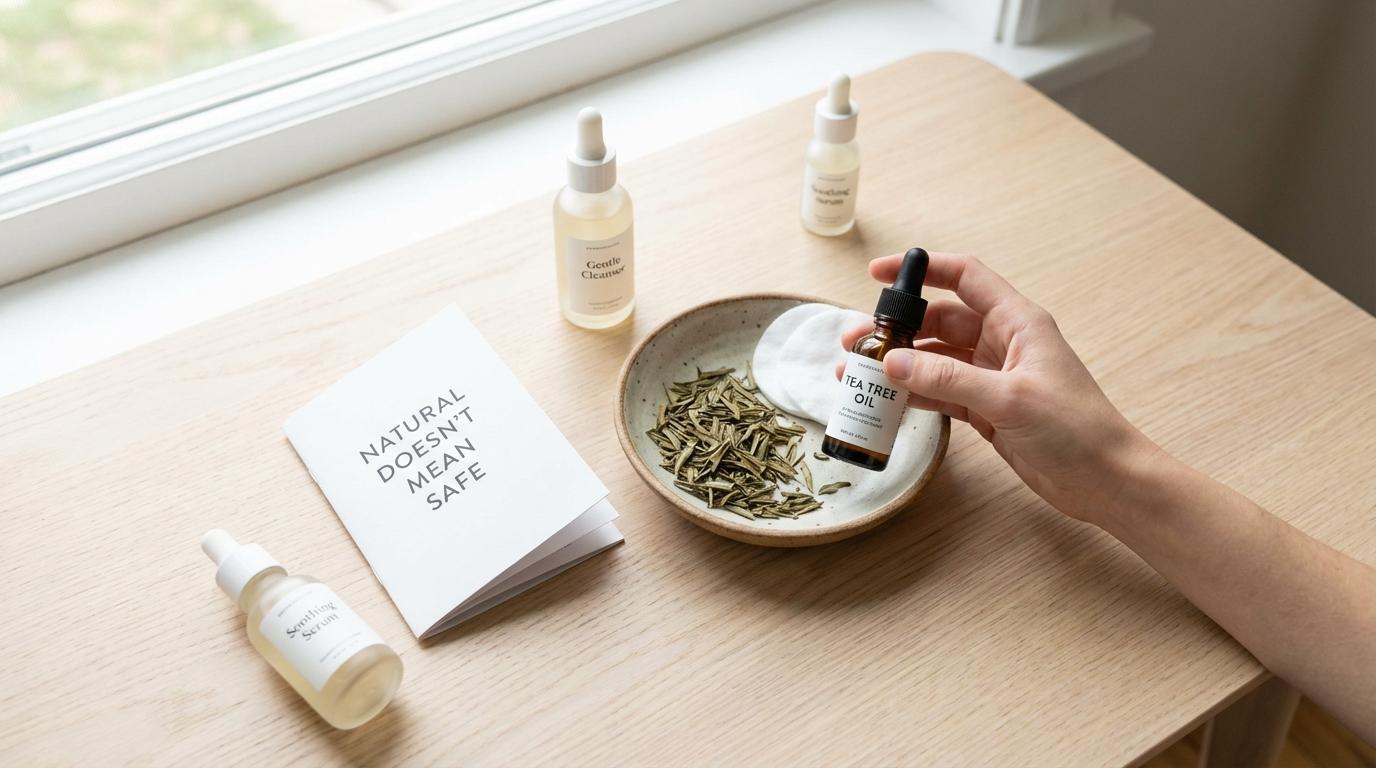
I need to address something that drives me absolutely bonkers in the skincare world: the assumption that natural automatically equals safe. Tea tree oil is the poster child for this misconception, and honestly, we need to talk about it.
Look, I get it. The idea of treating your breakouts with something that comes from a plant instead of a lab sounds appealing. Tea tree oil has been used for centuries, it smells kind of medicinal (which makes it feel legit), and there’s genuine science behind its antibacterial properties. But here’s the thing: arsenic is natural too. So is poison ivy. “Natural” is not a safety certificate.
What Tea Tree Oil Actually Does
Let’s give credit where it’s due. Tea tree oil, extracted from the leaves of Melaleuca alternifolia (a plant native to Australia), does have legitimate antibacterial and anti-inflammatory properties. Research published in the Medical Journal of Australia found that a 5% tea tree oil gel was effective at reducing both inflamed and non-inflamed acne lesions.
The oil contains compounds like terpinen-4-ol that can kill the bacteria responsible for acne (Cutibacterium acnes, if you want to get technical). A six-week study showed a 40% reduction in whiteheads and blackheads, a 40% drop in red acne bumps, and a 47% decrease in pus-filled pimples when using tea tree oil compared to placebo.
So yes, it works. But that’s not the whole story.
The Dilution Problem Nobody Warns You About
Here’s where things get tricky. Tea tree oil in its pure form is incredibly potent, and using it undiluted is basically asking for trouble. Most studies showing benefits used concentrations between 5% and 10%. That’s significantly different from the bottle of 100% pure tea tree oil you might grab at the health food store.
When people hear “natural remedy,” they often assume more is better. So they dab pure tea tree oil directly on their pimples, sometimes multiple times a day. This is a recipe for chemical burns, severe dryness, and ironically, more skin damage than the acne itself would have caused.
Proper dilution means mixing tea tree oil with a carrier oil (like jojoba or rosehip) at a ratio that brings the concentration down to that 5% range. But be honest with yourself: are you actually going to calculate precise dilution ratios every time you want to treat a breakout? Most people won’t, and that’s where the problems start.
Contact Dermatitis: A Very Real Risk
According to research from the Wiley Online Library, tea tree oil has caused more published allergic reactions than any other essential oil since cases were first reported in 1991. In routine patch testing, between 0.1% and 3.5% of people show positive reactions.
Those numbers might sound small, but consider this: millions of people use tea tree oil products. Even a 1% reaction rate means tens of thousands of people experiencing allergic contact dermatitis. Symptoms include redness, swelling, itching, and blistering. For people trying to clear their skin, developing a new inflammatory skin condition is the opposite of helpful.
What makes tea tree oil particularly sneaky is that fresh oil is only a mild to moderate sensitizer. But as the oil oxidizes (which happens naturally over time, especially if it’s exposed to light or air), its allergenic potential increases significantly. The major sensitizers include compounds like ascaridole, terpinolene, and limonene, which become more problematic as the oil degrades.
Translation: that bottle of tea tree oil sitting in your bathroom cabinet for the past year? It’s probably more likely to irritate your skin now than when you first bought it.
How Tea Tree Oil Stacks Up Against Proven Alternatives
The same Australian study that validated tea tree oil’s effectiveness also compared it directly to 5% benzoyl peroxide. Both treatments significantly reduced acne, but here’s what the research actually showed:
- Benzoyl peroxide reduced inflamed pimples by two-thirds within three months
- Tea tree oil reduced inflamed pimples by half in the same timeframe
- Tea tree oil worked more slowly overall
- Tea tree oil caused fewer side effects like dryness and irritation
So benzoyl peroxide works better and faster, but tea tree oil is gentler. That sounds like a reasonable trade-off, right? Maybe, but there’s more to consider.
Benzoyl peroxide has decades of research behind it, comes in precisely formulated products, and has a predictable mechanism of action. It kills acne bacteria, reduces inflammation, and has mild comedolytic (pore-clearing) activity. You know exactly what you’re getting.
Salicylic acid, another proven acne fighter, works differently. According to dermatological research from ScienceDirect, it penetrates into pores and dissolves the dead skin cell buildup that leads to blackheads and whiteheads. It’s particularly effective for people with oily, congestion-prone skin.
Tea tree oil? It has antimicrobial and anti-inflammatory properties, but that’s about it. It doesn’t address excess oil production, it doesn’t increase cell turnover, and it doesn’t penetrate pores the way salicylic acid does.
The Inconsistency Issue
When you buy a benzoyl peroxide or salicylic acid product from a reputable brand, you know the concentration, the formulation, and the stability. These products are regulated, tested, and consistent from bottle to bottle.
Tea tree oil? Not so much. The concentration of active compounds can vary significantly depending on where the plants were grown, how they were harvested, and how the oil was extracted and stored. That bottle you bought might be more or less potent than expected, and there’s really no way to know.
Add in the oxidation factor I mentioned earlier, and you’re essentially working with a moving target every time you use it.
Who Should Actually Consider Tea Tree Oil
I’m not saying tea tree oil is useless. For some people, it might be a reasonable option:
- Those with very mild acne who prefer to start with gentler treatments
- People who’ve had bad reactions to benzoyl peroxide or salicylic acid
- Anyone using it in a properly formulated product (not pure oil) with stable concentrations
- People who’ve done a patch test and confirmed they don’t react to it
If you do decide to try tea tree oil, use it in a product that’s been formulated specifically for skincare rather than buying pure essential oil and DIYing it. Look for concentrations around 5%, and always do a patch test on your inner arm before applying it to your face.
When to Skip It Entirely
Tea tree oil is probably not for you if:
- You have sensitive or easily irritated skin
- You have a history of allergic reactions to skincare products
- You have moderate to severe acne that needs more aggressive treatment
- You’re pregnant or breastfeeding (there’s not enough safety data)
- You’re not willing to do a proper patch test first
And please, for the love of all things skincare, never use tea tree oil undiluted. Ever. Not even as a “spot treatment.” Your skin is not a chemistry experiment.
The Smarter Approach to Acne
If you’re dealing with breakouts, here’s my honest advice: start with the ingredients that have the strongest evidence and the most predictable results.
For mild acne and blackheads, a 2% salicylic acid product is hard to beat. It’s affordable, widely available, and effective without being harsh.
For inflammatory acne with red, angry pimples, benzoyl peroxide at 2.5% to 5% concentration is incredibly effective. Yes, it can cause some dryness, but that’s manageable with a good moisturizer.
For stubborn or moderate acne, talking to a dermatologist about retinoids is worth your time. These vitamin A derivatives address multiple causes of acne simultaneously and have decades of research proving their effectiveness.
Tea tree oil fits somewhere in the “maybe, for some people, sometimes” category. It’s not the worst thing you could put on your skin, but it’s definitely not the best either. And the whole “natural” angle shouldn’t be the reason you choose it over more effective, more predictable options.
What I Actually Want You to Remember
Natural ingredients can be wonderful. They can also be irritating, allergenic, and less effective than their synthetic alternatives. The origin of an ingredient tells you nothing about its safety or efficacy for your particular skin.
Tea tree oil has real antibacterial properties, but it also carries real risks. It works more slowly than benzoyl peroxide, requires careful dilution that most people won’t bother with, and becomes more sensitizing as it oxidizes. For most people with acne, there are better options available at the same price point or less.
Your skin deserves ingredients chosen based on evidence, not marketing narratives about what’s “natural” or “pure.” If tea tree oil works for you after proper testing and cautious use, great. But don’t let the naturalistic fallacy convince you it’s automatically the better choice. It’s not.