
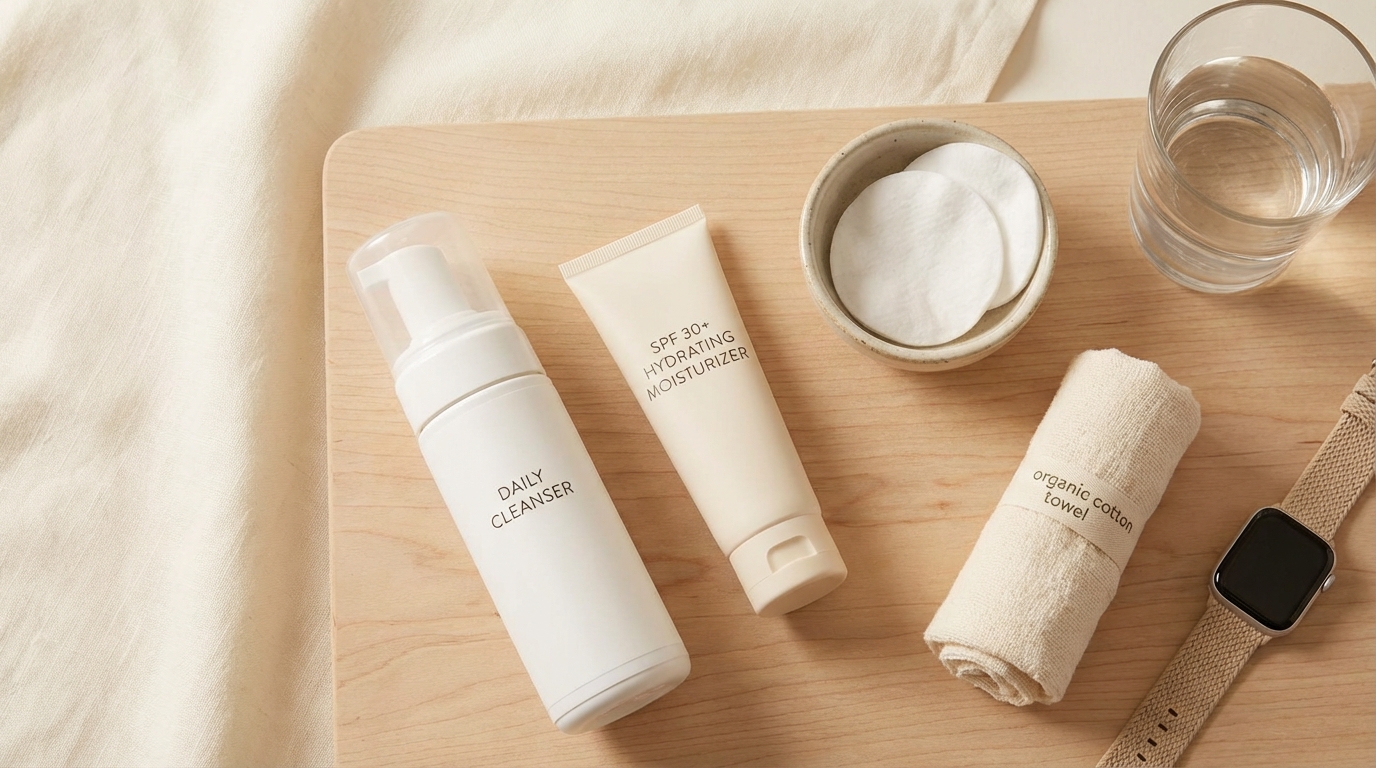
I am going to say something that might make skincare brands a little nervous: most people only need two products. A cleanser and a moisturizer with SPF. That is it.
Before you scroll away thinking this is another oversimplified take from someone who does not understand actual skin problems, hear me out. I spent years as a beauty editor, testing hundreds of products, and the people with the best skin? They kept it simple.
The Two Products You Actually Need
Let us break this down without the marketing fluff.
Product One: A Gentle Cleanser
Your cleanser should remove dirt, makeup, and excess oil without making your skin feel tight or squeaky. That tight feeling? It means you have stripped your skin barrier. Not good.
Look for a basic gel or cream cleanser. Skip anything with strong actives like glycolic acid in your face wash. You are washing it off anyway, so those actives barely have time to work. According to the American Academy of Dermatology, a gentle cleanser used twice daily is all most people need.
Good drugstore options exist for under 0. CeraVe, Vanicream, La Roche-Posay. Nothing fancy needed here.
Product Two: Moisturizer with SPF
This is your workhorse. A good moisturizer with built-in SPF 30 or higher handles hydration and sun protection in one step.
Sun damage causes about 80% of visible skin aging. That is not marketing, that is research from the Skin Cancer Foundation. So if you are only going to do one protective thing for your skin, blocking UV rays is it.
The combo product also means you will actually use it. Every extra step in your routine is another chance to skip it when you are tired or running late.
When Two Products Are Enough
This minimal routine works best if you:
Have generally normal skin without major concerns. No severe acne, no diagnosed rosacea, no significant hyperpigmentation. Just regular skin that needs basic care.
Are in your early to mid-twenties with no specific skin conditions requiring treatment.
Want to maintain healthy skin rather than fix specific problems.
Have a limited budget and want to spend it wisely. Better to use two quality products consistently than own ten things you never touch.
Travel frequently and need a routine you can maintain anywhere.
Struggle with consistency. A two-step routine is hard to skip. A ten-step routine is easy to abandon.
When You Might Need More
I am not going to pretend this works for everyone. Some skin situations genuinely need more attention.
Active acne often requires targeted treatments like benzoyl peroxide or prescription retinoids. But even then, you are adding one treatment product, not building a whole cosmetics counter.
Significant hyperpigmentation might benefit from a vitamin C serum or azelaic acid. The Cleveland Clinic has a solid guide on treatment options.
Dry skin that does not respond to regular moisturizer could need a separate hydrating serum or facial oil at night.
Aging concerns in your thirties and beyond often benefit from retinol a few nights per week.
But notice the pattern: you add ONE thing to address ONE concern. You do not need seven serums layered in a specific order with precise wait times between each.
The Budget-Friendly Truth
Here is the math that skincare marketing does not want you to do.
A basic cleanser: $8-15. A moisturizer with SPF: $12-20. That is $20-35 for a complete routine that can last two to three months.
Compare that to buying a cleanser, toner, essence, serum, treatment, eye cream, moisturizer, and separate sunscreen. You are looking at $100+ easily, often much more if you are buying what Instagram tells you to.
The products you do not buy cannot irritate your skin. They cannot interact badly with each other. They cannot sit in your cabinet collecting dust and guilt.
Simple routines also make it easier to identify what is working or causing problems. If you break out and you are using eight products, good luck figuring out the culprit. With two products, troubleshooting is straightforward.
Making This Routine Work
Morning: Rinse with water or use your cleanser if your skin feels oily. Apply your SPF moisturizer. Done.
Night: Cleanse to remove the day’s buildup and sunscreen. You can apply the same moisturizer without SPF, or just skip moisturizer if your skin does not feel dry. Some people’s skin does fine without nighttime moisturizer, especially oilier types.
That is the whole routine. Spend those saved minutes and dollars on something else. Sleep more. Drink water. Eat vegetables. Those things arguably do more for your skin than product number seven through ten.
The skincare industry has convinced us that more equals better. That is great for their profits but not necessarily for your skin. Your skin is an organ, not a project that needs constant intervention.
Give the two-product routine a month. Your skin might thank you for doing less. And your wallet definitely will.