
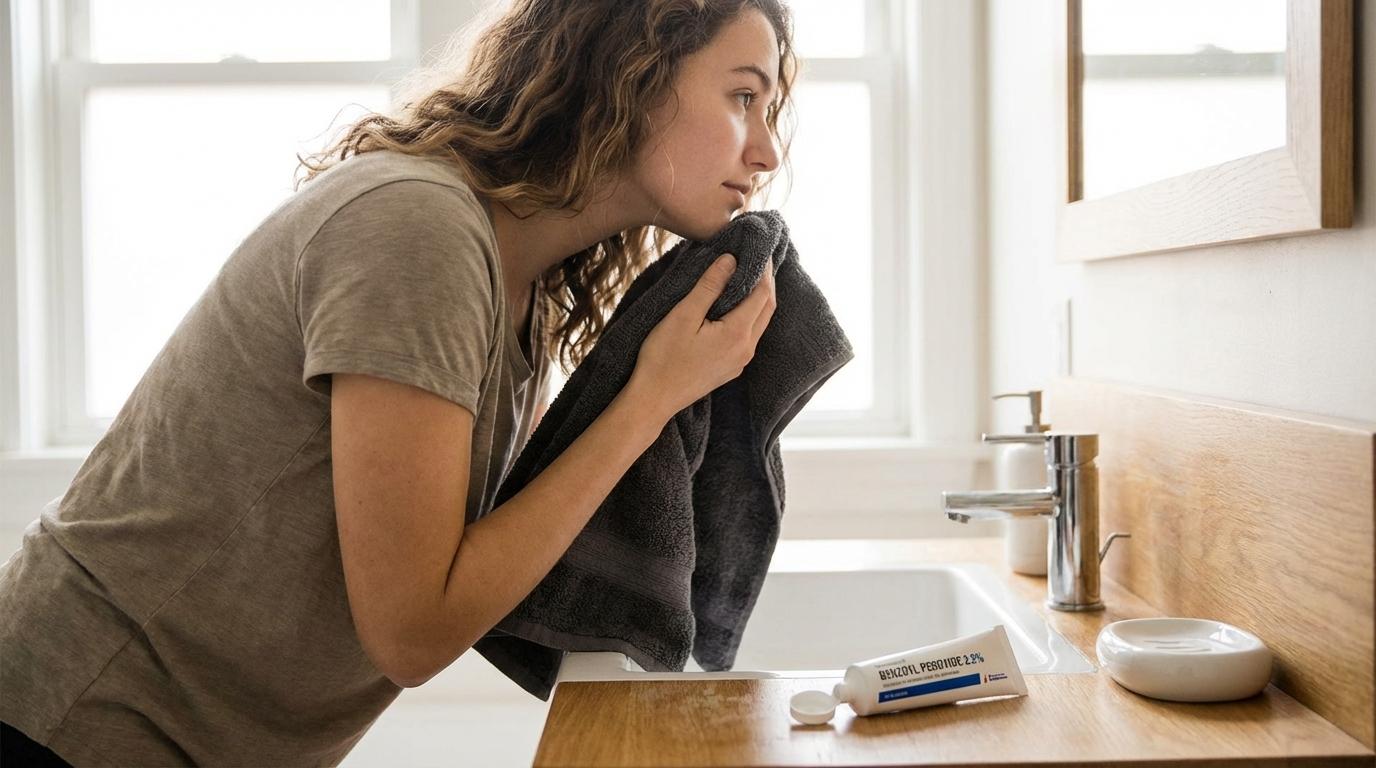
Look, I get it. You finally found an acne treatment that actually works, and then you noticed those mysterious orange-ish spots appearing on your favorite navy pillowcase. Or that white streak on your black towel. Benzoyl peroxide is incredibly effective at fighting breakouts, but it comes with a reputation for destroying everything it touches. The good news? You can absolutely use BP without turning your bathroom into a fabric graveyard. Let me break down exactly how this ingredient works and how to use it smarter.
The Science Behind How Benzoyl Peroxide Kills Acne Bacteria
Benzoyl peroxide is what chemists call an oxidizing agent. When you apply it to your skin, it breaks down into benzoic acid and oxygen. That oxygen is the key player here. The bacteria responsible for inflammatory acne, called Cutibacterium acnes (formerly known as Propionibacterium acnes), are anaerobic, meaning they thrive in environments without oxygen. When BP floods your pores with oxygen, these bacteria literally cannot survive.
What makes BP particularly special is that bacteria cannot develop resistance to it. Unlike antibiotics, which bacteria can eventually outsmart through genetic mutations, the oxidative mechanism of benzoyl peroxide is too fundamental for bacteria to adapt to. This is why dermatologists often recommend using BP alongside prescription antibiotics. It helps prevent antibiotic resistance while boosting overall effectiveness.
Beyond just killing bacteria, BP also has mild comedolytic properties, meaning it helps break down the dead skin cells and sebum that clog pores in the first place. It is a multi-tasker that attacks acne from multiple angles.
Why Lower Percentages Work Just as Well
Here is something that surprised me when I first learned it: research comparing 2.5%, 5%, and 10% benzoyl peroxide found that all three concentrations were equally effective at reducing inflammatory acne lesions. That is right. The 2.5% formulation performed just as well as the 10% version in clinical trials.
The difference? Side effects. Higher concentrations cause significantly more dryness, peeling, redness, and irritation. So if you have been suffering through that tight, flaky feeling because you thought more was better, you can actually dial it back and get the same results with happier skin.
A 2022 study published in Clinical, Cosmetic and Investigational Dermatology looked at exactly how long different BP concentrations need to stay on skin to kill bacteria. The findings were fascinating: 5% and 10% BP achieved bactericidal effects in just 30 seconds. But 2.5% BP needed about 15 minutes, and 1.25% needed around 60 minutes. This research is actually what makes the contact therapy method so powerful, but more on that in a moment.
For most people with facial acne, starting with 2.5% or 5% BP is the smart move. Reserve the 10% formulations for thicker skin on your back, chest, or shoulders where irritation is less of an issue.
The Contact Therapy Method: A Smarter Way to Use BP
Contact therapy, sometimes called short contact therapy, is a technique where you apply benzoyl peroxide, let it sit for a specific amount of time, and then wash it off completely. This approach gives you the acne-fighting benefits while dramatically reducing irritation and, yes, the risk of bleaching your stuff.
Here is how it works in practice:
- Apply your BP product to clean, dry skin. This could be a cleanser, gel, or cream.
- Set a timer. Based on the research, 5% to 10% BP only needs about 2 to 5 minutes to do its job. For 2.5%, aim for 15 to 30 minutes.
- Rinse thoroughly with a gentle cleanser. Make sure all product is removed.
- Continue with the rest of your routine.
A Phase III clinical study tested this exact approach on patients with body acne, having them apply 5% BP gel and rinse it off after one hour. After 12 weeks, patients saw a 73% reduction in inflammatory lesions. The method works.
The beauty of contact therapy is flexibility. If your skin is particularly sensitive, you can start with just 1 to 2 minutes and gradually increase the contact time as your skin builds tolerance. You still get results, just with a gentler approach.
BP cleansers are especially well-suited for this method since they are already formulated to be rinsed off. Look for a BP wash in the 4% to 5% range and let it sit on your skin for a couple of minutes before rinsing. Your skin gets the antibacterial benefits without prolonged exposure that leads to excessive dryness.
Protecting Your Fabrics from Benzoyl Peroxide
Now for the practical stuff. Benzoyl peroxide is an oxidizing agent, which means it does to fabric dyes exactly what it does to bacteria: it destroys them. The bleaching is permanent. Once those orange or white spots appear, there is no reversing the damage. Prevention is everything.
Go White Where It Matters
The simplest solution is using white fabrics for anything that might contact your BP-treated skin. Keep a dedicated set of white towels for drying your face. Switch to white or very light colored pillowcases. Consider white sheets if you apply BP at night. White cannot bleach, so you eliminate the problem entirely.
Wait for Full Absorption
If you use a leave-on BP product, wait until it has completely absorbed and dried before touching any colored fabrics. This usually takes about 10 to 15 minutes. Do not put on your favorite shirt immediately after applying. Do not hop into bed right away. Give it time.
Wash Your Hands Thoroughly
This one catches people off guard. Even after applying BP to your face, residue on your fingers can transfer to clothes, towels, and anything else you touch. Wash your hands with soap immediately after application and dry them on a white towel. Those mysterious bleach spots on shirt collars and sleeves often come from hand contact, not face contact.
Use Contact Therapy at Night
Applying BP before bed using the contact therapy method, then rinsing it off and following with your nighttime moisturizer, means you go to sleep with clean skin. No product left to transfer to pillowcases. You can actually use colored bedding this way.
Layer Strategically
If you must use BP during the day with a leave-on product, wear a white undershirt or tank top beneath your outer layer. This creates a barrier between your treated skin and that sweater you actually care about.
Consider Resistant Fabrics
Some brands now make towels and sheets specifically designed to resist benzoyl peroxide bleaching. Consumer Reports tested several and found that certain stain-resistant towels held up well even to heavy BP application. If you love your colorful towels, these might be worth the investment.
Wash Contaminated Items Separately
If something does get BP on it, wash it separately and promptly with cold water. BP can transfer from one item to another in the wash, so keep potentially contaminated items isolated. Cold water helps prevent the oxidation reaction from accelerating.
Building a BP Routine That Actually Works
Putting this all together, here is what a practical benzoyl peroxide routine looks like:
Morning option: Use a BP cleanser in the shower. Apply to damp skin, let it sit for 2 to 3 minutes while you do other shower things, then rinse thoroughly. Dry off with a white towel. No leave-on product means no fabric worries for the rest of your day.
Evening option: After cleansing, apply a 2.5% to 5% BP gel to problem areas. Wait 15 to 30 minutes (longer for lower percentages). Rinse with a gentle cleanser. Apply your regular nighttime moisturizer. Go to bed with clean skin and no product transfer worries.
Start with every other day application and work up to daily use as your skin adjusts. If you experience excessive dryness or peeling, scale back on frequency rather than fighting through it. More is not always better with BP.
One more tip: always apply BP before other active ingredients like retinoids. Some research suggests that BP can degrade certain actives if layered on top. If you use both, apply BP first, wait for it to dry completely (or rinse if using contact therapy), then follow with your other treatments. Layering retinol with other actives requires careful timing to avoid unnecessary irritation.
Making Peace with This Powerful Ingredient
Benzoyl peroxide has been a cornerstone of acne treatment for decades because it genuinely works. Bacteria cannot develop resistance to it, lower concentrations are just as effective as higher ones, and the contact therapy method lets you harness its power while minimizing both skin irritation and fabric casualties.
You do not have to choose between clear skin and keeping your nice towels. With a few smart habits and the right approach, you can have both. Start with a lower percentage, experiment with contact times, invest in some white linens for your bathroom, and wash those hands thoroughly every single time. Your skin, and your wardrobe, will be better for it.