
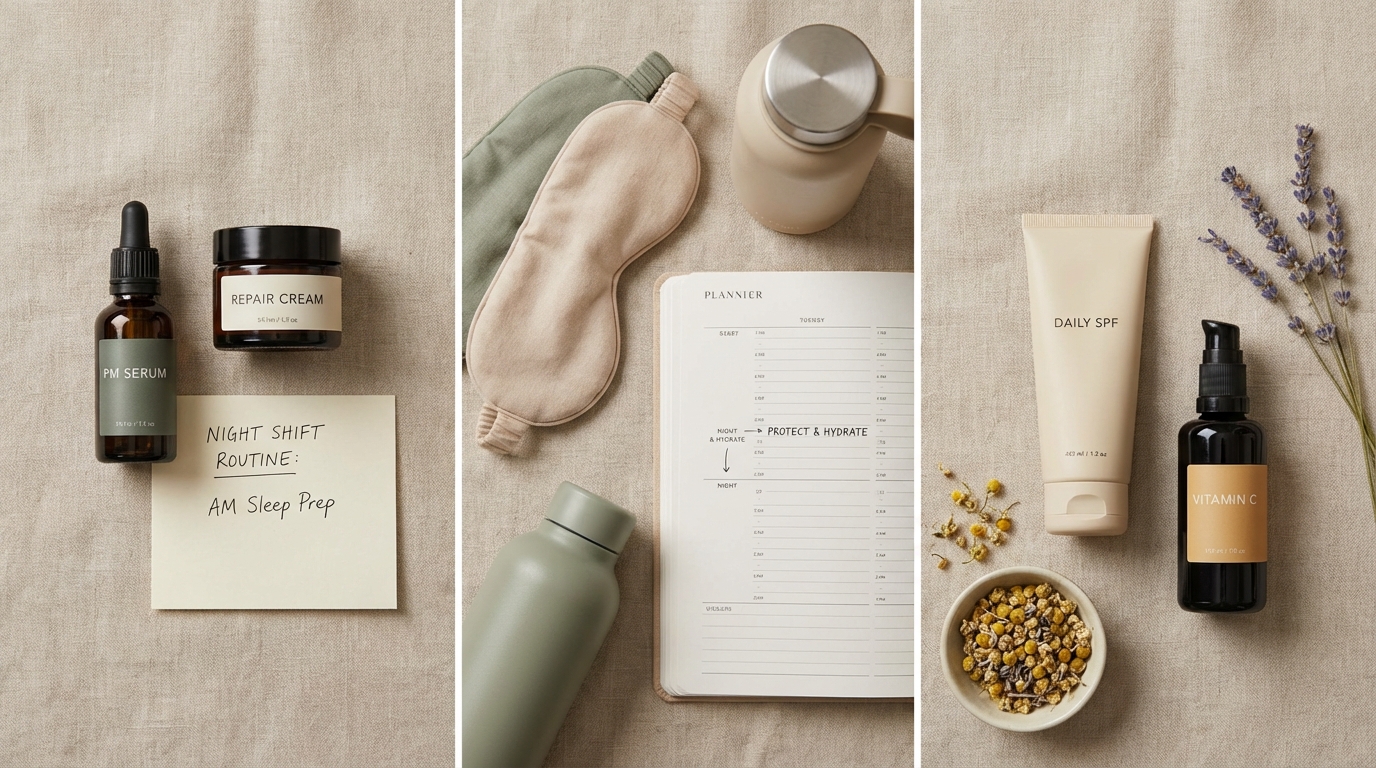
Working the night shift messes with basically everything. Your sleep schedule, your eating habits, your social life, and yes, your skin. I worked overnight shifts at a hospital for two years during nursing school, and let me tell you, my skin went through it. The fluorescent lights, the dry recycled air, the complete confusion about when to apply what. It took me months to figure out a routine that actually made sense for my backwards schedule.
Here is what I learned: traditional skincare advice assumes you wake up in the morning and sleep at night. When that is not your reality, you need to think differently about when and how you take care of your skin.
The Big Mental Shift: It Is About Sleep, Not Sunlight
Most skincare routines are organized around the sun. Morning routine prepares your skin for daylight exposure. Evening routine repairs the damage and supports overnight recovery. But when you work nights, the sun is not the organizing principle of your life anymore. Sleep is.
Think of it this way: your “morning routine” happens whenever you wake up, whether that is 4pm or 7pm. Your “evening routine” happens before you go to sleep, even if that means applying night cream at 8am. Once I stopped trying to match the clock and started matching my actual life, everything clicked.
Pre-Shift Routine (Your “Morning”)
This is when you wake up from your daytime sleep and get ready for work. For most night shift workers, this happens in the late afternoon or early evening.
The Basics
Cleanse gently. You have been sleeping, not out in the world accumulating dirt and pollution. A gentle cleanser is all you need. Some people skip cleansing entirely and just splash with water, which is fine too. Your skin has not been exposed to much while you were asleep.
Hydrating serum or essence. If you use one, now is the time. Something with hyaluronic acid helps prep your skin for the dry environment you are about to enter.
Moisturizer. Pick something that will hold up for your entire shift. If your workplace is aggressively air-conditioned, you might want something slightly heavier than a typical day cream.
SPF if you will see any sun. Here is where it gets tricky. If you are waking up at 4pm and leaving for work at 5pm, you might catch some late afternoon sun on your commute. In summer, that could mean real UV exposure. During those months, wear sunscreen. In winter when it is dark by the time you leave? You can probably skip it.
What About “Daytime” Active Ingredients?
Products with vitamin C, niacinamide, or other ingredients typically used in the morning can still be applied before your shift. These ingredients are not specifically morning ingredients, they are just photostable (they do not break down in light) and work well under sunscreen. Since you are mostly going to be indoors under artificial light, they will work fine.
During Your Shift: The Forgotten Part
Nobody talks about mid-shift skincare, but when your shift is 8 or 12 hours long, your skin needs attention in the middle of it. Here is my night shift survival kit:
A facial mist. Office buildings, hospitals, warehouses, and pretty much any workplace with HVAC are incredibly drying. A quick spritz of a hydrating mist can make a huge difference. Look for one with glycerin or hyaluronic acid, not just water (plain water actually evaporates and takes your skin’s moisture with it).
A small moisturizer or balm. I kept a little pot of Aquaphor in my locker for my lips and dry patches around my nose. The air where I worked was ruthless.
Blotting papers if you get oily. Some people go the opposite direction and get super greasy during long shifts. Blotting papers are better than constantly washing your face or piling on powder.
Eye drops. Not skincare exactly, but dry eyes from staring at screens or bad lighting make your whole face look tired. Keeping your eyes comfortable helps.
Post-Shift Routine (When You Get Home)
You are exhausted. You have been awake all night. The last thing you want to do is a 10-step routine. I get it. Here is the non-negotiable minimum: cleanse and moisturize.
The Important Part
Double cleanse if you wore makeup or sunscreen. An oil-based cleanser or micellar water first, then your regular cleanser. Even if you were just in an office, a full day’s worth of sebum and environmental grime needs to come off.
If you can only do one thing, make it cleansing. Going to sleep with your work night still on your face is a recipe for clogged pores and breakouts. I learned this the hard way during my first month of night shifts.
The Ideal Post-Shift Routine
If you have a few more minutes and are not completely dead on your feet:
Cleanse thoroughly. Yes, both steps of the double cleanse.
Treatment products. This is when your “night” products come in. Retinol, acids, or whatever actives you use can be applied now. Your skin is about to have several hours of rest to absorb and respond to these ingredients without sun exposure.
Heavier moisturizer or sleeping mask. Since you are going to be unconscious for the next 6-8 hours, your skin has time to benefit from richer products. A sleeping mask or a thick night cream works great here.
Eye cream if you use one. The skin around your eyes does not have oil glands and gets dehydrated faster. Night shift eye circles are real, and giving that area some extra love helps.
Protecting Your Skin From Night Shift Specific Problems
Working nights creates some unique skin challenges that day workers do not deal with.
The Artificial Light Situation
Fluorescent lights and computer screens emit small amounts of blue light. There is ongoing debate about whether this is enough to cause skin damage or accelerate aging. The research is not conclusive. What IS clear is that harsh overhead lighting can make existing skin issues look worse and mess with your circadian rhythm, which affects everything including skin health.
If you are concerned about blue light, products with antioxidants like vitamin C, vitamin E, or niacinamide can offer some protection. Some people also wear blue light filtering glasses, though this is more about eye strain and sleep quality than skin.
The Dehydration Problem
Most workplaces are chronically dry, and you are in them for extended periods. Combat this by:
Drinking water throughout your shift (obvious but easy to forget when you are busy). Using a humidifier at home while you sleep, if your bedroom is dry. Choosing skincare products with humectants that draw moisture into your skin. Avoiding products with high alcohol content that can dry you out further.
The Sleep Quality Factor
Daytime sleep is usually lighter and more interrupted than nighttime sleep. This affects your skin’s repair process. Make your bedroom as dark as possible with blackout curtains. Keep it cool. Establish a consistent sleep schedule even on your days off, as much as you can. Your skin (and the rest of your body) will thank you.
Maintaining Consistency When Your Schedule Is Chaos
The hardest part of night shift skincare is not knowing what products to use. It is actually doing the routine when you are exhausted, when your schedule keeps changing, or when you are switching between day shifts and night shifts.
What Helped Me
Keep products visible and accessible. If your cleanser and moisturizer are right next to your bed, you have no excuse. I literally kept a small basket of essentials on my nightstand.
Simplify ruthlessly. A 3-step routine you actually do is better than a 10-step routine you skip. On your most tired nights, just cleanse and moisturize. Everything else is bonus.
Set a pre-sleep alarm. Seriously. An alarm that goes off 15 minutes before you want to be in bed, reminding you to wash your face. I felt ridiculous the first time I did this, but it worked.
Prep for rotating schedules. If you switch between days and nights, do not try to maintain different routines for each. Keep it simple enough that the same basic steps work regardless of when you are sleeping.
A Sample Night Shift Routine
Here is what a typical week might look like:
Wake up (5pm): Splash face with water or gentle cleanser. Hydrating toner. Moisturizer. SPF if there is still daylight.
During shift (as needed): Facial mist. Lip balm. Water.
After shift (8am): Double cleanse. Serum with niacinamide or vitamin C. Eye cream. Retinol (every other night). Heavy moisturizer or sleeping mask.
Days off: Try to keep your wake and sleep times somewhat consistent. Use your regular routine aligned to when you actually sleep, not what time it is.
The Real Talk
Night shift work is hard on your body, and your skin is part of your body. You might deal with more breakouts, more dullness, more dark circles than you did before. That is normal, and it is not your fault.
Do what you can with skincare, but also give yourself grace. Getting enough sleep matters more than any serum. Eating actual food instead of vending machine snacks matters more than any mask. Managing your stress matters more than any expensive treatment.
Your skin will survive night shift work. Focus on the basics, stay consistent when you can, and do not beat yourself up when you are too tired to do anything but crash into bed. Tomorrow night you can try again.