
Your acids are fighting each other and you didn’t even know it! I spent way too long wondering why my glycolic acid wasn’t doing much, only to realize I was layering it completely wrong (and possibly canceling out half my routine in the process). If you’ve ever stared at your bathroom counter full of serums like they’re chess pieces you don’t know how to move, this one’s for you.
Why Order Actually Matters
Acids aren’t like moisturizers where you can kind of slap them on whenever. They have pH levels, and those pH levels determine how well they work. When you use an acid, your skin’s natural pH (around 4.5-5.5) temporarily shifts to let the product do its thing. Use them in the wrong order, and you’re basically throwing off the whole system.
The general rule? Go from lowest pH to highest. This means your strongest, most acidic products go first, and you work your way up to the gentler ones. It sounds backward (shouldn’t you ease into it?), but the science actually makes sense. Lower pH products need direct contact with skin to be effective. Layer something with a higher pH underneath, and you’ve just made your acid way less potent.
The pH Lineup You Need to Know
Let me break down the typical pH ranges of common acids so you’re not Googling this every time you do your routine:
- Glycolic acid: usually around 3.0-4.0
- Salicylic acid: typically 3.0-4.0
- Lactic acid: around 3.5-4.0
- Mandelic acid: often 3.5-4.5
- Azelaic acid: usually 4.0-5.0 (gentler, higher pH)
- Vitamin C (L-ascorbic acid): most effective below 3.5
So if you’re using vitamin C and glycolic acid in the same routine (which, honestly, proceed with caution), the vitamin C typically goes first because it often has the lower pH. Then you’d wait before applying anything else. Speaking of waiting…
The Waiting Game Between Acids
This is where things get tedious, but also where results actually happen. After applying an acid, your skin needs time at that lower pH to let the exfoliation work. Immediately slapping on the next product raises the pH too fast and reduces effectiveness.
How long should you wait? The short answer: 15-20 minutes for maximum efficacy. The realistic answer for those of us who don’t have spa mornings: at least 5-10 minutes makes a noticeable difference. Some dermatologists, like Dr. Rana Boroumand on Instagram, suggest that even a few minutes of wait time is better than none at all.
I know, I know. Who has twenty minutes to just stand there between each step? (Not me, which is why I usually apply my acid, then go make coffee, check my phone, contemplate my existence, and come back.) The point is, try to build in some breathing room. Your skin will notice.
When Not to Use Acids on the Same Day
Some combinations are less “chemical harmony” and more “chemical chaos.” There are certain pairings you just shouldn’t attempt in the same routine, or sometimes even the same day.
Glycolic acid + Retinol: Both are heavy hitters for exfoliation and cell turnover. Using them together (especially at first) is a fast track to irritation city. If you want both in your life, alternate nights. For tips on safely adding retinol to your routine, check out this guide on layering retinol.
Vitamin C + Niacinamide: Old advice said never mix these. Newer research suggests they’re actually fine together for most people, but if you notice flushing or reduced efficacy, separate them into AM and PM routines.
Multiple AHAs at once: Using glycolic AND lactic AND mandelic in one routine is overkill. Pick one AHA per routine, please. Your moisture barrier is begging you.
Salicylic acid + Benzoyl peroxide: Both target acne but together can be extremely drying. If you use both, apply them at different times of day, or on alternating days.
Building Your Weekly Acid Schedule
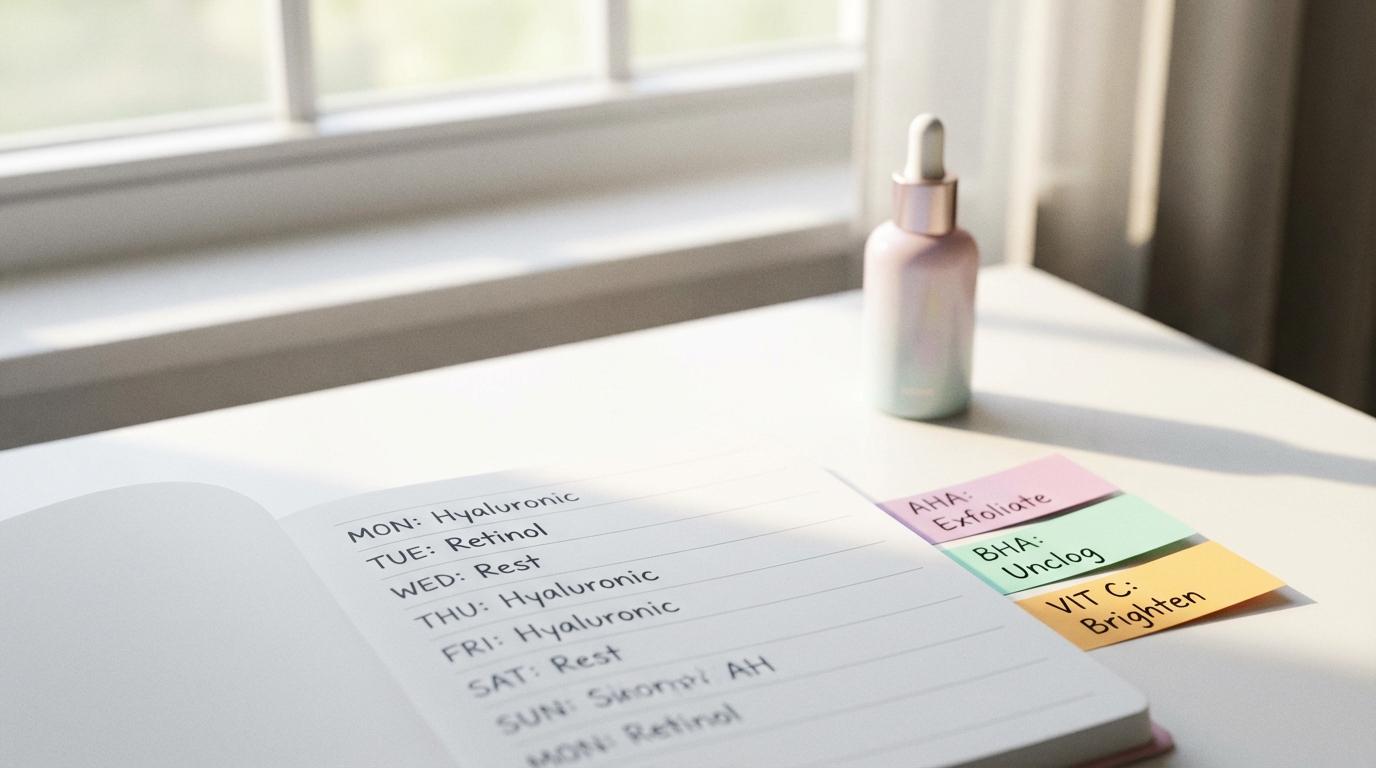
Here’s where we get practical. Instead of trying to cram everything into one night and ending up with irritated, angry skin, spread your actives throughout the week.
A sample schedule might look like this:
- Monday/Thursday: AHA night (glycolic or lactic acid)
- Tuesday/Friday: Retinol night (if you’re using one)
- Wednesday/Saturday: Hydration focus, maybe a gentle azelaic acid if redness is your thing. Speaking of which, azelaic acid is seriously slept on for calming irritated skin.
- Sunday: Rest day. Your skin regenerates. Let it breathe.
This is just a template. Your schedule depends on your skin’s tolerance, your specific concerns, and how your products interact. Start slow, like really slow, especially if you’re new to acids. One new active at a time, used every third day, then every other day, then daily if your skin can handle it.
What About Mornings?
Most acids make your skin more sensitive to sunlight (thanks, photosensitivity), so the common advice is to keep acids in your PM routine. But vitamin C? That one actually works well in the morning because it provides antioxidant protection throughout the day. Pair it with sunscreen (always) and you’re good.
Some people do use low-concentration AHAs in the morning without issues, but only if they’re religious about SPF. And I mean religious. A broad-spectrum SPF 30 or higher is non-negotiable if acids are part of your daytime routine.
Signs You’re Overdoing It
Because someone needs to say it: more acids does not equal better skin. If you’re experiencing any of the following, it’s time to scale back:
- Persistent redness that doesn’t calm down
- Skin that feels tight, dry, or “squeaky clean” (not good)
- Increased sensitivity to products that never bothered you before
- Tiny bumps or texture that appeared after starting acids
- Stinging when you apply basic moisturizer
If this sounds familiar, stop all acids for at least a week. Focus on hydration, gentle cleansers, and barrier repair. Your skin will recover, but it needs a break. Overexfoliation is real, and it happens to the most well-intentioned among us.
A Simple Starting Point
If you’re new to acids or rebuilding after a routine disaster (been there), start with one gentle acid. Lactic acid is a great entry point because it’s larger molecularly and doesn’t penetrate as deeply. Mandelic acid is another forgiving option.
Use it two to three times per week, after cleansing, before moisturizer. Wait a few minutes between steps. See how your skin responds over two to three weeks before adding anything else. Patience is annoying but necessary.
Once your skin is comfortable, you can start thinking about incorporating a second acid on alternate days, or introducing something like vitamin C in your morning routine. Build slowly. There’s no prize for having the most actives. The prize is skin that actually looks and feels healthy, which takes time and restraint.
Your acid collection deserves a strategy, not chaos. Figure out what goes first, give each product its moment, and stop trying to be a human chemistry experiment every night. Your future skin (the calm, smooth, not-irritated version) will be worth the planning.