
Tyrosinase sits at the very beginning of your skin’s melanin production pathway. This single enzyme is the rate-limiting step in how your skin creates pigment, which means that most brightening ingredients you’ve ever used are trying to slow it down in one way or another.
Understanding tyrosinase helps make sense of why certain skincare ingredients work for hyperpigmentation, why some work faster than others, and why addressing dark spots is often a slow, patient process. Your skin didn’t get those spots overnight, and the enzyme responsible isn’t going to stop overnight either.
The Melanin Synthesis Pathway
Melanin is the pigment that gives your skin, hair, and eyes their color. It’s produced by specialized cells called melanocytes, which live in the bottom layer of your epidermis. The process of creating melanin is called melanogenesis, and it involves a cascade of chemical reactions.
Tyrosinase kicks off the whole process. It converts an amino acid called tyrosine into another compound called DOPA (dihydroxyphenylalanine), then converts DOPA into dopaquinone. From dopaquinone, the pathway branches into creating either eumelanin (brown/black pigment) or pheomelanin (red/yellow pigment), depending on other factors.
Without tyrosinase activity, melanin production stalls at the very first step. This is why it’s such a central target for skin brightening. You could theoretically interrupt the pathway at other points, but stopping it before it even really starts is particularly effective.
Melanocytes produce melanin in response to various triggers. UV exposure is the big one. When your skin senses UV radiation, it signals melanocytes to ramp up production as a protective response. Hormones, inflammation, and certain medications can also trigger increased melanin synthesis.
How Tyrosinase Inhibitors Work
Most brightening ingredients are classified as tyrosinase inhibitors. They interfere with the enzyme’s ability to do its job, slowing down melanin production at the source.
The mechanism varies depending on the ingredient. Some inhibitors are competitive, meaning they compete with tyrosine for the enzyme’s active site. If the inhibitor gets there first, the enzyme can’t process tyrosine, so melanin production slows. Others are non-competitive, binding to a different part of the enzyme and changing its shape so it can’t function properly.
Copper is essential for tyrosinase activity. The enzyme contains copper ions at its active site. Some ingredients work by chelating (binding up) copper, making it unavailable for the enzyme to use. No copper, no functional tyrosinase.
The level of inhibition matters. Partial inhibition slows melanin production without stopping it completely, leading to gradual lightening of hyperpigmentation over weeks to months. This is generally what we want in cosmetic applications. Complete inhibition would be problematic since melanin serves protective functions.
Ingredients That Target Tyrosinase
Many familiar brightening ingredients work through tyrosinase inhibition. Understanding this helps explain why certain combinations make sense and why some ingredients get recommended over others.
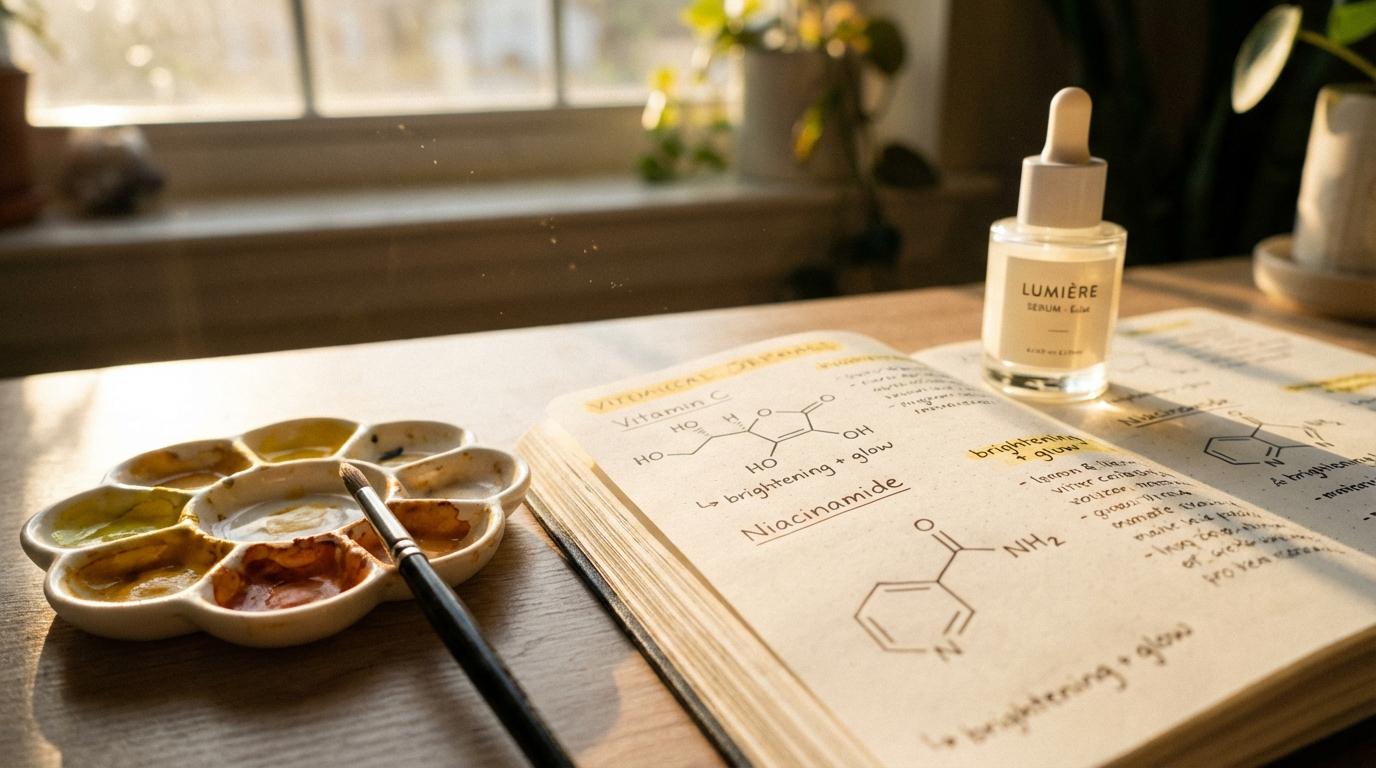
Vitamin C (ascorbic acid) is a mild tyrosinase inhibitor. It also has antioxidant properties that protect against UV-induced pigmentation and can help fade existing pigment through other mechanisms. The inhibition isn’t as strong as some other ingredients, which is part of why vitamin C works gradually.
Arbutin is a natural compound found in bearberry plants. It releases hydroquinone slowly when applied to skin, providing tyrosinase inhibition without the concentration of pure hydroquinone. Alpha arbutin is considered more stable and effective than beta arbutin.
Kojic acid is derived from fungi and is a fairly potent tyrosinase inhibitor. It chelates copper at the enzyme’s active site. Kojic acid can be irritating for some people and may destabilize in formulations, so it’s often combined with other ingredients.
Azelaic acid inhibits tyrosinase and also has anti-inflammatory properties, making it useful for post-inflammatory hyperpigmentation from acne. Its additional benefits for acne make it a multitasker.
Tranexamic acid works through multiple mechanisms, including some tyrosinase inhibition. It’s particularly interesting because it can be taken orally or applied topically, and it helps with melasma, which is notoriously difficult to treat.
Niacinamide doesn’t directly inhibit tyrosinase, but it interferes with melanin transfer from melanocytes to keratinocytes (the cells that make up most of your epidermis). The melanin gets made, but it doesn’t get distributed as effectively, which still reduces visible pigmentation.
Hydroquinone is the most potent tyrosinase inhibitor available in skincare. At 2%, it’s available OTC in some countries. Higher concentrations require a prescription. Its potency makes it effective but also means it carries more risk of irritation and a rare condition called ochronosis with prolonged overuse.
Brightening at the Source
Targeting tyrosinase addresses pigmentation at its origin, which is both the strength and the limitation of this approach.
The strength is that you’re preventing new melanin from being made. Over time, as your skin naturally turns over and sheds cells containing old melanin, the overall pigmentation decreases. New cells coming up have less melanin in them because production was suppressed.
The limitation is timing. Skin cell turnover takes about four to six weeks on average, and the full cycle of replacing pigmented cells with less pigmented ones takes longer. This is why brightening treatments require months of consistent use to show significant results. You’re waiting for biology to run its course.
Combining tyrosinase inhibitors with exfoliants can speed things along. Ingredients like glycolic acid or retinoids increase cell turnover, helping to shed pigmented cells faster while new, less pigmented cells replace them. This combination approach is why many brightening routines include both types of ingredients.
Sun protection is essential when targeting pigmentation. UV exposure triggers melanocytes to produce more melanin, counteracting your brightening efforts. Using tyrosinase inhibitors without sunscreen is essentially one step forward, two steps back. A good SPF habit makes every other brightening product work better.
Individual Variation Factors
Not everyone responds equally to tyrosinase inhibitors. Several factors influence how well these ingredients work for any given person.
Skin tone and ethnicity affect baseline tyrosinase activity. People with more melanin typically have more active melanocytes and may need stronger or longer treatment courses to see results. This isn’t a limitation of the products but rather a reflection of biological differences.
The cause of hyperpigmentation matters. Post-inflammatory hyperpigmentation from acne often responds well to tyrosinase inhibitors. Melasma, which has hormonal components, is more stubborn and may require combination approaches. Sun spots respond but may recur with continued sun exposure.
Depth of pigmentation influences results. Melanin in the epidermis (upper skin layers) is more accessible and responds faster to topical treatments. Melanin that has dropped into the dermis (deeper layers) is much harder to treat topically and may require professional treatments like lasers.
Genetics play a role too. Some people are simply more prone to hyperpigmentation than others. If you scar dark after every minor injury or get melasma easily, you’ll likely need to be more aggressive and consistent with prevention and treatment.
Realistic Expectations
Tyrosinase-targeting ingredients work, but they work within biological limits. Expecting dramatic results in two weeks sets you up for disappointment. Expecting gradual improvement over three to six months is more realistic.
Complete removal of stubborn hyperpigmentation may not be possible with topical products alone. Professional treatments like chemical peels or laser therapy can go deeper and produce more dramatic results, though they come with their own considerations and costs.
Maintenance is usually ongoing. Even after achieving your desired results, some level of continued brightening product use and diligent sun protection helps prevent new pigmentation from developing. Think of it as management rather than a one-time fix.
Understanding tyrosinase gives you a framework for thinking about brightening that’s grounded in how your skin actually works. The enzyme is doing its job, protecting you from UV damage. We’re just asking it to do that job a little less enthusiastically so we can fade the spots we don’t want.