
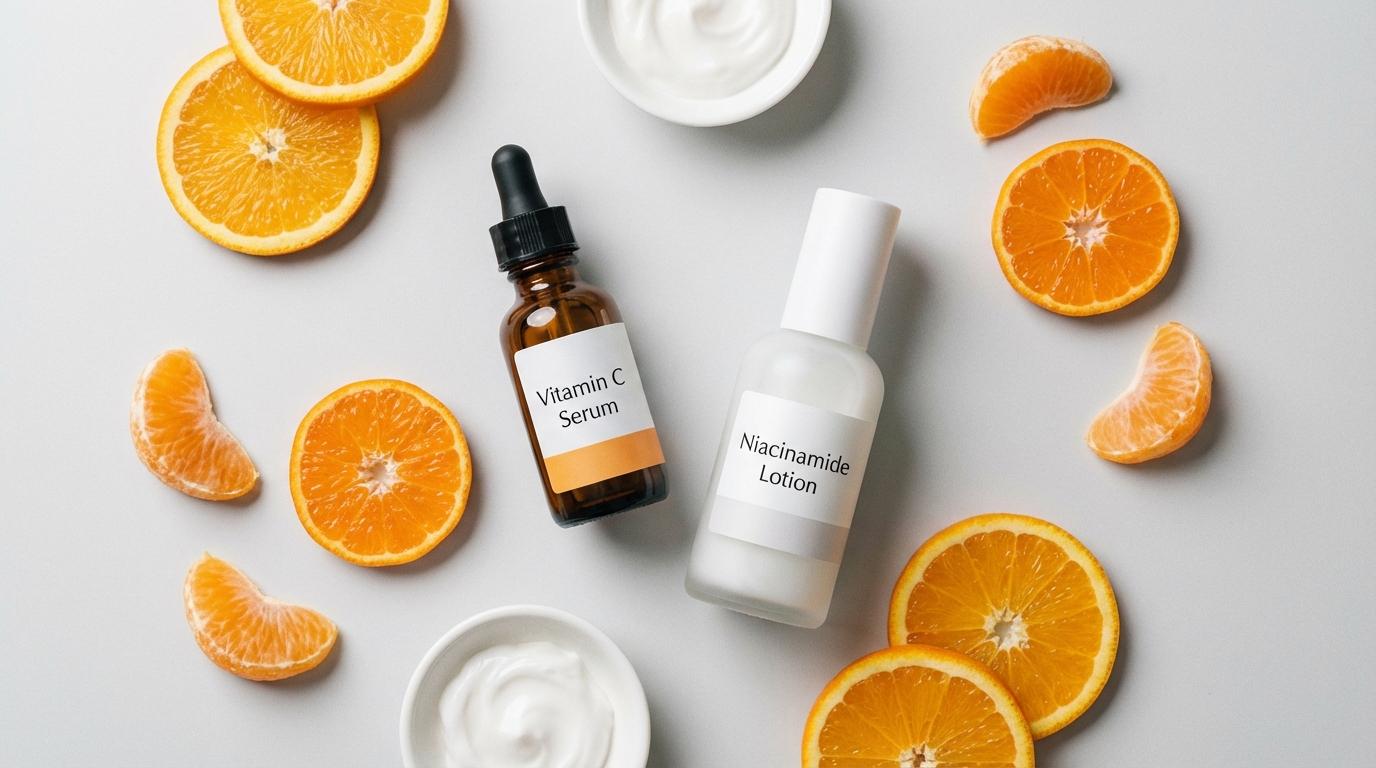
Everyone knows you can’t mix vitamin C and niacinamide in your skincare routine. Except that’s completely wrong, and the “science” behind this claim is about as relevant to your morning routine as a chemistry experiment from the Kennedy administration.
I remember the first time I read about this supposed incompatibility. I was deep in a skincare forum rabbit hole at 2 AM (as one does), and someone was absolutely certain that mixing these two ingredients would cause flushing, irritation, and basically ruin everything. The confidence was impressive. The science? Not so much.
Let me walk you through what actually happened, why the myth persists, and how you can confidently use both of these powerhouse ingredients without your face staging a revolt.
The 1960s Study Everyone Misunderstands
The origin story of this skincare myth traces back to research conducted in the early 1960s. Scientists observed that when pure ascorbic acid (vitamin C) mixed with niacinamide under specific conditions, a compound called nicotinic acid could form. Nicotinic acid can cause vasodilation, which translates to redness and flushing on your skin.
Sounds alarming, right? But here’s what those forum posts never mention: the conditions required for this reaction to occur.
The original experiments used extremely high temperatures, extended exposure times, and highly concentrated solutions that have zero resemblance to what you’re putting on your face. We’re talking about laboratory conditions designed to stress-test chemical stability, not conditions that exist in your bathroom cabinet at room temperature.
To put this in perspective, you’d need to heat your skincare products to temperatures that would make them unusable anyway. Your serum sitting in your medicine cabinet? It’s not experiencing the thermal stress of a laboratory autoclave.
Why Modern Formulations Changed Everything
Skincare chemistry has come a long way since the Beatles were topping charts. Today’s formulations are engineered with stability in mind, using buffers, pH adjusters, and stabilizing agents that the researchers in those original studies didn’t have access to.
Modern vitamin C serums are formulated at pH levels that keep the ascorbic acid stable and effective. Quality niacinamide products are similarly well-buffered. When you layer these products on your skin, the small amounts of each ingredient, combined with the stabilizing elements in their formulations, make the conversion to nicotinic acid essentially negligible.
A 2004 study published in the Journal of Cosmetic Dermatology specifically investigated this question. Researchers tested niacinamide and vitamin C combinations at various pH levels representative of actual skincare products. Their finding? The ingredients remained stable and did not undergo significant degradation when combined.
Another study from 2005 in the Journal of Investigative Dermatology examined the effects of combining niacinamide and vitamin C topically on human volunteers. The result was not irritation or flushing, but actually improved outcomes: reduced hyperpigmentation and better overall skin tone.
The Complementary Benefits You’re Missing
Beyond just “not reacting badly,” vitamin C and niacinamide actually work beautifully together. Understanding why requires a quick look at what each ingredient does.
Vitamin C (ascorbic acid) is a potent antioxidant that neutralizes free radicals, stimulates collagen production, and inhibits melanin synthesis. It’s your defense against environmental damage and a key player in brightening uneven skin tone. If you’re building a morning routine that includes vitamin C, you’re already ahead of the curve.
Niacinamide (vitamin B3) works differently. It strengthens your skin barrier, regulates sebum production, reduces inflammation, and also addresses hyperpigmentation through a separate pathway. For those dealing with excess oil, it’s a core component of any routine designed for oily skin.
When you use both, you’re attacking skin concerns from multiple angles. Your vitamin C provides antioxidant protection and collagen support. Your niacinamide strengthens the barrier and keeps oil in check. They’re not competing; they’re collaborating.
The pH Question (And Why It Matters Less Than You Think)
Some skincare enthusiasts argue that vitamin C needs a low pH to penetrate skin effectively, while niacinamide works better at a higher pH. Therefore, they conclude, using them together compromises both.
This argument has a grain of truth but draws the wrong conclusion.
Yes, pure ascorbic acid penetrates best at a pH around 3.5 or lower. And yes, niacinamide is most stable at a neutral pH. But when you apply these products in sequence rather than literally mixing them in your palm, each has time to work before the next one goes on.
Your skin also has its own buffering capacity. It doesn’t passively accept whatever pH you throw at it. Within minutes of application, your skin begins normalizing the pH of whatever you’ve applied. This means the window for any theoretical interaction is extremely narrow.
The practical upshot: apply your vitamin C, give it a minute or two to absorb, then follow with your niacinamide product. This isn’t because they’ll “react badly,” but because it’s good layering practice that ensures both products absorb optimally.
How to Actually Use Them in Your Routine
Ready to put theory into practice? Here’s how to incorporate both ingredients effectively.
Morning Routine Option
After cleansing and while your skin is still slightly damp, apply your vitamin C serum. This is typically an L-ascorbic acid serum in the 10-20% concentration range. Wait about 60 seconds for initial absorption. Follow with your niacinamide product, which might be a dedicated serum or part of your moisturizer. Finish with sunscreen, because vitamin C increases photosensitivity and undoing all that antioxidant work with sun damage would be counterproductive.
Evening Routine Option
If you prefer using vitamin C at night (some people find it layers better under their evening products), the same sequencing applies. Cleanse, apply vitamin C, wait briefly, then continue with niacinamide and the rest of your routine. Just know that you’re missing out on some of the daytime antioxidant protection that makes vitamin C particularly useful in the morning.
The Combined Product Approach
Some brands now formulate products containing both vitamin C and niacinamide. These products have been stability-tested to ensure the ingredients play nicely together at the specific ratios and pH levels used. If layering feels like too much effort, a well-formulated combination product is a legitimate shortcut.
What If You Actually Experience Irritation?
Some people do experience flushing or irritation when using vitamin C and niacinamide together. But before blaming the combination, consider other explanations.
Vitamin C, particularly L-ascorbic acid at higher concentrations, can be irritating on its own. If your vitamin C serum stings or causes redness even without niacinamide in the mix, that’s a vitamin C tolerance issue, not a combination issue. Try a lower concentration or a vitamin C derivative like sodium ascorbyl phosphate or ascorbyl glucoside.
Similarly, niacinamide at very high concentrations (above 5%) can cause flushing in some individuals. This is the niacinamide itself, not its interaction with vitamin C. Dialing back to a 2-4% niacinamide product often resolves this.
Fragrance, essential oils, or other sensitizing ingredients in your products could also be culprits. Before assuming the vitamin C and niacinamide are fighting, examine your full ingredient lists for potential irritants.
The Real Combinations to Watch Out For
While vitamin C and niacinamide are safe to pair, there are ingredient combinations that do warrant more caution.
Retinoids and AHAs/BHAs used together can over-exfoliate and compromise your skin barrier. If you’re using both, alternate nights rather than layering them.
Benzoyl peroxide can oxidize and deactivate vitamin C, so those two should be used at different times of day. Benzoyl peroxide is better for evenings anyway, as it can degrade in sunlight.
Vitamin C and strong acids (like glycolic or salicylic acid in high concentrations) together may cause irritation, not because they react chemically but because both can be sensitizing. If you use both, start with the vitamin C, let it absorb completely, and follow with the acid rather than reversing the order.
Reading the Research Yourself
I encourage you to look at the actual studies rather than taking internet advice at face value, including mine. Search for the 2004 Journal of Cosmetic Dermatology stability study and the 2005 Journal of Investigative Dermatology work on topical combinations. Primary sources are always more reliable than forum posts, no matter how confidently written.
When evaluating skincare claims, ask yourself: What were the actual experimental conditions? Do they resemble real-world use? Is the study from this decade, or is it older than your parents’ wedding photos?
Skincare science moves forward. Clinging to conclusions from the 1960s when modern research contradicts them isn’t being careful; it’s being stubborn.
What the Dermatologists Say
Board-certified dermatologists have largely moved past this myth. Dr. Shereene Idriss, Dr. Sam Bunting, and numerous other dermatologist content creators have addressed this topic publicly, confirming that vitamin C and niacinamide can be used together safely.
The consensus among dermatological professionals: use both ingredients if they address your skin concerns, pay attention to how YOUR skin responds, and stop worrying about theoretical reactions that don’t actually happen under normal use conditions.
Building Your Routine Around Both
If you’re starting from scratch, here’s a practical approach.
Week 1-2: Introduce vitamin C alone. Use it every other morning to gauge tolerance. Look for any irritation, stinging, or excessive redness.
Week 3-4: Add niacinamide on alternate days. Notice how your skin responds to each ingredient individually.
Week 5 onward: If both are well-tolerated, begin using them in sequence. Apply vitamin C first, wait briefly, then follow with niacinamide. Monitor for any changes.
Most people will find this combination works beautifully. Brighter skin, more even tone, controlled oil, and a stronger barrier. The minority who experience issues usually find that adjusting concentrations or timing resolves the problem.
The vitamin C and niacinamide “conflict” is skincare folklore dressed up in scientific language. Modern formulations, contemporary research, and dermatologist consensus all point to the same conclusion: these ingredients work well together. Your routine can include both without drama, and your skin will likely thank you for the combined benefits.
Now go update your routine and stop letting a 60-year-old study dictate your skincare choices.