
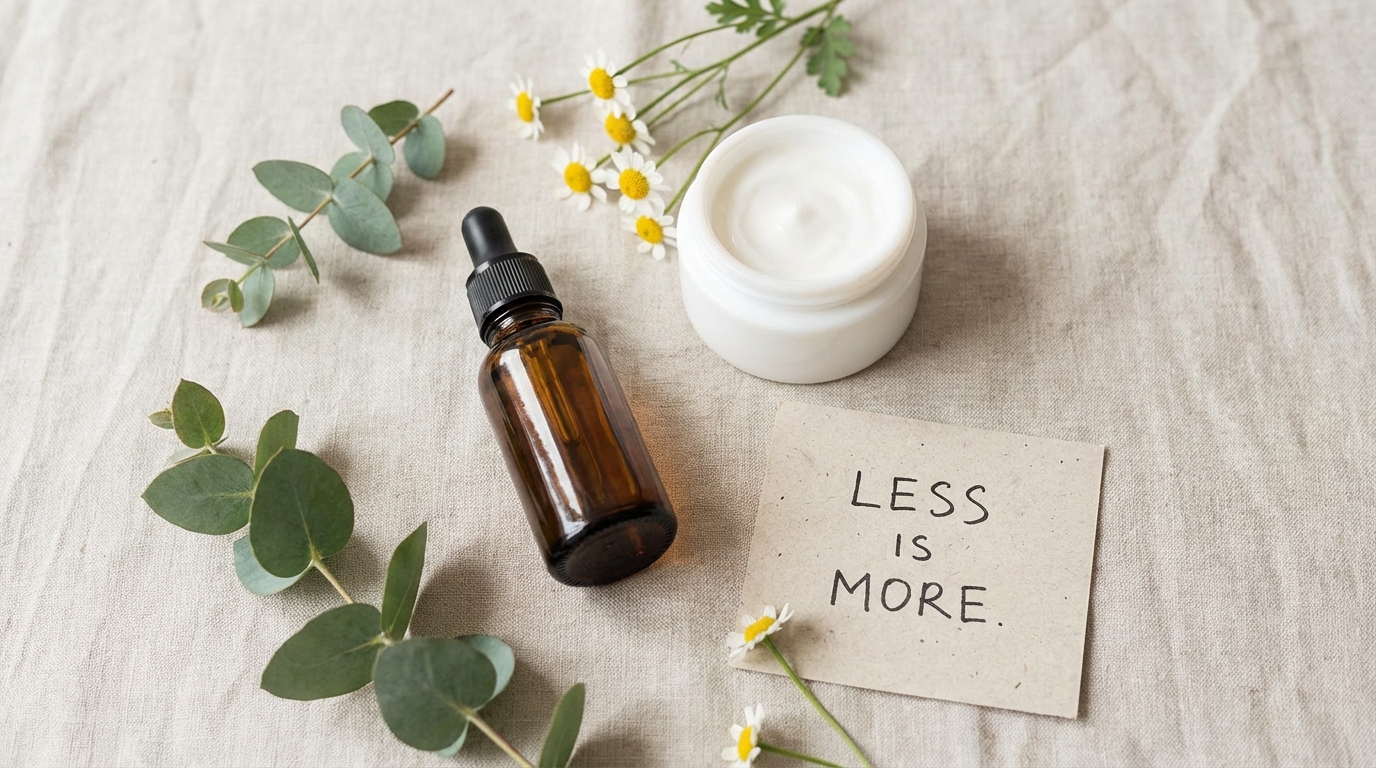
There is a persistent idea in skincare that consistency is everything. Use your products every single day, never miss a step, and your skin will reward you. But the reality is more nuanced than that. Sometimes, your skin genuinely benefits from a break.
As someone with a biochemistry background, I find this topic fascinating because it touches on how our skin actually functions as a living organ. Let me walk you through the science of why occasional rest days can actually improve your skin.
Understanding Your Skin Barrier
Your skin barrier, also called the stratum corneum, is the outermost layer of your epidermis. Think of it as a brick wall. The cells are the bricks, and the lipids between them are the mortar. This barrier keeps water in and irritants out.
When you apply products constantly, especially those with active ingredients, you are essentially asking this barrier to do extra work. It has to process what you are putting on it while also performing its regular protective functions.
Research published in the Journal of the American Academy of Dermatology shows that over-application of certain actives can lead to barrier disruption. The barrier loses some of those lipid layers, becoming more permeable and more sensitive.
Signs that your barrier might need a break include increased sensitivity, redness that was not there before, products that used to feel fine now stinging, and skin that looks dull or feels tight despite moisturizing.
The Case for Active Ingredient Breaks
Active ingredients like retinoids, alpha hydroxy acids, and vitamin C work by triggering specific cellular responses. Retinoids, for example, bind to receptors in your cells and increase cell turnover. AHAs dissolve the bonds between dead skin cells, promoting exfoliation. If you are using multiple actives, understanding how to layer retinol without irritation becomes especially important during recovery periods.
These processes are beneficial, but they also put a certain amount of stress on your skin cells. Your cells can adapt and build tolerance, which is why dermatologists often recommend starting slowly with new actives. But continuous daily use without breaks can sometimes lead to diminishing returns or irritation.
A study from the National Institutes of Health found that periodic breaks from retinoid use can help maintain the skin’s response to the active without building excessive tolerance or experiencing chronic irritation.
This does not mean you need to take a week off every month. Even just reducing frequency from every night to every other night, or taking one or two nights off per week, can give your skin time to recover and reset.
Reading Your Skin’s Signals
Your skin communicates with you constantly. Learning to interpret these signals is one of the most valuable skincare skills you can develop.
Signs your skin wants a break:
Increased oiliness can paradoxically mean your skin is overworked. When the barrier is compromised, your sebaceous glands sometimes ramp up oil production in an attempt to compensate for the lost protective barrier.
New breakouts in unusual areas might indicate irritation rather than typical acne. Irritation-induced breakouts often appear as clusters of small bumps that look different from your regular pimples.
Products absorbing too quickly could mean your barrier is too permeable. Healthy skin absorbs products at a moderate pace. If everything seems to sink in instantly, your barrier might be compromised.
That tight feeling after cleansing, even with a gentle cleanser, suggests your skin is losing moisture faster than it should.
What to do on rest days:
Keep it minimal. Cleanse gently, apply a basic moisturizer, and use sunscreen during the day. Skip serums, acids, and treatment products. Let your skin exist without being asked to process a bunch of active compounds.
When Less Really Is More
The skincare industry has a vested interest in selling you more products. But from a purely scientific standpoint, your skin does not need constant intervention to function well.
Your skin has remarkable self-regulating capabilities. It produces its own moisturizing factors, sheds dead cells naturally through a process called desquamation, and hosts a microbiome that helps maintain its health. These processes happen without any products at all.
Products can support these natural functions, but they can also interfere with them if overused. Research from ScienceDirect suggests that overly aggressive skincare routines can actually disrupt the skin microbiome, leading to various skin issues.
There is also the psychological benefit of letting go of product obsession. Skincare should enhance your life, not become a source of stress and elaborate rituals that consume your time and mental energy.
Practical Ways to Incorporate Rest Days
You do not need to plan this out on a calendar, though you certainly can if that helps you. The simplest approach is to pay attention to how your skin looks and feels.
If you wake up and your skin looks irritated, inflamed, or just not happy, consider making that a rest day. Use only your most basic, gentle products.
After a night out where you got less sleep than usual, your skin is already under stress. This might be a good time to reference night owl skincare routines that account for irregular sleep patterns, but in general, exhausted skin does not need your strongest retinol on top of it.
If you have been using a new product and experiencing any unusual reactions, take a few days off to see if things calm down. This also helps you identify whether that product is the cause.
Some people find that one or two rest days per week works well as a regular schedule. Others prefer to go by feel. Neither approach is wrong.
The key insight here is that perfect consistency is not actually the goal. The goal is healthy skin, and sometimes that means giving your skin space to do its own thing. Your skin has been taking care of itself for a lot longer than the skincare industry has existed. Trust it a little.