
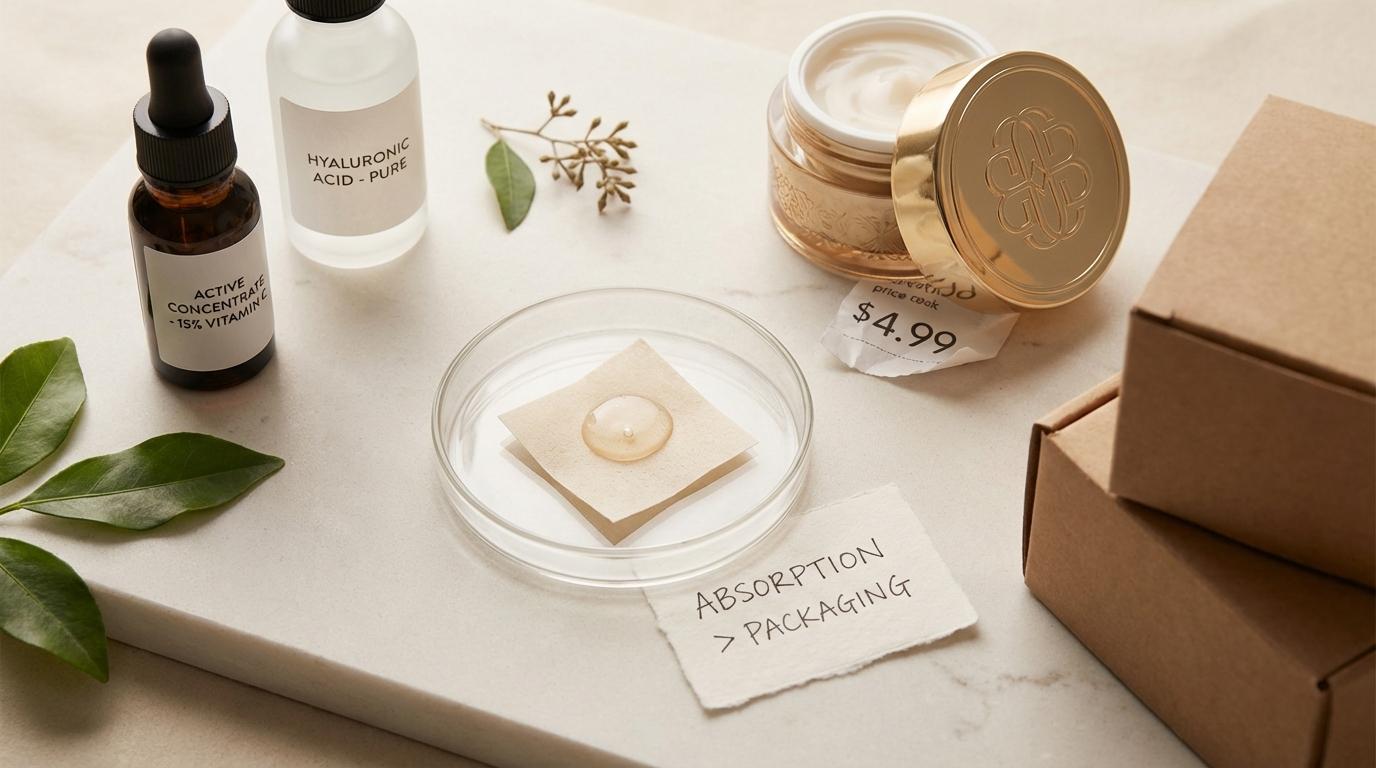
You saved up for weeks. You watched every YouTube review. You finally clicked “add to cart” on that $85 serum everyone swears by. And now, three weeks in, your skin looks… exactly the same as it did when you were using your $12 drugstore pick.
I know this feeling because I’ve been there. I once convinced myself that a $120 vitamin C serum would transform my hyperpigmentation overnight. Spoiler: it didn’t. What actually helped was understanding the science behind why price tags and results don’t always match up.
The Concentration Reality Check
Here’s what expensive skincare brands don’t want you to know: the effectiveness of any serum depends almost entirely on ingredient concentration and formulation quality, not on how much you paid for it.
Let’s talk numbers. According to research published in the Indian Dermatology Online Journal, vitamin C serums are most effective between 10% and 20% concentration. Above 20%? You’re just paying for potential irritation, not better results. That $15 serum with 15% L-ascorbic acid will perform identically to the $150 version at the same concentration.
The same principle applies across the board:
- Retinol: Most formulations cap out at 1%, which is already highly effective
- Niacinamide: Studies show 2-5% concentrations deliver real results
- Salicylic acid: Works at just 0.5-2.5% concentration
- Glycolic acid: 5-10% for beginners, 15-20% for experienced users
That expensive serum sitting on your bathroom shelf? Check the concentration. If it’s the same as a drugstore alternative, your skin literally cannot tell the difference between the two.
How Serums Actually Absorb Into Your Skin
Your skin doesn’t have a price-tag detector. It responds to molecules, not marketing. When you apply a serum, what matters is bioavailability, which is how well the active ingredients can actually penetrate your skin barrier and get to work.
Here’s the frustrating truth: an ingredient with poor bioavailability won’t do much for your skin even if it’s present in high concentrations. A vitamin C serum might boast 15% on the label, but if the formula isn’t stabilized properly, that vitamin C oxidizes before it ever reaches the deeper layers of your skin where it can actually stimulate collagen production.
According to skincare formulators at Mayk, proper formulation ensures active ingredients remain stable over time and can penetrate effectively. This means the $20 serum from a brand that prioritizes formulation science could genuinely outperform a $200 serum that’s all about luxury packaging.
pH levels matter too. Retinoids need specific pH ranges for optimal absorption. Vitamin C derivatives require careful stabilization. These formulation details are where real differences exist, and they have nothing to do with price.
The Markup on Fancy Packaging
Let’s talk about where your money actually goes when you buy an expensive serum. Industry insiders have revealed that even products considered “very expensive to make” cost manufacturers around $6 per unit maximum. Cheaper products? Less than $1 to produce.
So where does the rest of your $85 go?
Marketing. Packaging. Brand positioning. That sleek glass bottle with the gold dropper? It costs more than the serum inside it. The celebrity endorsements, the glossy magazine ads, the influencer partnerships… you’re paying for all of it.
As reported by Rolling Out, many drugstore brands now use the exact same science-backed ingredients as luxury labels without the premium markup. The difference isn’t in the formula. It’s in the branding.
Companies like The Ordinary proved this model works. They keep prices low by skipping traditional advertising. Their 10% niacinamide serum contains the same ingredient at the same concentration as serums costing five times more. Your skin responds to the niacinamide, not the logo on the bottle.
What the Research Actually Shows
A 2021 review in the Journal of Cosmetic Dermatology analyzed 47 vitamin C serums across all price ranges. The finding? No direct correlation between cost and antioxidant potency. Several serums under $20 performed as well as, or better than, luxury options when it came to free radical scavenging and photoprotection.
Good Housekeeping’s Beauty Lab took this further with actual testing. Their top-performing anti-aging serum? A drugstore product from No7 that boosted skin firmness by 21% in four weeks. It beat out serums costing three and four times more.
Retinol is retinol whether it comes in a $300 jar or a $12 tube. The concentration and formulation stability matter. The price tag literally does not affect how your skin responds to active ingredients. If you’re using retinol, proper layering technique matters far more than how much you paid for the product.
Finding Effective Budget Alternatives
Ready to stop overpaying? Here’s how to find serums that actually work without the markup.
Check the ingredients list first. The closer an active ingredient appears to the top of the list, the higher its concentration. If vitamin C is listed after fragrance and preservatives, the concentration is probably too low to make a real difference.
Look for transparent brands. Companies that list exact percentages (like The Ordinary, Good Molecules, or Naturium) let you compare apples to apples. A 10% niacinamide serum is a 10% niacinamide serum regardless of price. Many budget skincare products now match or exceed the performance of luxury alternatives.
Consider ingredient synergy. A lower concentration of a key ingredient can be perfectly effective when supported by complementary ingredients. Vitamin C works better when paired with vitamin E and ferulic acid. Some budget brands nail this combination while expensive ones miss the mark.
Prioritize stability. Dark glass bottles and airless pumps protect sensitive ingredients like vitamin C from light and air exposure. A well-packaged $15 serum will stay potent longer than a poorly packaged $80 one.
As noted by Beautiful With Brains, a well-formulated drugstore product with 10% niacinamide will outperform a luxury serum with 2% niacinamide every single time, regardless of the price difference.
When Splurging Might Make Sense
I’m not saying expensive serums are always a waste. There are specific situations where paying more can be justified.
Certain vitamin C derivatives are more stable than pure L-ascorbic acid. They last longer on your shelf without oxidizing, but this stability technology does come at a higher price. If you’ve struggled with vitamin C serums going brown and useless before you finish them, a pricier stabilized version might actually save you money long-term.
Some cutting-edge ingredients, like peptide complexes or newer delivery systems, genuinely cost more to develop and manufacture. If you’re specifically seeking these innovations, budget brands might not offer them yet.
But for the core workhorses of skincare, like retinol, niacinamide, hyaluronic acid, and basic vitamin C, there’s rarely a scientific reason to spend more.
The Real Variables That Matter
If your serum isn’t working, expensive or not, consider these factors before blaming the product:
Application technique: Apply serums to clean, dry skin. A pea-sized amount is usually enough. More product doesn’t mean better results.
Consistency: Give any new product at least six to eight weeks before judging its effectiveness. Your skin cells take about a month to turn over, so changes won’t happen overnight.
Product order: Serums go after cleansing and before moisturizer. Applying them over heavy creams blocks absorption.
Ingredient conflicts: Some actives don’t play well together. Using vitamin C in the morning and retinol at night prevents them from canceling each other out.
The expensive serum that “didn’t work” might have worked fine if you’d used it correctly for long enough.
The Bottom Line
That expensive serum isn’t working better because price and effectiveness aren’t connected. What matters is concentration, formulation quality, stability, and how the ingredients interact with your specific skin.
The beauty industry has spent billions convincing us that higher prices mean better results. But your skin doesn’t care about branding. It cares about molecules.
Start reading ingredient lists. Compare concentrations. Look for transparent brands that tell you exactly what you’re getting. Your skin, and your wallet, will be better off for it. You might also find using salicylic acid properly helpful.
And that $85 serum you’re side-eyeing right now? Check if there’s a $15 alternative with the same key ingredients at the same concentration. There probably is. Your skin won’t know the difference.