
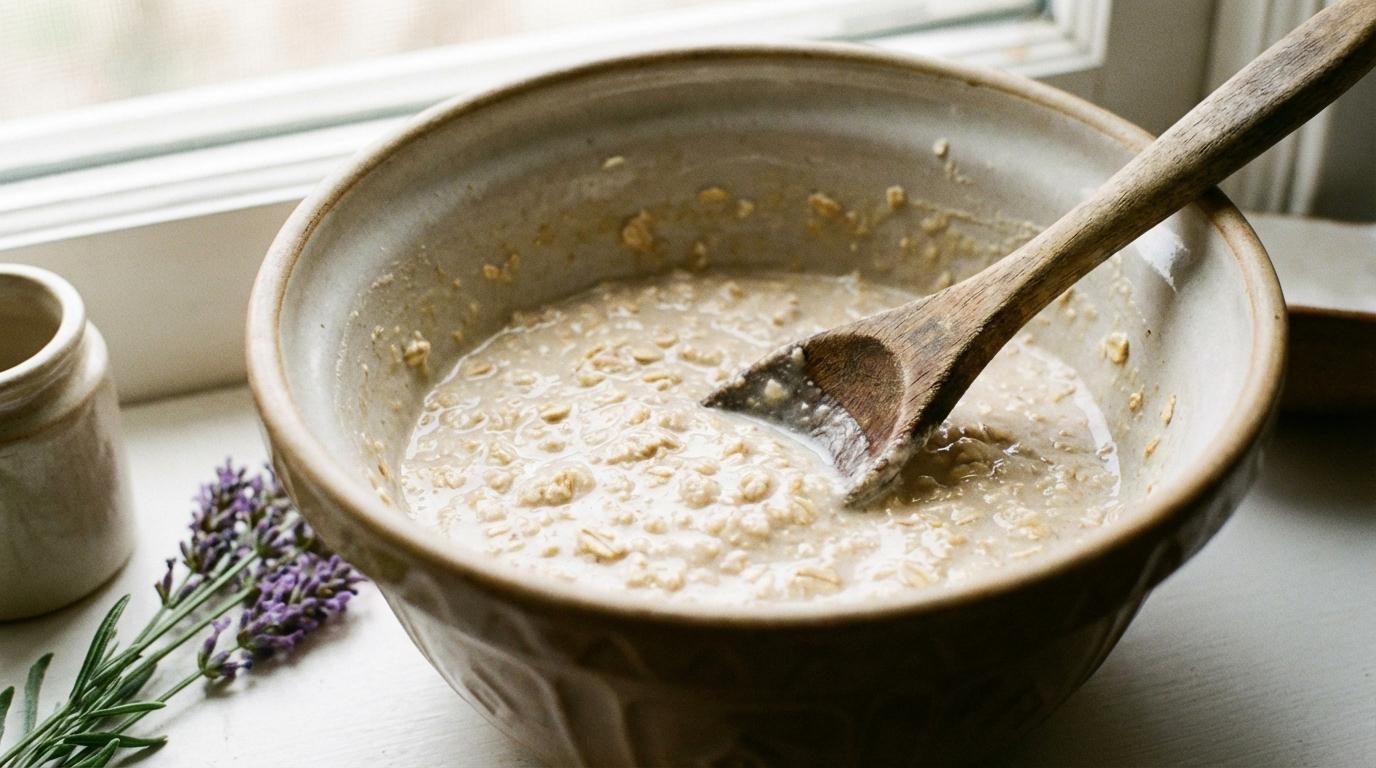
Stop scrolling through expensive face masks and look in your pantry. That canister of oatmeal sitting next to your coffee? It’s one of the most effective skincare ingredients you can put on irritated skin. I’m not talking about the instant flavored packets with sugar. I’m talking about plain, old-fashioned oats that cost less than your morning latte.
After years of testing luxury skincare as a beauty editor, I’ve circled back to this humble kitchen staple more times than I can count. Here’s why oatmeal works, how to make a mask that actually helps, and when to use it.
Why Colloidal Oatmeal Is a Skincare Powerhouse
Colloidal oatmeal isn’t some marketing buzzword. It’s oats that have been finely ground into a powder that disperses evenly in water. The FDA approved it as a skin protectant back in 2003, which tells you something about how seriously the scientific community takes it.
The magic lies in the oat’s natural chemistry. Oats contain beta-glucans, which form a protective film on your skin that locks in moisture. They also pack avenanthramides, a group of antioxidants found exclusively in oats that calm inflammation and reduce redness.
Then there are the saponins. These natural cleansers gently remove dirt and oil without stripping your skin barrier. Unlike harsh sulfates that leave your face feeling tight and dry, saponins maintain your skin’s natural pH.
The lipid content in oats also matters. These fats reinforce your skin barrier, the protective layer that keeps moisture in and irritants out. When your barrier is compromised, everything stings, flakes, and looks angry. Oatmeal helps patch it up.
Who Should Use an Oatmeal Face Mask
This mask shines brightest for irritated skin. If your face is throwing a tantrum from over-exfoliation, harsh weather, a new product gone wrong, or just general sensitivity, oatmeal is your friend.
Eczema sufferers already know about oatmeal baths, but the same principles apply to your face. The anti-inflammatory properties help calm flare-ups without adding more chemicals to already reactive skin. If you’re dealing with facial eczema, check out our guide to the eczema-friendly skincare routine for a complete approach.
Dry skin types benefit from the moisture-locking beta-glucans. Oily skin might seem like an unlikely candidate, but oatmeal’s gentle cleansing action can help without triggering the rebound oil production that harsh products cause.
Post-procedure skin loves oatmeal too. After laser treatments, chemical peels, or even just aggressive extractions, an oatmeal mask soothes without interfering with healing.
The only people who should skip this: anyone with a known oat allergy. Yes, it exists, and yes, it can cause reactions when applied topically.
The Simple Recipe That Actually Works
You don’t need fifteen ingredients to make an effective oatmeal mask. The best version uses three at most. Here’s what works:
Basic Oatmeal Mask
Ingredients:
- 2 tablespoons colloidal oatmeal (or finely blended regular oats)
- 2-3 tablespoons warm water
Instructions:
- If using regular oats, blend them in a food processor or coffee grinder until they become a fine powder. Test by adding a pinch to water. It should dissolve and turn the water milky, not sink to the bottom.
- Mix the oat powder with warm water until you get a spreadable paste. Not too runny, not too thick.
- Apply to clean, dry skin. Spread evenly, avoiding the eye area.
- Leave on for 15-20 minutes. The mask will feel slightly sticky as it dries.
- Rinse with lukewarm water using gentle circular motions. The oats provide light physical exfoliation as you remove them.
- Pat dry and follow with your usual moisturizer.
Honey-Oatmeal Mask (Extra Soothing)
For severely irritated or dry skin, add raw honey to the mix.
Ingredients:
- 2 tablespoons colloidal oatmeal
- 1 tablespoon raw honey
- 1-2 tablespoons warm water
Honey is a natural humectant that pulls moisture into skin. It also has antibacterial properties, making this version good for mild acne alongside irritation. Mix all ingredients, apply, wait 15-20 minutes, rinse.
Yogurt-Oatmeal Mask (Brightening)
Plain yogurt adds lactic acid for gentle exfoliation and probiotics for skin barrier support.
Ingredients:
- 2 tablespoons colloidal oatmeal
- 2 tablespoons plain full-fat yogurt
Skip the water here. The yogurt provides enough moisture to create a paste. This version works well for dull skin that needs brightening without irritation. Apply, wait 10-15 minutes, rinse.
The Right Way to Make Colloidal Oatmeal at Home
You can buy colloidal oatmeal online, but making it costs pennies. Start with plain rolled oats or steel-cut oats. Instant oats work but may contain additives.
Blend in short bursts. Long continuous blending generates heat that can degrade some of the beneficial compounds. Stop when the powder is fine enough that you can’t see individual oat pieces.
To test if it’s fine enough, drop a tablespoon into a glass of water. Properly ground colloidal oatmeal disperses throughout the water and makes it cloudy. If the oats sink to the bottom, blend more.
Store extra colloidal oatmeal in an airtight container away from moisture. It keeps for months. Make a big batch and save yourself the grinding step for future masks.
How Often to Use Your Oatmeal Mask
This isn’t a daily thing. Even gentle masks can disrupt your skin if overused. Here’s the frequency guide based on your skin situation:
For general maintenance on normal to dry skin: Once a week. This provides consistent soothing and barrier support without overdoing it.
For active irritation or sensitivity flare-ups: Every other day until symptoms calm down, then drop to once weekly. The anti-inflammatory effects are cumulative but don’t require daily application.
For eczema-prone skin: 2-3 times per week during flares, once weekly for maintenance. Always patch test first, even if you’ve used oatmeal before, since sensitized skin can react unpredictably.
For oily or acne-prone skin: Once weekly maximum. The mask is gentle but still provides some occlusion that could contribute to breakouts if overused.
After procedures or over-exfoliation: Daily for 3-5 days, then reduce to every other day, then weekly as your skin heals. The goal is calming, not treatment.
Common Mistakes That Ruin Your Oatmeal Mask
I’ve seen people mess this up in predictable ways. Here’s what to avoid:
Using flavored oatmeal: The added sugars, artificial flavors, and preservatives can irritate skin. Stick to plain oats only.
Not grinding fine enough: Chunky oats don’t deliver the same benefits and can scratch delicate facial skin. Take the time to blend properly.
Using hot water: Heat can deactivate some of the beneficial compounds. Warm is fine, hot is not.
Leaving it on too long: More time doesn’t mean more benefit. After 20 minutes, you’re just letting the mask dry out and potentially irritate your skin as you try to remove it. Set a timer.
Scrubbing aggressively when removing: The oats provide gentle exfoliation on their own. You don’t need to add pressure. Gentle circles, lukewarm water, done.
Skipping moisturizer afterward: The mask preps your skin beautifully for moisturizer. Don’t waste that opportunity. Apply your hydrating products while your skin is still slightly damp.
Where to Find Quality Oats for Your Mask
Your grocery store has everything you need. Look for plain rolled oats or steel-cut oats in the cereal aisle. Store brands work just as well as fancy organic versions for this purpose.
If you want pre-ground colloidal oatmeal, check the skincare aisle or pharmacy section. Aveeno makes colloidal oatmeal packets designed for baths that work perfectly for masks. The baby section often has oat-based bath products that are essentially the same thing.
Health food stores sometimes carry bulk colloidal oatmeal at lower prices than individual packets. Online retailers offer larger quantities if you plan to make masks regularly.
For more budget-friendly skincare finds, our guide to your grocery store skincare aisle covers other affordable ingredients worth trying.
Combining Oatmeal Masks With Your Routine
Timing matters. Use your oatmeal mask after cleansing but before the rest of your routine. The mask removes some surface debris, so applying it to uncleansed skin wastes its potential.
Skip active ingredients on mask days. Retinol, AHAs, BHAs, and vitamin C can wait. The point of an oatmeal mask is calming, not treating. Adding actives undermines that goal and risks irritation.
After rinsing the mask, your skin is perfectly prepped for hydrating products. Layer your hydrating toner, serum, and moisturizer while skin is still damp. The oatmeal has removed dead cells and primed your barrier to absorb these products better.
If you use a facial oil, this is the time. The lipids in oatmeal work synergistically with facial oils to reinforce your barrier.
The Bottom Line
An oatmeal face mask won’t solve every skin problem, but it does one thing exceptionally well: calming irritated, angry, reactive skin without adding more chemicals to the mix. At a few cents per mask, it’s the best return on investment in skincare.
Make a batch of colloidal oatmeal, store it in a jar, and pull it out when your skin needs a break from the world. No fancy equipment, no expensive ingredients, no complicated techniques. Just oats, water, and fifteen minutes of letting your skin breathe.
Sometimes the simplest solutions really are the best ones.